- Free Consultation: (217) 544-4057 Tap Here To Call Us





Illinois Cannabis DUI: Trooper Blood Draws and Medical Cards


Last Reviewed & Updated: October 23, 2026
By: W. Scott Hanken | Former Sangamon County Prosecutor | Springfield Criminal Defense & DUI Attorney | Voted “Best Attorney” — Illinois Times Best of Springfield & State Journal-Register Reader’s Choice | Springfield, IL | Sangamon County | (217) 544-4057 | hankenlaw.com
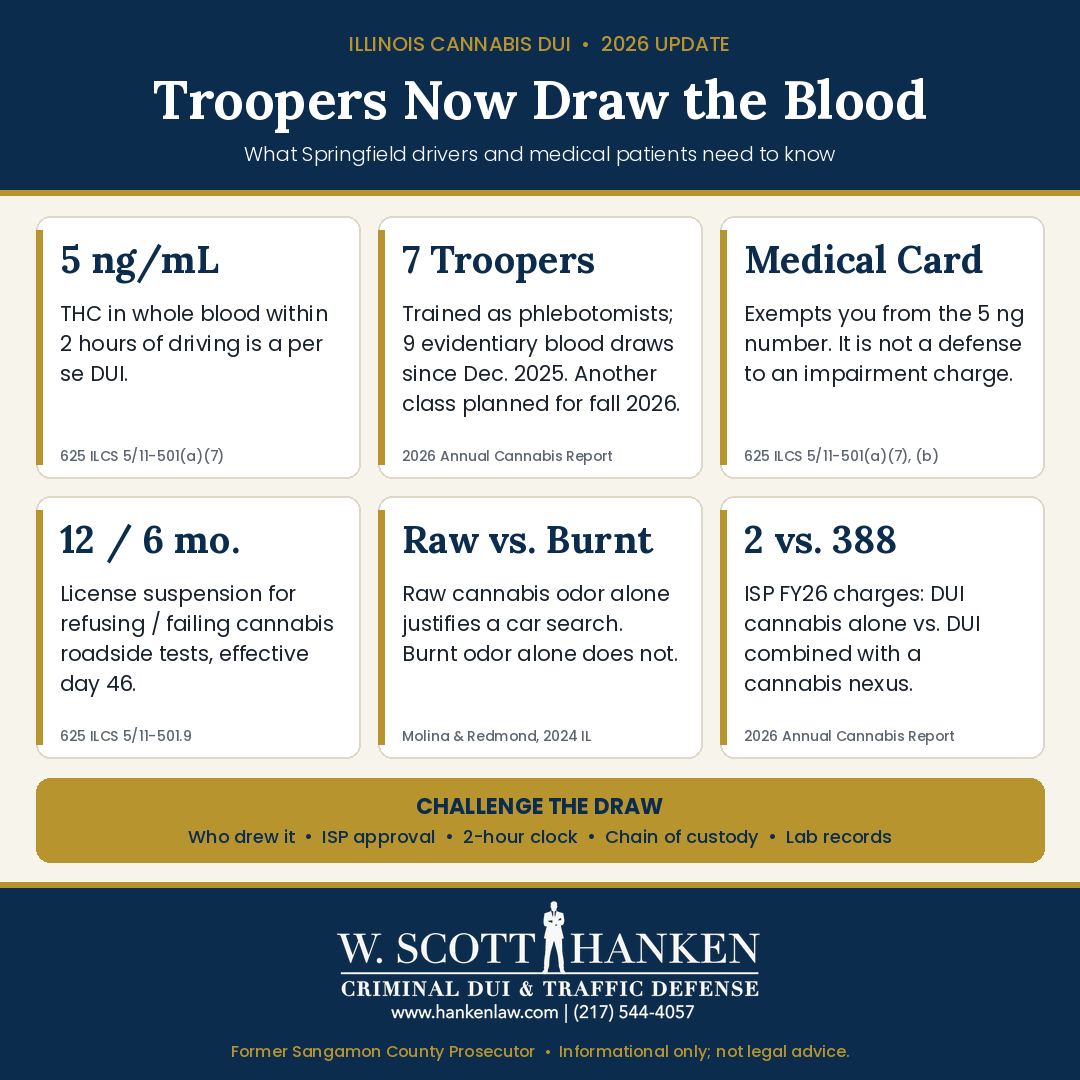
Illinois State Police troopers now draw blood in cannabis DUI cases. A test within two hours of driving showing 5 nanograms or more of THC per milliliter of whole blood supports a DUI charge. Registered medical cannabis patients are exempt from that number, but not from an impairment charge.
Bottom Line: The two-hour blood test has always been the weak point in Illinois cannabis DUI prosecutions, because hospitals were slow or refused to draw. A new State Police pilot program puts trained phlebotomists in uniform to close that gap. If you were arrested for driving high in Springfield or anywhere in Sangamon County, the blood draw itself is now a new and important thing to challenge: who drew it, when, how, and whether the officer had a lawful basis to ask. A medical card helps you, but far less than most patients think.
Charged with a cannabis DUI? Call W. Scott Hanken, Attorney at Law at (217) 544-4057 for a free consultation.
In This Guide
- What Did Illinois State Police Change About Cannabis DUI Blood Draws?
- What Is the Legal THC Limit for Driving in Illinois?
- Can a Medical Marijuana Card Protect You From a DUI in Illinois?
- Can Police Make You Take Field Sobriety Tests for Cannabis?
- Can Police in Illinois Search My Car If They Smell Weed?
- What Are the Penalties for a Cannabis DUI in Illinois?
- How Do You Fight a Cannabis DUI Blood Test in Sangamon County?
- What Do Illinois’ Own Numbers Say About Cannabis DUI Enforcement?
- What Else Can a Cannabis DUI Cost a Medical Patient?
- Frequently Asked Questions (FAQs)
What Did Illinois State Police Change About Cannabis DUI Blood Draws?
State troopers trained as forensic phlebotomists are now drawing evidentiary blood samples in DUI investigations instead of waiting on hospitals. The program started in December 2025 and could go statewide.
The details come from the State of Illinois 2026 Annual Cannabis Report, dated September 30, 2026. The Marijuana Herald reported on it on October 16, 2026. According to the Illinois State Police section of that report:
- Seven troopers from Troops 8 and 10 graduated from a community college forensic phlebotomy program in May 2025.
- Their training ran four weeks online, three days in the classroom, and one week of clinicals that included 100 successful blood draws.
- Troopers began performing evidentiary draws in December 2025 and had completed nine draws with no reported complications.
- As of June 2026, ISP was recruiting candidates from every Troop in the state for another training class in fall 2026. The stated goal of the pilot is to decide whether a statewide program is feasible.
- ISP also bought two more instruments for measuring THC in blood, one for its Springfield lab and one for Chicago, for about $890,500. They are expected online during fiscal year 2027.
The report is blunt about why. ISP says officers across the state struggle to get timely blood draws, and that the two-hour window in the cannabis DUI statute causes significant problems when prosecuting these cases. The Marijuana Herald, describing the program, reported that hospitals sometimes refuse to draw blood for police and that others make officers wait hours.
For a driver in Springfield, the practical effect is simple. The bottleneck that used to protect you is being engineered away. Fewer cases will fall outside the two-hour window, and more cases will carry a number.
Statute Callout — Who may draw blood in an Illinois DUI case, 625 ILCS 5/11-501.2(a)(2): “only a physician authorized to practice medicine, a licensed physician assistant, a licensed advanced practice registered nurse, a registered nurse, trained phlebotomist, or licensed paramedic, or other qualified person approved by the Illinois State Police may withdraw blood for the purpose of determining the alcohol, drug, or alcohol and drug content therein.” Section 11-501.2 was last amended by P.A. 102-982, effective July 1, 2023. Two other parts of the same section matter just as much: (a)(1) requires every chemical analysis to be performed according to standards set by the Illinois State Police, and (a)(4) entitles you or your attorney, on request, to “full information concerning the test or tests.”
What Is the Legal THC Limit for Driving in Illinois?
Illinois sets a per se limit of 5 nanograms of delta-9 THC per milliliter of whole blood, or 10 nanograms per milliliter of another bodily substance, measured within two hours of driving.
The offense is defined in 625 ILCS 5/11-501(a)(7). That section was last amended by P.A. 102-982, effective July 1, 2023, a statewide terminology change that replaced “accident” with “crash” and did not alter the cannabis provisions. The concentration itself is defined in 625 ILCS 5/11-501.2(a)(6). Section 11-501.2(b-5) also creates two presumptions. At 5 nanograms or more in whole blood, the law presumes you were under the influence of cannabis. Below 5 nanograms, there is no presumption either way, but the result can still be considered alongside other evidence of impairment.
That second rule matters more than people realize. A result of 3 nanograms does not end the case. Section 11-501(a)(4) separately prohibits driving “under the influence of any other drug or combination of drugs to a degree that renders the person incapable of safely driving,” and (a)(5) covers the combined influence of alcohol and drugs. Under those provisions, the State can prosecute you for driving while impaired by cannabis with no blood number at all, using the officer’s observations, your driving, your statements, and roadside test results. In Sangamon County, that is exactly how many cannabis cases get charged: impairment first, blood number second.
Can a Medical Marijuana Card Protect You From a DUI in Illinois?
No, not completely. A valid medical cannabis registry card exempts you from the 5-nanogram per se charge, but not from being charged with driving while impaired.
Statute Callout — The medical cannabis exception, 625 ILCS 5/11-501(a)(7): “Subject to all other requirements and provisions under this Section, this paragraph (7) does not apply to the lawful consumption of cannabis by a qualifying patient licensed under the Compassionate Use of Medical Cannabis Program Act who is in possession of a valid registry card issued under that Act, unless that person is impaired by the use of cannabis.”
Statute Callout — Legal use is not a defense to impairment, 625 ILCS 5/11-501(b): “The fact that any person charged with violating this Section is or has been legally entitled to use alcohol, cannabis under the Compassionate Use of Medical Cannabis Program Act, other drug or drugs, or intoxicating compound or compounds, or any combination thereof, shall not constitute a defense against any charge of violating this Section.”
Read those two provisions together. Subsection (a)(7) carves registered patients out of the per se number. Subsection (b) then makes clear that being a registered patient is no defense to anything else in the statute. The exemption has three conditions: lawful consumption, a valid card, and possession of the card. And it disappears entirely if the State proves you were impaired.
Illinois had 120,039 active medical cannabis patients as of June 30, 2026, according to the Illinois Department of Public Health’s portion of the same annual report. Every one of them needs to understand that the card changes what the State has to prove. It does not make driving after use legal.
Here is why this matters even more now. A medical patient who uses daily can carry measurable THC long after any effect has worn off. For a recreational user, a high blood number is often the whole case. For a registered patient, the number alone should not convict, so the fight shifts to impairment evidence: the reason for the stop, the field sobriety tests, the officer’s training, and video.
In my 37+ years of practice in Sangamon County, including my years as a prosecutor, one of the most common misunderstandings I hear from medical cannabis patients is that the registry card is a complete defense. It is not. The card changes what the State has to prove, but it does not stop an arrest, a license suspension, or a prosecution built on impairment evidence.
What if I have a medical card and my blood tested over 5 nanograms?
You should not be convicted on the number alone, but you can still be convicted if the State proves you were impaired. The per se charge under 11-501(a)(7) does not apply to a registered patient, so the State must prove actual impairment, usually under 11-501(a)(4). The exemption is written into the statute itself, and the statute conditions it on lawful use and possession of a valid registry card. In practice, that means bringing proof of a valid, unexpired card to the first court date in the Sangamon County Circuit Court, and then holding the State to its burden on impairment. Expect prosecutors to point to driving behavior, roadside tests, and any admission about when you last used.
Your license is a separate fight, and there the card protects you even less. A registered cardholder who refuses or fails required testing faces the same suspension as any other driver. It is 12 months for a refusal or failure to complete testing, and 6 months for submitting to testing that shows cannabis impairment. Both take effect on the 46th day after notice under 625 ILCS 5/11-501.9(f) and (h).
Do not count on a Monitoring Device Driving Permit to get you through it. The MDDP is the ignition interlock (BAIID) permit that lets most first offenders keep driving during a suspension, and it is tied to statutory summary suspensions under Section 11-501.1. Section 6-206.1, last amended by P.A. 102-699, effective April 19, 2022, applies when a first offender “is arrested for any offense as defined in Section 11-501 or a similar provision of a local ordinance and is subject to the provisions of Section 11-501.1.” It makes no provision for a suspension entered under 11-501.9 for refusing or failing cannabis roadside tests. That gap applies to cardholders and recreational users alike. Even when an MDDP is available, subsection (a-1) bars the holder from driving a commercial motor vehicle. With no MDDP to fall back on, an early challenge to the suspension in the Sangamon County Circuit Court becomes even more important.
Can Police Make You Take Field Sobriety Tests for Cannabis?
Yes, if the officer has a cannabis-specific reason to suspect impairment, and refusing carries a 12-month license suspension. This applies to every driver, medical card or not.
Under 625 ILCS 5/11-501.9, last amended by P.A. 102-558, effective August 20, 2021, anyone driving on Illinois highways is deemed to have consented to validated roadside chemical tests or NHTSA standardized field sobriety tests when an officer has reasonable suspicion of cannabis impairment.
Statute Callout — The officer needs a cannabis-specific reason, 625 ILCS 5/11-501.9(a): “The law enforcement officer must have an independent, cannabis-related factual basis giving reasonable suspicion that the person is driving or in actual physical control of a motor vehicle while impaired by the use of cannabis… The person’s possession of a registry identification card issued under the Compassionate Use of Medical Cannabis Program Act alone is not a sufficient basis for reasonable suspicion.”
The consequences under 11-501.9(f) and (h):
- Refuse or fail to complete the tests: 12-month suspension.
- Submit and the tests show cannabis impairment: 6-month suspension.
- Either suspension takes effect on the 46th day after notice.
- The officer’s sworn report must include the factual basis for reasonable suspicion. A defective report should not result in a suspension being entered.
That reporting requirement is a real defense tool. If the only “cannabis-related” fact in the report is that you handed over a medical card with your license, the statute says that is not enough. If a medical condition, injury, or age affected how you performed, 11-501.2(a-5)(3) allows you to present evidence that you lacked the physical capacity to perform the tests. That matters for the many medical patients certified for chronic pain or other physical conditions. For a deeper walk-through of these suspensions and how to fight them, see our guide to cannabis DUI and implied consent under 625 ILCS 5/11-501.9.
Can Police in Illinois Search My Car If They Smell Weed?
Yes, if a trained officer smells raw cannabis, and no, if the only odor is burnt cannabis. The Illinois Supreme Court held that raw cannabis odor alone is probable cause to search a vehicle, but burnt cannabis odor alone is not.
The Illinois Supreme Court decided both questions in 2024. In People v. Redmond, 2024 IL 129201, the Court held that the odor of burnt cannabis, standing alone, no longer provides probable cause to search a vehicle after legalization, putting it on the same footing as the odor of alcohol. In People v. Molina, 2024 IL 129237, a divided Court held that the odor of raw cannabis alone does provide probable cause, at least where the officer is trained and experienced in telling raw cannabis from burnt. The Court’s reason was that the odor suggests the cannabis is not in the sealed, odor-proof container Illinois law requires in a vehicle under 625 ILCS 5/11-502.15.
For cannabis DUI cases, this matters at the very start of the stop. Many Springfield cannabis DUI arrests begin with an officer saying he “smelled marijuana.” Which kind, how he could tell, and what else he observed all decide whether the search, and everything found after it, survives a motion to suppress.
The legislature has tried to change this and so far has failed. Senate Bill 42 would bar stops, detentions, and searches based solely on cannabis odor when the vehicle is driven or occupied by someone 21 or older. It would also drop the odor-proof container requirement that the Molina decision rests on. It passed the Senate 33 to 20 and cleared a House committee, but on May 23, 2025 it was re-referred to the House Rules Committee. As of mid-October 2026, it had not moved since. Until the General Assembly acts, Redmond and Molina are the law in every Sangamon County courtroom.
Need help with a Springfield cannabis DUI? Call W. Scott Hanken, Attorney at Law at (217) 544-4057.
What Are the Penalties for a Cannabis DUI in Illinois?
A cannabis DUI carries the same criminal penalties as an alcohol DUI, because every penalty in 625 ILCS 5/11-501(c) and (d) applies to any violation of subsection (a). A first offense is a Class A misdemeanor under 11-501(c)(1), punishable by up to 364 days in jail and a fine of up to $2,500.
| Situation | Classification | Key consequences |
|---|---|---|
| First DUI (no aggravating factors) | Class A misdemeanor, 11-501(c)(1) | Up to 364 days jail; fine up to $2,500; court supervision possible; a conviction means revocation, with no license application for 1 year (6-208(b)(1)) |
| DUI while transporting a child under 16 | 11-501(c)(3) | Subject to 6 months of imprisonment, plus an additional mandatory minimum $1,000 fine and 25 days of community service in a program benefiting children |
| DUI crash causing bodily harm to a transported child under 16 | Class 4 felony, 11-501(d)(1)(J) | Aggravated DUI; mandatory $2,500 fine and 25 days of community service in a program benefiting children (11-501(d)(2)(H)) |
| Second DUI | Class A misdemeanor, 11-501(c)(2) | Mandatory minimum 5 days jail or 240 hours community service; no license application for 5 years if within 20 years of the first (6-208(b)(2)), and not until after holding a restricted driving permit for at least 5 continuous, violation-free years (6-208(b)(1.3)) |
| Third DUI | Class 2 felony, 11-501(d)(2)(B) | Aggravated DUI; prison-eligible; no license application for 10 years (6-208(b)(3)) |
| Fourth DUI | Class 2 felony, 11-501(d)(2)(C) | Probation and conditional discharge not available; lifetime bar on applying for a license, with narrow statutory exceptions (6-208(b)(4)) |
| DUI crash causing death | Class 2 felony, 11-501(d)(2)(G) | 3 to 14 years for one death; 6 to 28 years for two or more, absent extraordinary circumstances; no license application for 2 years after revocation or 24 months after release, whichever is later (6-208(b)(1)) |
| Refused cannabis field sobriety tests (11-501.9) | Administrative | 12-month suspension, effective day 46 |
| Failed cannabis field sobriety tests (11-501.9) | Administrative | 6-month suspension, effective day 46 |
| Refused chemical test (11-501.1, first offender) | Statutory summary suspension, 6-208.1(a)(1) | 12 months |
| Tested at or above 5 ng (11-501.1, first offender) | Statutory summary suspension, 6-208.1(a)(2) | 6 months |
| Refused chemical test (11-501.1, not a first offender) | Statutory summary suspension, 6-208.1(a)(3) | 3 years |
| Tested at or above 5 ng (11-501.1, not a first offender) | Statutory summary suspension, 6-208.1(a)(4) | 1 year |
Criminal classifications are from 625 ILCS 5/11-501, last amended by P.A. 102-982. Revocation periods are from 625 ILCS 5/6-208, last amended by P.A. 99-642, effective July 28, 2016. Summary suspension periods are from 625 ILCS 5/6-208.1, last amended by P.A. 102-982, effective July 1, 2023. Any time served on a summary suspension is credited toward a later DUI revocation for the same incident under 6-208.1(d).
The license consequences often hurt more than the criminal sentence. A summary suspension can start before your first court date, which is why the 90-day window to file a petition to rescind matters from the day of arrest.
Sangamon County Snapshot: Where Your Cannabis DUI Case Will Be Decided
- Court. Cases arising in Springfield and Sangamon County are heard in the Sangamon County Circuit Court, part of Illinois’ Seventh Judicial Circuit.
- Lab. The Illinois State Police Springfield laboratory is one of only two ISP sites with instruments that quantify THC in blood. A third Springfield instrument is expected online in fiscal year 2027, according to the 2026 Annual Cannabis Report.
- Who draws the blood. The first seven trooper-phlebotomists came from ISP Troops 8 and 10. ISP was recruiting candidates from every Troop for a fall 2026 class, so expect the program to reach more of the state.
- License clock. A suspension under 11-501.9 takes effect on the 46th day after notice, and a summary suspension can start before your first court date.
How Do You Fight a Cannabis DUI Blood Test in Sangamon County?
You attack the draw, the timing, and the lab, in that order. The new trooper phlebotomy program creates specific questions that did not exist when hospitals did every draw.
As a former Sangamon County prosecutor, I know the State’s instinct is to treat a lab number as the end of the discussion. That is exactly why the defense has to slow down and examine every step that produced it: who drew the blood, when, under what authority, and how the sample got to the lab. A number is only as reliable as the process behind it.
The statute allows a “trained phlebotomist” or “other qualified person approved by the Illinois State Police” to draw blood, so a trooper drawing blood is not automatically unlawful. But the State has to prove the person who drew your blood actually fit that description. That opens discovery into:
- Training and approval records. Certification from the forensic phlebotomy course, the clinical log, and the ISP approval that makes the trooper a “qualified person.”
- The clock. The per se offense requires a THC concentration within two hours of driving. A draw at two hours and ten minutes does not prove a two-hour number.
- The conflict of roles. When the arresting trooper is also the person who drew and handled your blood, the same witness is vouching for the investigation, the draw, and the custody of the sample. That is a credibility issue worth exploring in front of a Sangamon County jury.
- Procedure and custody. Tube type, preservative, labeling, storage, transport, and every signature in the chain to the lab.
- The lab itself. ISP’s Springfield crime lab is one of only two locations running the instruments that quantify THC in blood, and two new instruments still have to complete method verification before use. Ask which instrument ran your sample and request its validation and maintenance records. Under 11-501.2(e), any laboratory testing for cannabis or other drugs must comply with ISO/IEC 17025:2005. That edition has since been superseded. The Illinois State Police forensic laboratories state in their Quality Manual that they are accredited by ANAB to the current ISO/IEC 17025:2017 standard. Either way, the lab’s accreditation and quality records are fair game.
- Full information. Section 11-501.2(a)(4) gives you or your attorney the right, on request, to full information concerning the test. Make that request in writing, early.
There is also a constitutional layer. Drivers generally cannot be forced to give blood without a warrant or a genuine emergency. The U.S. Supreme Court held in Missouri v. McNeely, 569 U.S. 141 (2013), that the natural dissipation of alcohol does not automatically create an emergency. In Birchfield v. North Dakota, 579 U.S. 438 (2016), it held that a warrantless blood test cannot be justified as a search incident to arrest. A faster in-house draw reduces the State’s ability to claim there was no time to get a warrant. Crash cases are different. Under 11-501.2(c)(2), when an officer has probable cause to believe an impaired driver caused death or personal injury to another, the driver must submit to testing on request, notwithstanding any ability to refuse elsewhere in the Code. Those cases need individual analysis.
What records does ISP require when a trooper draws blood?
More than most drivers expect, and every one of them belongs in a discovery request. The trooper program runs under ISP Directive OPS-093, Phlebotomy Blood Draws, revised November 6, 2025. Among other things, the directive requires the trooper to:
- Hold an ISP Forensic Phlebotomy Officer Certification after completing an ISP-approved accredited training program, and, to recertify every two years, draw 12 blood samples per year and attend biennial policy lectures.
- Obtain the driver’s written and verbal consent, and not attempt a draw if the driver is uncooperative in any way.
- Tell the driver he or she is a certified ISP Forensic Phlebotomy Officer, say how many tubes will be drawn, and ask about blood thinners and other medications.
- Have a witness present, make no more than two attempts, and follow ISP’s Forensic Venipuncture Checklist for every draw.
- Complete a Phlebotomy Draw Report and enter every draw, in the order performed, in a Forensic Phlebotomy Officer Log.
Ask for all of it: the certification, the checklist, the draw report, and the log. A missing checklist, an undocumented attempt, or a log entry out of sequence is exactly the kind of gap that undermines a blood result. And because the directive is built on consent, a trooper draw taken over your objection would break ISP’s own policy.
Rule Callout — 20 Ill. Adm. Code 1286.320(b): “For samples collected in Illinois, the blood sample shall be collected by a licensed physician, physician assistant, licensed advanced practice nurse, registered nurse, trained phlebotomist, or certified paramedic.” Unlike the statute, the State Police’s own blood-collection rule does not list “other qualified person approved by the Illinois State Police.” Expect the State to have to show the trooper qualifies as a trained phlebotomist.
The same rule requires the sample to be collected in the presence of an officer or agency employee who can authenticate it, labeled with the driver’s name and the date it was drawn, and delivered to a certified laboratory as soon as practicable (1286.320(a), (e) and (f)). It also requires the lab to keep any remaining sample for six months after testing unless the submitting agency or prosecutor directs otherwise (1286.320(g)). If you want an independent retest, ask early, before that window closes.
What if the trooper who arrested me also drew my blood?
That does not make the blood draw illegal, but it opens the draw to challenge. The trooper’s qualifications and handling become central issues in your case. The statute, 625 ILCS 5/11-501.2(a)(2), authorizes draws only by listed professionals or a person the Illinois State Police has approved, and (a)(1) requires the analysis to follow ISP standards. When the investigator, the phlebotomist, and the evidence custodian are the same person, every gap in training paperwork, timing, or custody becomes the State’s problem to explain. The program is new, with only nine draws reported in the State’s 2026 annual report, so these records have not yet been tested much in court.
What if I used cannabis yesterday, not today?
You can still be charged, but the State’s case is weaker, and the two-hour rule and the “no presumption” rule are your strongest tools. The statute measures THC within two hours of driving, and a result under 5 nanograms creates no presumption of impairment under 11-501.2. Regular users, including medical patients, can test positive long after the effects are gone. That is exactly why the State must connect any number to actual impairment at the time of driving. If you tested below 5 nanograms, the State’s case rests almost entirely on the officer’s observations, and those can be challenged with video and cross-examination.
What Do Illinois’ Own Numbers Say About Cannabis DUI Enforcement?
They show that standalone cannabis DUI cases are rare and that the State knows its proof problem. In fiscal year 2026, the Illinois State Police reported just 2 charges for DUI cannabis alone, compared with 388 for DUI combination with a cannabis nexus, according to the 2026 Annual Cannabis Report. Those are ISP statistics only and do not include the Springfield Police Department or the Sangamon County Sheriff’s Office.
Two things follow from that. First, most cannabis-related DUI charges arrive bundled with alcohol or another drug, which means the defense has to address each substance separately rather than treat the blood result as one number. Second, the phlebotomy program is aimed squarely at turning more of those cases into clean, standalone THC prosecutions. Drivers in Springfield should expect that shift to reach Sangamon County as ISP expands the program.
What Else Can a Cannabis DUI Cost a Medical Patient?
More than the criminal case. A medical card does not protect your commercial driver’s license, because federal DOT drug and alcohol rules still treat marijuana as prohibited for CDL holders regardless of state law. That did not change when state-licensed medical marijuana moved to Schedule III in April 2026. The U.S. Department of Transportation’s May 2026 drug-testing guidance says a state medical card cannot excuse a positive DOT drug test.
Gun ownership questions are separate again; our post on Marijuana and Guns in Illinois After U.S. v. Hemani explains how cannabis use interacts with your FOID card. And a DUI conviction cannot be expunged in Illinois, so supervision versus conviction is often the most important outcome to fight for.
Frequently Asked Questions (FAQs)
Yes. Below 5 nanograms there is no presumption of impairment, but under 625 ILCS 5/11-501(a)(4) the State can still charge and prove that you were impaired by cannabis. It can use the officer’s observations, driving behavior, roadside tests, and your statements.
Yes, but a refusal triggers a statutory summary suspension, 12 months for a first offender, and the refusal can be used as evidence against you under 11-501.2(c)(1). Refusing roadside cannabis field sobriety tests under 11-501.9 separately carries a 12-month suspension, and that refusal is also admissible under 11-501.2(d). If an officer believes an impaired driver caused death or personal injury, 11-501.2(c)(2) requires the driver to submit.
It can be. Illinois law allows a trained phlebotomist or another qualified person approved by the Illinois State Police to draw blood. Whether your particular trooper met that standard, followed ISP’s own phlebotomy directive, and drew the sample lawfully and on time are questions to investigate in your case.
No. A valid registry card exempts you only from the 5-nanogram per se charge. Section 11-501(b) says legal entitlement to use medical cannabis is not a defense to any other DUI charge, so you can still be charged with driving while impaired by cannabis. The card alone does not give police reasonable suspicion to test you. But if you refuse or fail testing, you face the same 6- or 12-month suspension under 11-501.9 as any other driver, and Section 6-206.1 does not provide a Monitoring Device Driving Permit for that suspension.
The trooper’s training, ISP approval, timing, and handling of the sample all become fair game in your case. Illinois law allows only listed professionals or a person the Illinois State Police has approved to draw blood, and the analysis must follow Illinois State Police standards. When one trooper does both jobs, any gap in that paperwork is the State’s problem to explain.
Burnt cannabis odor alone is not enough under People v. Redmond, 2024 IL 129201. Raw cannabis odor alone is enough under People v. Molina, 2024 IL 129237, when the officer is trained to tell raw from burnt, because Illinois requires cannabis in a vehicle to be in a sealed, odor-proof container. A bill to change that rule, SB 42, had not passed the House as of mid-October 2026.
There is no safe-harbor number of hours in Illinois law. The statute looks at your THC level within two hours of driving and at whether you were actually impaired. If you have used, the only safe choice is not to drive.
The per se limit measures delta-9 THC, and some hemp-derived products contain delta-9. Separately, the impairment provisions of the DUI law apply no matter what product caused the impairment. P.A. 104-0463 (Senate Bill 3222, the Cannabis and Hemp Omnibus) was signed June 12, 2026, and its new hemp-product rules take effect November 12, 2026.
A DUI conviction cannot be expunged or sealed in Illinois. A first offense may be eligible for court supervision, which is not a conviction, but even supervision for DUI remains on your record.
Further Reading
Practice Area
Related Articles
- Illinois Statutory Summary Suspension vs. Field Sobriety Test Suspension: Critical Differences for Springfield Drivers Facing Cannabis DUI Charges — Read this if a cannabis arrest left you facing two suspensions at once and you need to know which clock runs first.
- DUI Dismissal in Illinois: What Actually Gets Cases Dropped — Read this if you want to see what a successful challenge to the stop, the tests or the evidence looks like in practice.
- Illinois Hemp Act 2026: Is Delta-8 Now Illegal? — Read this if you used a delta-8 or other hemp product and want to know where it now stands legally.
- DUI Court Supervision Won’t Protect Your Illinois CDL — Read this if you hold a CDL, because even the best plea outcome can still cost you that license.
- Marijuana and Guns in Illinois After U.S. v. Hemani — Read this if you own a gun or hold a FOID card and are worried a cannabis charge puts it at risk.
Browse by Topic
Ready to Fight Your DUI Charge in Springfield?
Call W. Scott Hanken at (217) 544-4057 or contact us online for a free consultation. We serve clients throughout Springfield, Sangamon County, and Central Illinois.
About the Author: W. Scott Hanken, Attorney at Law
Scott Hanken is a Springfield, Illinois criminal defense attorney with over 37 years of experience, including service as a former Sangamon County prosecutor. He has been voted Best Attorney by the Illinois Times and State Journal-Register, holds an Avvo 10.0 “Superb” rating, and has earned over 270 five-star Google reviews. He serves clients throughout Sangamon County and Central Illinois.
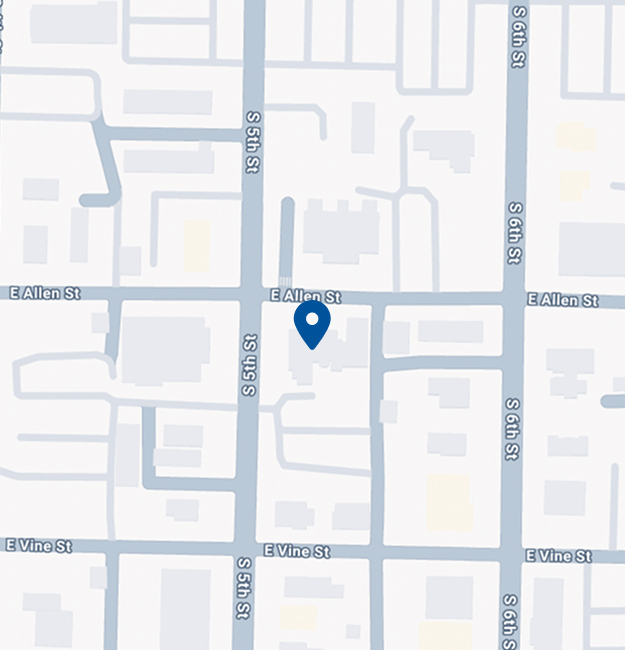
📍 1100 S 5th St, Springfield, IL 62703 | ☎ (217) 544-4057 | 🌐 hankenlaw.com
This article is for general educational purposes only and does not constitute legal advice. Every case is unique — contact an experienced Springfield criminal defense attorney for guidance on your specific situation.
Address
Our offices are located at the corner of South Fifth Street and Vine, in the historic Mary Bryant Home for the Blind.