- Free Consultation: (217) 544-4057 Tap Here To Call Us













Do Police Need a Warrant to Search Flock Data in Illinois?


Last Reviewed & Updated: October 14, 2026
By: W. Scott Hanken | Former Sangamon County Prosecutor | Springfield Criminal Defense Attorney | Voted “Best Attorney” — Illinois Times Best of Springfield & State Journal-Register Reader’s Choice | Springfield, IL | Sangamon County | (217) 544-4057 | hankenlaw.com
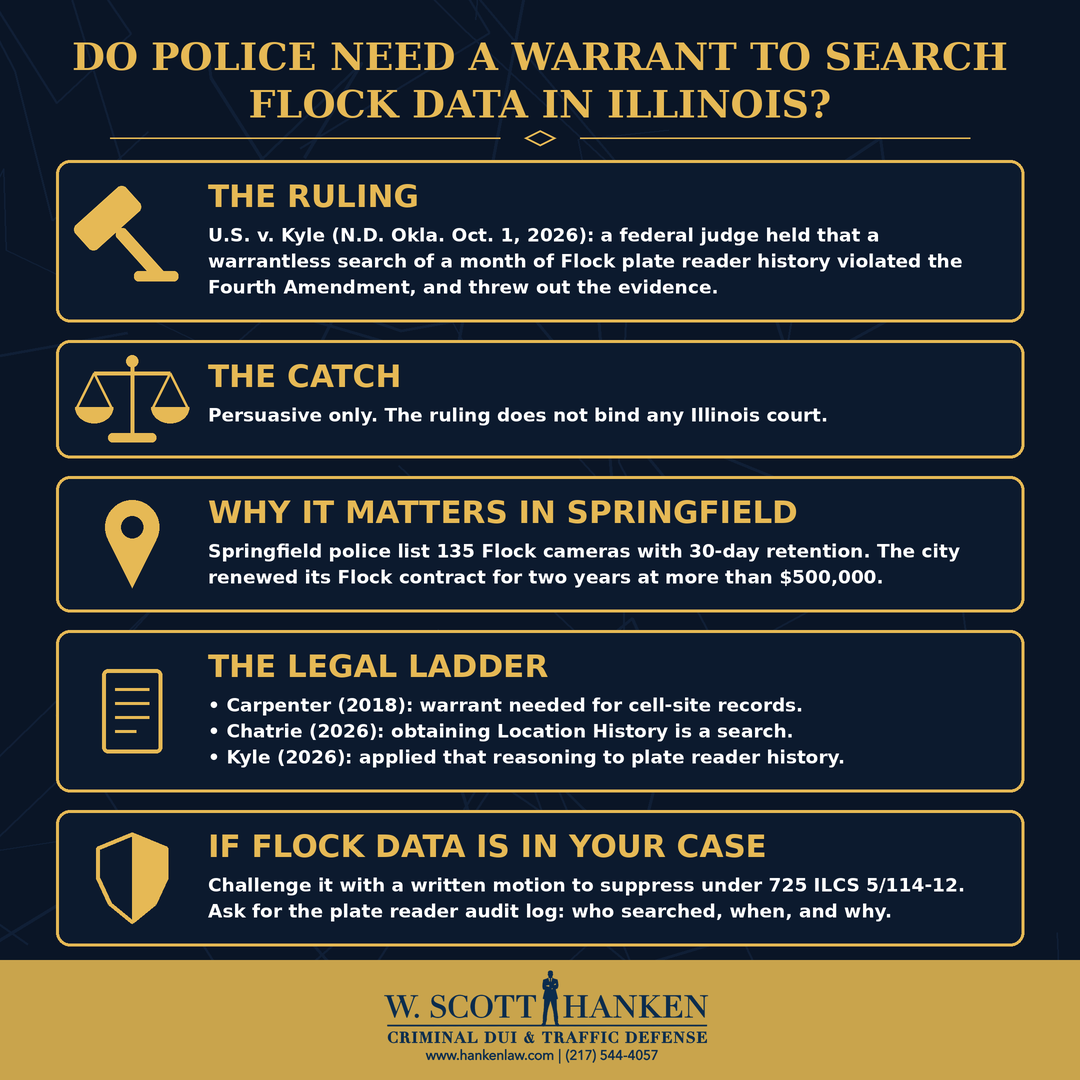
No court that binds Illinois has ruled that police need a warrant to search Flock license plate camera data. But on October 1, 2026, a federal judge in Oklahoma held that a warrantless search of one driver’s month-long plate reader history violated the Fourth Amendment and threw out the evidence.
Bottom Line: The ruling, United States v. Kyle, does not control any courtroom in Sangamon County. It is still one of the first federal decisions to treat a Flock history search the way the Supreme Court treated phone location data in Chatrie v. United States this June. If plate reader data helped build your case, your lawyer now has a written federal opinion to put in front of the judge.
If a traffic stop, a search, or an arrest in your case traces back to a license plate camera, call W. Scott Hanken, Attorney at Law at (217) 544-4057 before you talk to investigators.
Key Takeaways:
- United States v. Kyle (N.D. Okla. Oct. 1, 2026) held that a warrantless search of a month of plate reader history was an unconstitutional search.
- The ruling is persuasive only. It does not bind any Illinois court.
- The judge suppressed the evidence on two independent grounds: the plate reader search and the unlawful extension of the traffic stop.
- The court relied on Chatrie and Carpenter, the Supreme Court’s phone location cases.
- Springfield’s Flock transparency portal lists 135 cameras and a 30-day retention period, as of its November 26, 2025 update.
- In Illinois, the challenge is a written motion to suppress under 725 ILCS 5/114-12, and the defendant carries the burden.
What Did the Oklahoma Judge Decide About Flock Cameras?
The judge held that searching a driver’s stored plate reader history is a Fourth Amendment search, and that doing it without a warrant or probable cause was unconstitutional.
The case is United States v. Kyle, No. 26-CR-00189-SEH (N.D. Okla. Oct. 1, 2026), a 38-page opinion by U.S. District Judge Sara E. Hill. A Tulsa County deputy working highway drug interdiction saw a Mazda SUV with a California plate. He pulled out to follow it and ran the plate through two plate reader systems, Flock and VehicleManager. At that moment, the only thing he knew about the car was its plate.
The query returned more than 50 sightings of the vehicle across multiple states over about a month. It showed a quick trip from Locust Grove, Oklahoma, toward the California and Arizona border and back toward Missouri. The deputy then stopped the driver, Melisa Kyle, for following another car too closely. He gave her a written warning and returned her license. He asked to search the SUV. She said no. He detained her anyway for a dog sniff, and the search that followed led to a federal methamphetamine charge.
Judge Hill ruled three ways:
- The traffic stop itself was lawful. Following at roughly 30 feet at highway speed gave the deputy a valid reason to stop the car.
- The detention after the warning was not lawful. A short trip, extra luggage, a rental car, a cigarette, and ordinary nervousness did not add up to reasonable suspicion.
- The plate reader query was a separate, unconstitutional search. The court called the system “indiscriminate mass surveillance” and suppressed everything obtained after the query began.
Why Does the Chatrie Decision Matter to a License Plate Camera Case?
Chatrie matters because it gave judges the reasoning Judge Hill used: people keep a privacy interest in the whole of their movements, even movements made in public.
In Chatrie v. United States, 609 U.S. ___, No. 25-112 (June 29, 2026), the Supreme Court held that police conduct a search when they obtain cell phone Location History through a geofence warrant, even where the disputed request covered only two hours. Chatrie built on Carpenter v. United States, 585 U.S. 296 (2018), which required a warrant for historical cell-site records.
For 40 years, prosecutors have answered plate camera challenges with one case: United States v. Knotts, 460 U.S. 276 (1983), which said a driver has no reasonable expectation of privacy in travel on public roads. Judge Hill’s answer was direct. Knotts involved a single beeper in a single container. It expressly left open what would happen if dragnet-style surveillance ever arrived. In her view, a nationwide camera network that logs every passing car and hands officers a month of history on demand is that dragnet. Phones travel on public roads too, and that did not stop the Supreme Court in Carpenter or Chatrie.
I wrote about Chatrie this summer in my post on police drones and surveillance in Springfield. I said then that warrantless plate reader tracking was an active legal question, and that Springfield’s camera network could reconstruct a person’s movements. Until October 1, nearly every court to face that question had sided with the government. Kyle is one of the first federal opinions to say yes.
Does the Kyle Ruling Apply in Springfield or Sangamon County?
No. Kyle is a trial court decision from another federal circuit. It does not bind the Sangamon County Circuit Court, the Illinois Appellate Court, or the federal courthouse in Springfield.
Federal courts in Illinois follow the Seventh Circuit. That court is now considering a challenge to the Illinois State Police’s highway plate reader network in Scholl v. Illinois State Police, No. 25-1847, which was argued September 29, 2026. Until it rules, its closest decided case points the other way. In United States v. Tuggle, 4 F.4th 505 (7th Cir. 2021), the court held that 18 months of warrantless pole camera surveillance of a home was not a search. But Tuggle rested on a point that helps a Flock challenge. The court stressed that fixed cameras outside one house did not show where the defendant traveled or whom he visited. A plate reader history shows exactly that.
The local stakes are real. Springfield police list 135 Flock license plate readers and other cameras on the department’s Flock transparency portal, last updated November 26, 2025. That is the same figure Capitol News Illinois reported in August 2025. In July 2026, the City Council renewed the Flock contract for two years at a cost of more than $500,000, according to Fox Illinois. The Council added an amendment requiring an annual police report on how the system is used.
The records behind those cameras matter more than the cameras. The portal reports 418,371 vehicles detected and 2,016 searches over a 30-day period. It lists a 30-day retention period and says the department uses the system for retroactive searches. It also says every search requires a stated reason, and that those reasons are stored indefinitely. Springfield police say they log who ran each search, what was searched, and the related case. That log is the audit trail a defense lawyer should ask for.
I am seeing more and more references to Flock camera and ShotSpotter data in the police reports and discovery I receive in Sangamon County criminal cases. Often, Flock cameras are being used to chart a person’s whereabouts during a particular period of time. That is the same kind of search Judge Hill ruled on in Kyle: a look back at where a vehicle has been, not a single sighting.
Flock cameras and ShotSpotter technology increase the State’s surveillance capabilities, and they create a slippery slope as it relates to constitutional guarantees. I said that before Kyle. A federal judge has now said something very close to it in a published order.
How the Key Surveillance Rulings Compare
| Case | Technology | Search? | Key holding | Binding in Illinois? |
|---|---|---|---|---|
| Carpenter (U.S. 2018) | Cell-site location records | Yes | Police need a warrant for historical cell-site records. | Yes |
| Chatrie (U.S. 2026) | Google Location History, geofence | Yes | Obtaining Location History is a search, even for two hours. | Yes |
| Tuggle (7th Cir. 2021) | Pole cameras at a home, 18 months | No | Fixed cameras on one home did not track where the defendant traveled. | Federal courts in Illinois |
| Kyle (N.D. Okla. 2026) | Flock and VehicleManager history, about 30 days | Yes | A warrantless search of a month of plate history violated the Fourth Amendment. | No, persuasive only |
Worried that camera data is part of your case? Call (217) 544-4057. I review the stop, the search, and the data trail behind them.
Can Flock Evidence Be Thrown Out in an Illinois Case?
Yes, it can, but only through a written motion to suppress, and the defendant carries the burden.
Under 725 ILCS 5/114-12 (last amended by P.A. 97-1150, eff. 1-25-13), the motion must be in writing, must state the facts showing why the search was unlawful, and the defendant must prove it. In Sangamon County, that means the fight is won or lost on records: when the plate was queried, by whom, for what stated reason, and what came back.
Kyle shows why those records matter. The plate reader systems asked the deputy to enter a reason for each search. He entered “traffic violation” and “investigation” before he had seen any violation. The opinion records those entries, and the deputy’s bodycam captured the query results on his screen.
Illinois also has a second layer. Article I, Section 6 of the Illinois Constitution protects against “invasions of privacy,” language the Fourth Amendment does not contain. Illinois courts usually follow federal search law, but that privacy clause gives a defense lawyer an added argument here.
What If the Traffic Stop Itself Was Legal?
A legal stop does not save an illegal search that came first. In Kyle, the judge upheld the stop and still suppressed the evidence, because the plate query started before the stop and led to everything after it.
Kyle also rests on a second, older rule. Under Rodriguez v. United States, 575 U.S. 348 (2015), an officer cannot extend a finished traffic stop without new reasonable suspicion. That rule already applies in every Sangamon County courtroom. My post on when police can search your car covers the basics.
What If Police Got Only One Camera Hit, Not a Month of History?
Then Kyle helps much less. The ruling turned on a stored history: more than 50 sightings over about a month. A single real-time alert on a stolen car looks more like an officer reading a plate with his own eyes. The stronger challenge is to the historical search.
What If Springfield Keeps Flock Data for Only 30 Days?
Springfield’s Flock transparency portal lists a 30-day retention period. Thirty days did not save the search in Kyle, where the deputy had access to at least 30 days of data. And Chatrie rejected the idea that a short window means no search; two hours was enough there. Retention limits matter, but they do not end the argument.
What If the Data Came From Another State’s Cameras?
Illinois has a statute on that. 625 ILCS 5/2-130 (P.A. 103-540, eff. 1-1-24) bars sharing plate reader data to enforce immigration laws or laws that interfere with reproductive or other lawful health care. It also requires a written declaration from any out-of-state agency before Illinois data is shared. Springfield police have said they share Flock data with departments within 50 miles of the city, and that agencies outside that range must file a request, Fox Illinois reported. Ask where the data came from and what paperwork supports the transfer.
Will the Kyle Ruling Be Appealed?
Probably, though no appeal had been reported as of this writing. Flock has said it expects the ruling to be appealed and overturned.
One point that most coverage has missed: the suppression order stands on two independent grounds. Even if the Tenth Circuit rejects the plate reader holding, the unlawful extension of the stop supports the same result. The government did not identify any exception to the exclusionary rule, and the opinion does not discuss good faith. Illinois prosecutors will raise good faith. Expect them to cite People v. LeFlore, 2015 IL 116799, where the Illinois Supreme Court applied it to warrantless GPS tracking done under then-existing precedent.
LeFlore has limits. The court never decided whether the GPS tracking was a search. It assumed a violation and ruled on good faith alone. Three justices dissented. Justice Burke, joined by Justices Freeman and Theis, wrote that this good-faith exception conflicts with the Illinois exclusionary rule under People v. Krueger, 175 Ill. 2d 60 (1996). In Krueger, the Illinois Supreme Court held that Article I, Section 6 of the Illinois Constitution bars the good-faith exception for evidence seized under a statute later held unconstitutional. A dissent is not the law. It does give a defense lawyer in a Sangamon County Flock case an argument to raise and preserve.
Frequently Asked Questions (FAQs)
No. Kyle did not ban the cameras, and it does not bind Illinois courts. It held that one warrantless search of one driver’s stored history was unconstitutional.
No Illinois reviewing court or Seventh Circuit decision has required one. Kyle and Chatrie give defense lawyers a serious argument that a search of your location history should require one.
Through discovery and, where needed, a Freedom of Information Act request. Your lawyer should ask for the plate reader audit log, the stated search reason, and bodycam footage. My post on the Springfield police transparency dashboard explains the records process.
Not automatically. Kyle is persuasive authority. If a judge suppresses the key evidence, the State may be unable to proceed, but that outcome depends on a motion, a hearing, and the facts.
Chatrie decided a phone location case. It did not mention plate readers. Judge Hill applied its reasoning to them. Before Chatrie, most courts held that plate reader searches were not searches at all. Appeals now pending in the Fourth, Fifth, and Seventh Circuits may decide whether Chatrie changes that.
It can. Kyle was a drug interdiction stop. If the officer chose your car because of a plate reader history, both the query and the length of the stop are open to challenge. See my drug crimes defense page.
Further Reading
Related Articles
- Police Drones and Surveillance in Springfield, Illinois: What Your Rights Are — and Why They Matter Right Now — See how Flock cameras, drones, and the city’s Real Time Information Center work together in Springfield.
- What to Do During a Traffic Stop in Illinois: A Step-by-Step Guide — Know what to say and not say if a plate reader hit is what got you pulled over.
- Pleading the Fifth in Illinois: What You Need to Know — Learn why talking to investigators about your travel can hurt your case.
- Can Police Search Your Trash in Illinois? — Find out which other warrantless searches Illinois courts allow.
Browse by Topic
Ready to Fight Your Criminal Charge in Springfield?
Call W. Scott Hanken at (217) 544-4057 or contact us online for a free consultation. We serve clients throughout Springfield, Sangamon County, and Central Illinois.
About the Author: W. Scott Hanken, Attorney at Law
Scott Hanken is a Springfield, Illinois criminal defense attorney with over 37 years of experience, including service as a former Sangamon County prosecutor. He has been voted Best Attorney by the Illinois Times and State Journal-Register, holds an Avvo 10.0 “Superb” rating, and has earned over 270 five-star Google reviews. He serves clients throughout Sangamon County and Central Illinois.
📍 1100 S 5th St, Springfield, IL 62703 | ☎ (217) 544-4057 | 🌐 hankenlaw.com
This article is for general educational purposes only and does not constitute legal advice. Every case is unique — contact an experienced Springfield criminal defense attorney for guidance on your specific situation.
Address
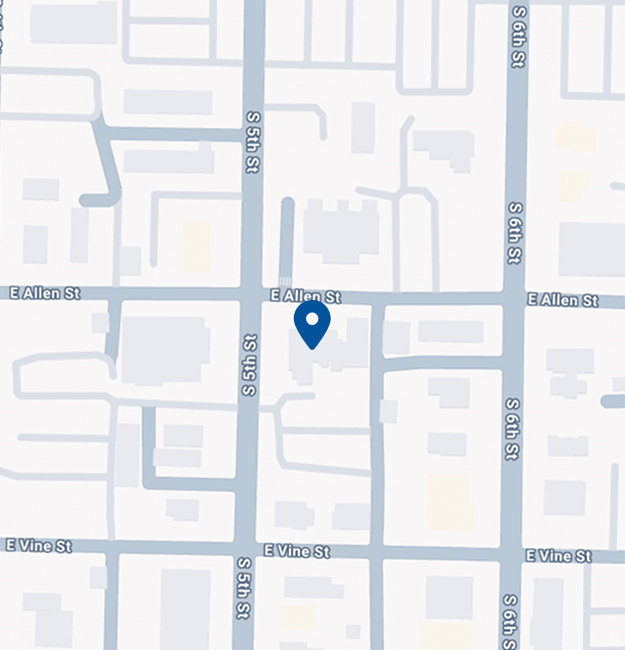
Our offices are located at the corner of South Fifth Street and Vine, in the historic Mary Bryant Home for the Blind.