- Free Consultation: (217) 544-4057 Tap Here To Call Us














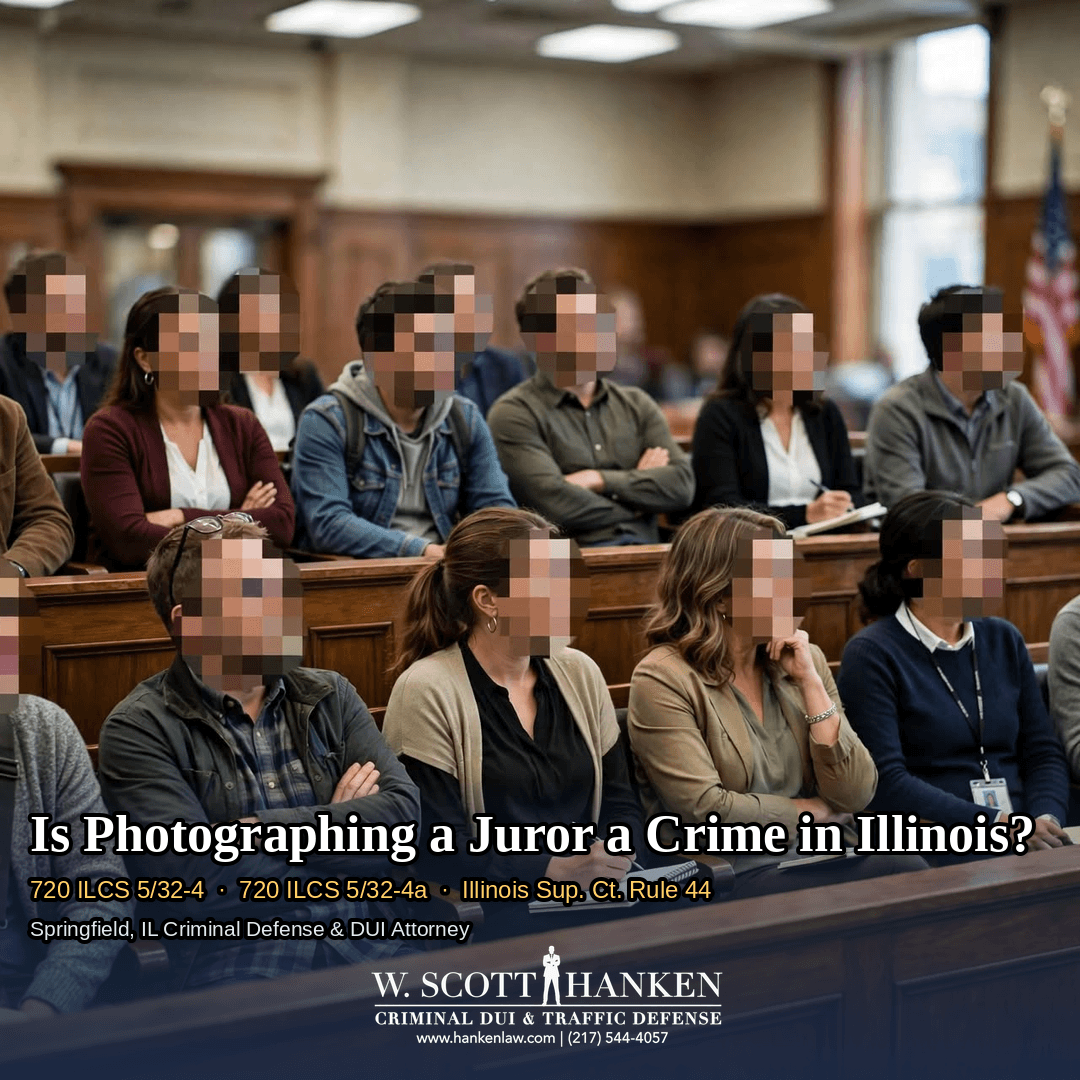
Jury Tampering and Juror Intimidation Charges in Illinois: What the Law Says About Photographing or Contacting a Juror


Last Reviewed & Updated: September 3, 2026
By: W. Scott Hanken | Former Sangamon County Prosecutor | Springfield Criminal Defense Attorney | Voted “Best Attorney” — Illinois Times Best of Springfield & State Journal-Register Reader’s Choice | Springfield, IL | Sangamon County | (217) 544-4057 | hankenlaw.com
Bottom Line: Taking a photograph of an Illinois juror is not, by itself, a crime under 720 ILCS 5/32-4 or 5/32-4a. Those statutes require a communication plus intent to influence or, for 32-4a, intent to harass because of the verdict or the juror’s participation in it. The same photo can still violate Illinois Supreme Court Rule 44, the extended media and portable-device policies, or a judge’s standing order, and can support contempt, trespass, or — if there is an approach, a threat, or a pattern of conduct — felony charges. Illinois has no single crime called “jury interference”; the conduct instead falls across several statutes, each triggered by different facts and intent.
A Courthouse Arrest in Massachusetts Raises the Question for Illinois
On September 2, 2026, a 56-year-old Massachusetts woman was arraigned on an intimidation charge after state police said she filmed jurors leaving Plymouth Superior Court during deliberations in the murder trial of Lindsay Clancy, the former labor and delivery nurse who does not deny strangling her three children in 2023 but has pleaded not guilty by reason of lack of criminal responsibility, arguing postpartum psychosis. The jury had reported that it was deadlocked hours before the arrest.
Prosecutors said the woman was parked in a restricted area behind the courthouse using her phone to record people leaving the building. The trial judge had issued an order in June barring the filming or photographing of jurors. Troopers reported finding juror video in the deleted-files folder on her phone after an initial look at her camera roll turned up nothing. Her attorney called the episode a misunderstanding and said she was trying to see the defendant. The judge questioned jurors individually the next day about whether the incident affected their ability to remain impartial.
Massachusetts folds juror intimidation into a single broad statute covering witnesses, jurors, and people furnishing information in connection with a criminal proceeding. Illinois takes a different approach. Rather than one catch-all offense, Illinois criminal law spreads jury-related misconduct across several distinct statutes, each with its own intent requirement and penalty range. That matters, because the same courthouse-parking-lot recording that produced a single felony charge in Plymouth could, under Illinois law — the law that would apply at the Sangamon County Courthouse or any other courthouse in Central Illinois — produce no criminal charge at all, or several, depending on exactly what the person did and why.
What Illinois Court Rules Say About Photographing Jurors
Illinois Supreme Court Rule 44 governs photography and broadcasting inside the courtroom itself, during sessions and recesses, and permits it only to the extent authorized by order of the Illinois Supreme Court. Rule 44’s courtroom photography ban does not automatically extend to hallways or other areas immediately adjacent to the courtroom, though a judge can regulate or restrict those areas by a separate order.
The juror-specific ban comes from a different document: the Policy for Extended Media Coverage in the Circuit Courts of Illinois, effective January 1, 2026, which replaced the policy in place since 2016. Section 3.0(c) is categorical: extended media coverage of jury selection and jurors is prohibited. The policy separately requires the judge to admonish the jury that approved media coverage does not permit filming or photographing jurors or the jury panel, in the courtroom or outside it.
Statute Callout — A third and broader source, the Illinois Supreme Court Policy on Portable Electronic Devices, applies to any court visitor, not just media. It generally bars taking photographs or recordings without a judge’s prior approval, and separately bars using a device to communicate or attempt to communicate with a juror or potential juror at any time.
Violating any of these three sources can mean confiscation of the device, removal from the courthouse, a finding of contempt of court, or referral for prosecution under whichever criminal statute the conduct actually satisfies.
A judge’s own standing order, like the one issued in the Clancy case, adds a second layer. Violating a specific judicial order barring contact with or photography of jurors exposes a person to indirect criminal contempt, which is a court’s inherent power to punish disobedience of its own orders. Contempt proceedings run separately from, and can be brought in addition to, any criminal charge filed by a prosecutor’s office.
Illinois Criminal Statutes That Could Apply
Communicating With a Juror — 720 ILCS 5/32-4(a)
Communicating with a person believed to be a juror, with intent to influence a matter that is or may come before that juror, is a Class 4 felony, regardless of whether the communication succeeds or the juror is bothered by it. This is the narrowest and most direct jury-tampering statute in the Illinois Criminal Code. It does not require a threat, harassment, or even an unpleasant exchange — only intent to influence and an act of communication, direct or indirect, “otherwise than as authorized by law,” so a judge’s or attorney’s proper contact with a juror is not swept in. Because it requires no verdict and no harassment, this is the statute that best fits a mid-trial incident like a spectator approaching or messaging a deliberating juror before any verdict is returned.
Harassment of a Juror — 720 ILCS 5/32-4a
Harassment of a juror is a Class 2 felony, but only when a person, intending to harass or annoy someone who has served or is serving as a juror because of the verdict the jury returned or the juror’s participation in that verdict, communicates with the juror or a family member in a way that produces mental anguish or emotional distress, or conveys a threat of injury. That verdict-linked element makes 32-4a a narrower fit than it might first appear: it is built for retaliation after a verdict, not for a mid-trial photograph taken before any verdict exists. A spectator photographing deliberating jurors is generally a poorer match for 32-4a than for the broader intent-to-influence language in 32-4(a).
Intimidation — 720 ILCS 5/12-6
General intimidation is a Class 3 felony, but it requires two things a photograph alone cannot supply. First, a threat to commit one of seven specified acts — inflicting physical harm on a person or property, confining or restraining someone, committing a felony or Class A misdemeanor, accusing someone of an offense, exposing someone to hatred or ridicule, taking or withholding official action, or bringing about a strike or boycott. Second, the intent to cause the other person to do something or refrain from doing something. Photography alone meets neither.
Intimidation also carries an unusual range for its class: the statute authorizes a term of not less than 2 and not more than 10 years. Where a spectator’s conduct includes a genuine one-time threat toward a juror rather than a repeated pattern, this statute is usually the better fit than stalking — and it exposes the person to more prison time than the Class 2 harassment offense above.
Stalking — 720 ILCS 5/12-7.3
Stalking is a Class 4 felony, and a second or subsequent conviction escalates to a Class 3 felony, but most subsections require a course of conduct — two or more acts — rather than a single day’s incident. A juror followed, surveilled, or photographed repeatedly across the length of a multi-week trial could meet that threshold even where a single afternoon’s photograph would not. A genuine threat made on just one occasion is better analyzed under the intimidation statute above than treated as a routine one-act stalking case.
Criminal Trespass — 720 ILCS 5/21-5 and 5/21-3
Entering a restricted, non-public area of an Illinois courthouse after being told the area is off-limits is most naturally charged as criminal trespass to State supported land, a Class A misdemeanor. That statute reaches any building on land supported in whole or in part with State funds, where a person enters after notice that entry is forbidden or remains after notice to depart, and thereby interferes with another person’s lawful use or enjoyment of the building or land. The general criminal trespass to real property statute, 720 ILCS 5/21-3, is a Class B misdemeanor and may apply to some courthouse-adjacent property, but the State-supported-land provision is the one prosecutors reach for first in a courthouse setting.
Resisting or Obstructing a Peace Officer — 720 ILCS 5/31-1
One more statute often rides alongside these charges. If a person resists arrest or otherwise obstructs an officer performing an authorized act — which does not always require physical force — resisting or obstructing a peace officer is a Class A misdemeanor, carrying a mandatory minimum of 48 consecutive hours in jail or 100 hours of community service with no probation available to reduce it. It becomes a Class 4 felony if the violation is the proximate cause of injury to the officer.
Illinois Charges That Could Apply to Improper Contact With a Juror
| Statute | Offense | Class | Core Trigger |
|---|---|---|---|
| 720 ILCS 5/32-4(a) | Communicating with a juror | Class 4 felony | Intent to influence a matter before the juror |
| 720 ILCS 5/32-4(b) | Deterring a party or witness | Class 3 felony | Threats, false information, or detention to deter testimony |
| 720 ILCS 5/32-4a(a) | Harassment of a juror | Class 2 felony | Communication because of the verdict, causing distress, or a threat |
| 720 ILCS 5/12-6 | Intimidation | Class 3 felony (2–10 yrs) | Threat plus intent to compel an act or omission |
| 720 ILCS 5/12-7.3 | Stalking | Class 4 felony (Class 3 on repeat) | Course of conduct — 2 or more acts |
| 720 ILCS 5/21-5 | Criminal trespass to State supported land | Class A misdemeanor | Entering or remaining after notice, interfering with lawful use |
| 720 ILCS 5/21-3 | Criminal trespass to real property | Class B misdemeanor | Entering or remaining after notice it is forbidden |
| 720 ILCS 5/31-1 | Resisting or obstructing a peace officer | Class A misdemeanor (Class 4 felony if injury) | Knowingly resisting arrest or obstructing an authorized act |
Does Taking a Photo of a Juror, By Itself, Violate Illinois Criminal Law?
This is where the analysis gets genuinely close, and it is the kind of question that decides whether a case gets charged as a felony, a misdemeanor, or not charged criminally at all.
None of the juror-specific Illinois statutes criminalize the act of photography by itself — each requires either intent to influence, a communication that produces distress, or an actual threat. A photograph taken silently from a public sidewalk, with no words exchanged and no attempt to approach, does not obviously satisfy the communication element that 720 ILCS 5/32-4 and 32-4a both require.
Prosecutors are not without an argument, however. The text of 32-4(a) reaches communication made “directly or indirectly,” and a prosecutor could contend that photographing a juror and then posting, showing, or otherwise circulating the image so it reaches the juror is itself an indirect communication. That theory is untested and fact-dependent, but it means the photo-alone analysis above is not an absolute shield — it is a strong defense position, not a guarantee, particularly once the photograph is used for something beyond the photographer’s own possession.
That does not mean the conduct goes unaddressed. It means the consequence more often lands first as a court-security matter — confiscation of the phone, removal from the courthouse, or a contempt citation for violating a judge’s standing order — before it becomes a felony prosecution. Prosecutors typically need something more: an approach toward the juror, a spoken exchange, entry into a restricted area, or a pattern of repeated conduct that supports stalking or harassment. That distinction is exactly the kind of fact-specific issue that separates a dismissed case from a felony conviction, and it is where early representation matters most.
The Bottom Line
The arrest outside the Clancy trial is a reminder that courthouse conduct carries real criminal exposure well beyond the trial itself. In Illinois, that exposure is not a single statute but a web of them — jury tampering, harassment, intimidation, stalking, trespass, and obstruction — each triggered by a different combination of conduct and intent. Anyone contacted by police about an incident involving a juror, a courthouse security officer, or a judge’s standing order should assume prosecutors are evaluating several of these statutes at once, and should get an attorney involved before answering questions.
Frequently Asked Questions (FAQs)
No. Photography and recording are generally barred without prior judicial approval, and even authorized extended media coverage under Illinois Supreme Court Rule 44 and the circuit courts’ media policy still prohibits filming jurors.
Not automatically. It violates Illinois court policy and can bring confiscation, removal, or contempt, but a separate criminal charge generally requires proof of intent to influence under 720 ILCS 5/32-4, or, for 720 ILCS 5/32-4a, intent to harass because of the verdict or the juror’s participation in it.
It depends on which statute the State charges. Harassment of a juror under 720 ILCS 5/32-4a is a Class 2 felony, punishable by three to seven years in prison. Communicating with a juror to influence a case under 720 ILCS 5/32-4(a) is a Class 4 felony, punishable by one to three years. If the conduct also supports an intimidation charge under 720 ILCS 5/12-6, that Class 3 felony carries its own statutory range of two to ten years — the longest exposure of the three.
Usually not. Most stalking charges under 720 ILCS 5/12-7.3 require a course of conduct — two or more acts — across separate occasions. A genuine threat made on a single occasion is generally better analyzed as intimidation under 720 ILCS 5/12-6 than treated as a one-act stalking case.
Yes. Communicating with someone believed to be a juror with intent to influence a pending matter is a Class 4 felony under 720 ILCS 5/32-4(a), even without any harassment or threat.
Most often criminal trespass to State supported land under 720 ILCS 5/21-5, a Class A misdemeanor. That charge stands on its own and does not depend on proving anything about a juror.
Further Reading
Related Articles
- The Lindsay Clancy Deadlocked Jury: What the Tuey-Rodriquez Charge Is, and Why a Mistrial Is Not Automatic — Explains what the deadlocked jury in this same trial actually faces next.
- If Lindsay Clancy Were Tried in Illinois: No Soft Landing — Shows how the underlying case would be charged and defended under Illinois law.
- Resisting a Peace Officer in Illinois (720 ILCS 5/31-1) — Goes deeper on the obstruction charge that frequently rides alongside a courthouse arrest.
- Can an Illinois Prosecutor Argue That Asking for a Lawyer Shows Guilt? — Answers the obvious follow-up if you take this article’s advice and decline to answer questions.
- Charged With Disorderly Conduct in Springfield? Here’s What 720 ILCS 5/26-1 Actually Means For You — Covers the other catch-all charge officers reach for when conduct in a public building draws attention.
Browse by Topic
Ready to Fight Your Criminal Charge in Springfield?
Call W. Scott Hanken at (217) 544-4057 or contact us online for a free consultation. We serve clients throughout Springfield, Sangamon County, and Central Illinois.
About the Author: W. Scott Hanken, Attorney at Law
Scott Hanken is a Springfield, Illinois criminal defense attorney with over 37 years of experience, including service as a former Sangamon County prosecutor. He has been voted Best Attorney by the Illinois Times and State Journal-Register, holds an Avvo 10.0 “Superb” rating, and has earned over 270 five-star Google reviews. He serves clients throughout Sangamon County and Central Illinois.
📍 1100 S 5th St, Springfield, IL 62703 | ☎ (217) 544-4057 | 🌐 hankenlaw.com
This article is for general educational purposes only and does not constitute legal advice. Every case is unique — contact an experienced Springfield criminal defense attorney for guidance on your specific situation.
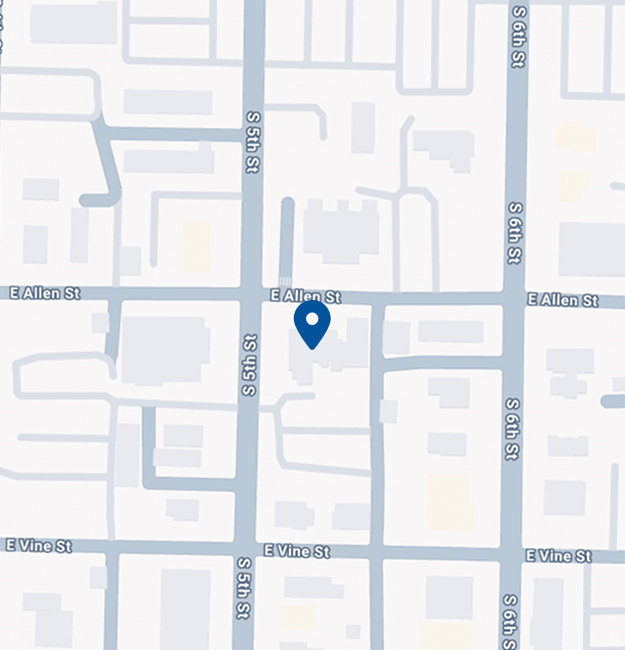
Address
Our offices are located at the corner of South Fifth Street and Vine, in the historic Mary Bryant Home for the Blind.