- Free Consultation: (217) 544-4057 Tap Here To Call Us









Marijuana and Guns in Illinois After U.S. v. Hemani


Last Reviewed & Updated: October 2, 2026
By: W. Scott Hanken | Former Sangamon County Prosecutor | Springfield Criminal Defense & Weapons Offenses Defense Attorney | Voted “Best Attorney” — Illinois Times Best of Springfield & State Journal-Register Reader’s Choice | Springfield, IL | Sangamon County | (217) 544-4057 | hankenlaw.com
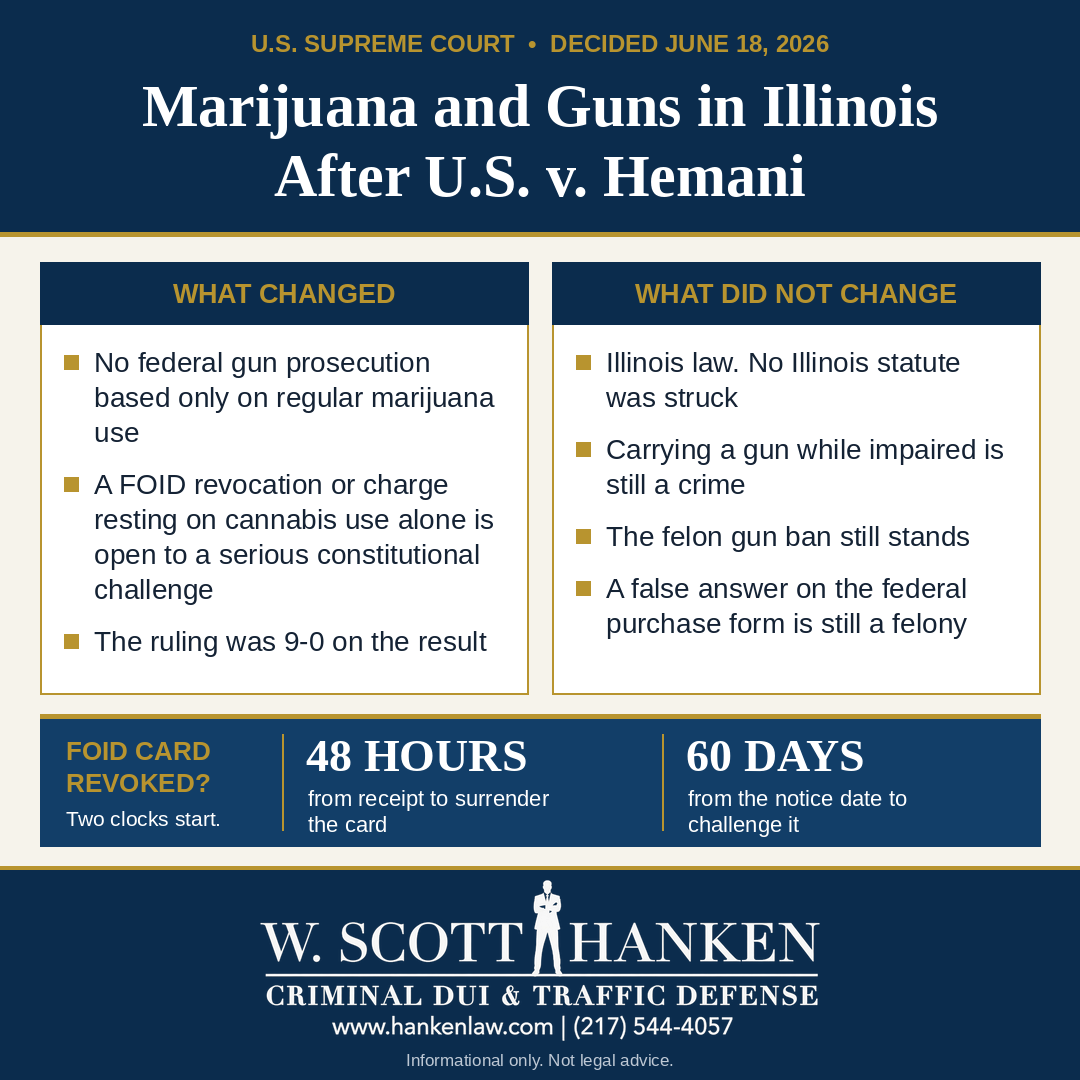
After United States v. Hemani, decided June 18, 2026, the federal government cannot prosecute a gun owner solely for regular marijuana use. The ruling does not reach addiction, carrying while impaired, felons, or false answers on a purchase form. Illinois law did not change.
Bottom Line: Hemani is a federal, as-applied ruling. It struck no Illinois statute. In Springfield and across Sangamon County, FOID revocations and state gun charges still run through Illinois law, and federal gun cases run through the Central District of Illinois. Here is what changed: a revocation or charge that rests on regular cannabis use alone, with no conviction and no proof of addiction or present impairment, is now open to a serious constitutional challenge.
Charged with a gun offense or facing a FOID revocation in Springfield? Call W. Scott Hanken, Attorney at Law at (217) 544-4057.
What did the Supreme Court decide in United States v. Hemani?
The Court held that prosecuting a man for owning a gun, based solely on his admitted marijuana use, violated the Second Amendment. All nine justices agreed on the result.
Ali Hemani told federal agents he used marijuana about every other day. He kept a gun at home. The government charged him under 18 U.S.C. § 922(g)(3), which bars any “unlawful user” of a controlled substance from possessing a firearm and carries up to 15 years in federal prison. Prosecutors did not claim he was an addict, that his drug use ever made him a danger to himself or others, or that he did anything with the gun other than keep it at home.
The record held more than that. The search began as a terrorism-related investigation, and agents also found cocaine that Hemani claimed as his. The government charged none of it. It relied on the marijuana admission alone, and the Court decided the case on that theory.
Justice Gorsuch wrote the opinion in United States v. Hemani, No. 24-1234, 608 U.S. ___ (2026). Applying New York State Rifle & Pistol Assn. v. Bruen, 597 U.S. 1 (2022) and United States v. Rahimi, 602 U.S. 680 (2024), the Court required the government to show a historical tradition supporting the ban. The government pointed to founding-era “habitual drunkard” laws. The Court found three mismatches:
- Different people. Historical laws reached drinkers so incapacitated they could not manage their own affairs, not people who drank regularly.
- Different purpose. Those laws targeted idleness, family ruin, and public morals, not violence.
- Different process. A conviction, a probate hearing, or a proceeding before a justice of the peace usually came before any loss of liberty. Section 922(g)(3), as the government reads it, disarms a person automatically, with no process beforehand.
Can I own a gun in Illinois if I use marijuana?
Usually yes, if you hold a valid FOID card and have no other disqualifier. Hemani did not create that right, and it did not change Illinois law.
The decision is “as applied.” Section 922(g)(3) remains in the U.S. Code, and marijuana remains a federally controlled substance. Federal gun cases arising in Sangamon County are prosecuted in the U.S. District Court for the Central District of Illinois, which sits in Springfield. In that courtroom, Hemani now controls. The Seventh Circuit’s earlier decision upholding the statute, United States v. Yancey, 621 F.3d 681 (7th Cir. 2010), can no longer support a prosecution that rests on regular use and nothing else.
State court is different. In the Sangamon County Circuit Court, gun cases are charged under the Illinois Criminal Code and the FOID Card Act. Hemani did not rule on any Illinois statute. Its reasoning gives defense counsel a framework for attacking Illinois provisions that borrow from federal drug rules, and nothing more than that yet.
As a former Sangamon County ASA and a defense attorney, I will be direct about this. A federal decision does not amend the FOID Act or the Criminal Code. A Sangamon County charge or revocation still has to be challenged here, in the circuit court, before the FOID Card Review Board, or before the Director of the State Police.
Can the Illinois State Police revoke my FOID card for cannabis?
Yes. The statute still allows it, but a revocation based only on regular use now faces a serious constitutional challenge.
Statute Callout — 430 ILCS 65/8(d) and (n): The Illinois State Police may deny or revoke a FOID card if the person is “addicted to narcotics” or is “prohibited from acquiring or possessing firearms or firearm ammunition by any Illinois State statute or by federal law.” 430 ILCS 65/8 (P.A. 104-31, eff. 1-1-26; P.A. 104-270, eff. 8-15-25).
Statute Callout — 430 ILCS 65/1.1: “Addicted to narcotics” means a person (1) convicted of an offense involving the use or possession of cannabis, a controlled substance, or methamphetamine within the past year, or (2) “determined by the Illinois State Police to be addicted to narcotics based upon federal law or federal guidelines.” 430 ILCS 65/1.1 (P.A. 104-270, eff. 8-15-25).
Here is how the two statutes interact with Hemani, and it is the part most summaries miss. The second definition has no conviction and no hearing. The Illinois State Police, headquartered in Springfield, make the call administratively, using federal standards. Section 8(n) works the same way: if federal law prohibits you, Illinois revokes. Both provisions borrow the federal theory the Supreme Court rejected, and both operate without the pre-deprivation process the Court found missing.
The first definition is the sturdier one for the State. It follows a criminal conviction, so a court process came first. That is an argument, not a holding. The Court’s process footnote named two federal provisions as examples, § 922(g)(1) and § 922(g)(4), and said nothing in the opinion should be taken to cast doubt on them. It did not rule on any state definition.
In late 2019, just before adult-use cannabis became legal in Illinois on January 1, 2020, the State Police said publicly that they would not revoke a FOID card based solely on legal adult-use cannabis, but would revoke where a person was shown to be addicted to or a “habitual user” of cannabis. Hemani did not strike 430 ILCS 65/8(d), 65/8(n), or 720 ILCS 5/24-3.1(a)(3). What it did is narrower and still significant: a revocation or charge that rests on regular cannabis use alone, with no conviction and no proof of addiction or present impairment, is now open to a serious constitutional challenge.
Facing a FOID revocation notice? 48 hours from receipt to surrender the card. 60 days from the date on the notice to challenge it. Call (217) 544-4057.
Does a medical card, a dispensary purchase, or a cannabis conviction affect my FOID card?
They lead to three different outcomes. Only the conviction is a listed ground for revocation.
| Your situation | What Illinois says | FOID outcome |
|---|---|---|
| Illinois medical cannabis card | The Illinois State Police FOID page says a medical cannabis card will not cause a FOID or concealed carry denial or revocation | No revocation on that basis |
| Adult-use dispensary purchase | The same State Police page says cannabis use consistent with Illinois law will not cause a FOID or concealed carry denial or revocation | No revocation on that basis |
| Conviction for a cannabis use or possession offense within the past year | Meets the first definition of “addicted to narcotics” in 430 ILCS 65/1.1 | Ground for denial or revocation under 430 ILCS 65/8(d) |
What gun charges can a cannabis user still face in Sangamon County?
Several. Hemani narrowed one federal theory, and every other charge below remains available to prosecutors in Springfield.
| Situation | Law | Penalty | Affected by Hemani? | What to do |
|---|---|---|---|---|
| Regular marijuana use plus gun ownership, nothing more (federal) | 18 U.S.C. § 922(g)(3) | Up to 15 years | Yes. Prosecution barred on these facts | Call before you talk to police or federal agents |
| “Narcotic addict” in possession of a firearm | 720 ILCS 5/24-3.1(a)(3) | Class A misdemeanor (long guns, ammunition); Class 4 felony (handguns) | Not decided. Open to challenge | Say nothing about drug use. Raise Hemani by written motion |
| Concealed carry while under the influence | 430 ILCS 66/70(d) | Class A misdemeanor, first or second; Class 4 felony, third | No | Treat it like a DUI. Call before any statement |
| Failing to surrender FOID and file a disposition record after revocation | 430 ILCS 65/9.5 | Class A misdemeanor | No | 48-hour surrender, then challenge |
| False information on a FOID application | 430 ILCS 65/14(d-5) | Class 2 felony | No | Do not correct or explain it without counsel |
| False answer on the federal gun purchase form | 18 U.S.C. § 922(a)(6) | Up to 10 years | No | Answer truthfully. Call before you sign or explain |
| Unlawful possession of weapons by felons (formerly unlawful use or possession of weapons by felons) | 720 ILCS 5/24-1.1; 18 U.S.C. § 922(g)(1) | Class 3 felony, 2 to 10 years; Class 2 felony, 3 to 14 years, for a repeat offense, certain prior felonies, or parole or MSR status | No. The Court said so expressly | Call immediately. Hemani is not a defense |
A Class A misdemeanor carries up to 364 days in jail and a fine up to $2,500. A Class 4 felony carries 1 to 3 years in prison. Statutes: 720 ILCS 5/24-3.1; 430 ILCS 66/70; 430 ILCS 65/9.5; 430 ILCS 65/14; 720 ILCS 5/24-1.1 (P.A. 103-822, eff. 1-1-25).
What if I have a medical cannabis card and a FOID card?
Your position improved, but the Court did not rule on medical patients. Hemani rejected the government’s claim that regular marijuana use, standing alone, makes a person categorically dangerous, and the opinion noted that the federal government has moved some marijuana products to Schedule III, which recognizes accepted medical use. Nothing in the opinion suggests Hemani was a medical patient. In Springfield, the practical risk has always been the federal purchase form and the background check, not the State Police pulling the card.
What if police find a gun in my car and suspect I’m high during a Springfield traffic stop?
Hemani does not help you. The Court stated that it was not addressing people who are presently intoxicated. Illinois bars a concealed carry licensee from carrying while under the influence, measured by the same standards as a DUI. 430 ILCS 66/70(d). A first or second violation is a Class A misdemeanor. A third is a Class 4 felony. Expect a DUI charge alongside it. Repeat violations also put the license itself at risk: the State Police may suspend it for up to 6 months after a second violation and must permanently revoke it after a third.
What if I answered “no” to the drug question on the federal gun purchase form?
Hemani did not decide that question, and it did not authorize a false answer. ATF Form 4473 asks whether you are an unlawful user of marijuana or any controlled substance. A knowingly false statement to a licensed dealer that is material to the lawfulness of the sale violates 18 U.S.C. § 922(a)(6) and carries up to 10 years under 18 U.S.C. § 924(a)(2). A separate provision, 18 U.S.C. § 924(a)(1)(A), covers false statements in a dealer’s required records and carries up to 5 years. If you have already signed a form, talk to a lawyer before you talk to anyone else.
What if my FOID card was already revoked as “addicted to narcotics”?
You may have grounds to get it back, and the deadline is short. A record challenge must be filed on the State Police Request for FOID Investigation, Relief, and Reinstatement of Rights form within 60 days after the date on your notice. If your supporting documents are not complete within 60 days, the challenge is denied and closed. 20 Ill. Adm. Code 1230.70. Once the submission is complete, the Director must decide within 60 business days. 430 ILCS 65/10(a-10). Relief from the FOID Card Review Board or the circuit court requires a finding that restoring your rights “would not be contrary to federal law.” Before June 18, that requirement stopped most cannabis users cold. Hemani changes what federal law can constitutionally prohibit.
What did the Supreme Court leave undecided?
A great deal. The Court called its own decision narrow and listed what it was not ruling on:
- Bans on firearm possession by people who are addicted.
- Bans on possession while presently intoxicated.
- Future laws aimed at users of a specific drug that Congress finds especially dangerous.
- Prosecutions backed by individualized proof that a person’s drug use makes them dangerous.
- The felon-in-possession ban.
Justice Alito, joined by Justice Kagan, agreed with the result on a different ground: the government never showed that a regular marijuana user is incapacitated the way a historical “habitual drunkard” was. That reasoning matters for Illinois. Any prosecutor defending 720 ILCS 5/24-3.1(a)(3) will argue that “addict” means something more than “user.” The fight in the Sangamon County Circuit Court will be over where that line sits and who has to prove it.
What should I do if I’m charged or my FOID card is revoked?
Comply first, then challenge. A revocation notice starts a 48-hour clock to surrender the card and file a Firearm Disposition Record. 430 ILCS 65/9.5 (P.A. 103-154, eff. 6-30-23). Missing that deadline is a new Class A misdemeanor, and it hands the State an easy case while your real argument waits.
Then take these steps:
- Do not discuss your cannabis use with police or the State Police without counsel. Hemani’s own statements were the government’s entire case.
- Keep the revocation notice. The date on it starts the 60-day record-challenge deadline, and the stated ground determines which appeal route applies.
- Get the constitutional issue raised early. A Hemani challenge belongs in a written motion to dismiss, filed before trial.
Frequently Asked Questions (FAQs)
Usually yes, if you hold a valid FOID card and have no other disqualifier. Hemani did not create that right, and it did not change Illinois law.
Not for that alone. The State Police’s FOID page says cannabis use consistent with Illinois law will not cause a revocation. A conviction for a cannabis use or possession offense within the past year is a ground for revocation.
No. It held the law unconstitutional as applied to Hemani. The statute remains, and the Court left addicts, intoxicated carriers, and dangerous users for later cases.
The reasoning is not limited to marijuana, but the facts were. The Court said the government may still try to prove that a particular drug, or a particular person’s use, creates real danger.
Cannabis use does not automatically bar a license, and the State Police have said a medical card alone will not cause a denial. But two listed disqualifiers can reach cannabis users: two or more DUI violations, including drug DUIs, within the past 5 years, and residential or court-ordered drug treatment within the past 5 years. A license also requires a valid FOID card and no prohibition under the FOID Act or federal law. 430 ILCS 66/25 (P.A. 102-538, eff. 8-20-21). Law enforcement may also object to an applicant under 430 ILCS 66/15.
No. The ruling did not rewrite ATF Form 4473 or the false-statement statute. Answer the form truthfully, and get legal advice first if you are unsure how to answer.
No. The Court said nothing in its opinion casts doubt on the felon-in-possession ban.
Further Reading
Practice Area
Related Articles
- What Should I Know About a Firearm Owners Identification? — The full list of FOID disqualifiers, beyond “addicted to narcotics,” and how a pending charge can cost you the card.
- Can You Carry a Firearm in Your Vehicle in Illinois? — Most cannabis-and-gun cases start at a traffic stop. Know the transport rules before you drive.
- Can a Convicted Felon Ever Legally Own a Firearm Again in Illinois? — Hemani does nothing for felons. Here are the state and federal paths that do.
- Federal Gun Deregulation Won’t Save You From an Illinois Weapons Charge — Another case of federal change leaving Illinois gun law exactly where it was.
Browse by Topic
Ready to Fight Your Weapons Charge in Springfield?
Call W. Scott Hanken at (217) 544-4057 or contact us online for a free consultation. We serve clients throughout Springfield, Sangamon County, and Central Illinois.
About the Author: W. Scott Hanken, Attorney at Law
Scott Hanken is a Springfield, Illinois criminal defense attorney with over 37 years of experience, including service as a former Sangamon County prosecutor. He has been voted Best Attorney by the Illinois Times and State Journal-Register, holds an Avvo 10.0 “Superb” rating, and has earned over 270 five-star Google reviews. He serves clients throughout Sangamon County and Central Illinois.
📍 1100 S 5th St, Springfield, IL 62703 | ☎ (217) 544-4057 | 🌐 hankenlaw.com
This article is for general educational purposes only and does not constitute legal advice. Every case is unique — contact an experienced Springfield criminal defense attorney for guidance on your specific situation.

Address
Our offices are located at the corner of South Fifth Street and Vine, in the historic Mary Bryant Home for the Blind.