- Free Consultation: (217) 544-4057 Tap Here To Call Us















SCRAM and Breathalyzer Monitoring in Illinois DUI Cases


Last Reviewed & Updated: November 27, 2026
By: W. Scott Hanken | Former Sangamon County Prosecutor | Springfield Criminal Defense & DUI Attorney | Voted “Best Attorney” — Illinois Times Best of Springfield & State Journal-Register Reader’s Choice | Springfield, IL | Sangamon County | (217) 544-4057 | hankenlaw.com
In Illinois, a judge can order a SCRAM ankle bracelet or a remote breathalyzer as a condition of pretrial release or DUI probation, but only when the condition fits your case. A positive alert is not automatic jail. The State still has to prove the violation in court.
Bottom Line: If you are charged with DUI in Springfield or anywhere in Sangamon County, you are likely to face a SCRAM bracelet or a remote breathalyzer. Before trial, that means alcohol monitoring through the Office of Statewide Pretrial Services. After sentencing, it means alcohol testing on DUI probation. Before trial, the court must find that monitoring is necessary and is the least restrictive condition that will work. After sentencing, the court must tie it to your offense. If the device reports a drinking event or a tamper alert, you have the right to a hearing and the right to challenge the data.
Facing an alcohol monitoring order or a monitoring violation? Call W. Scott Hanken, Attorney at Law at (217) 544-4057 before your next court date.
Key Terms
- SCRAM: Secure Continuous Remote Alcohol Monitoring. This is an ankle bracelet that tests your sweat for alcohol around the clock.
- TAC: Transdermal alcohol concentration. This is the reading a SCRAM bracelet takes through your skin. It is not a blood or breath alcohol level.
- Remote breathalyzer: A portable breath-testing device. It prompts you to test at scheduled or random times and photographs you to confirm your identity.
What Is a SCRAM Device, and How Is It Different From a Remote Breathalyzer?
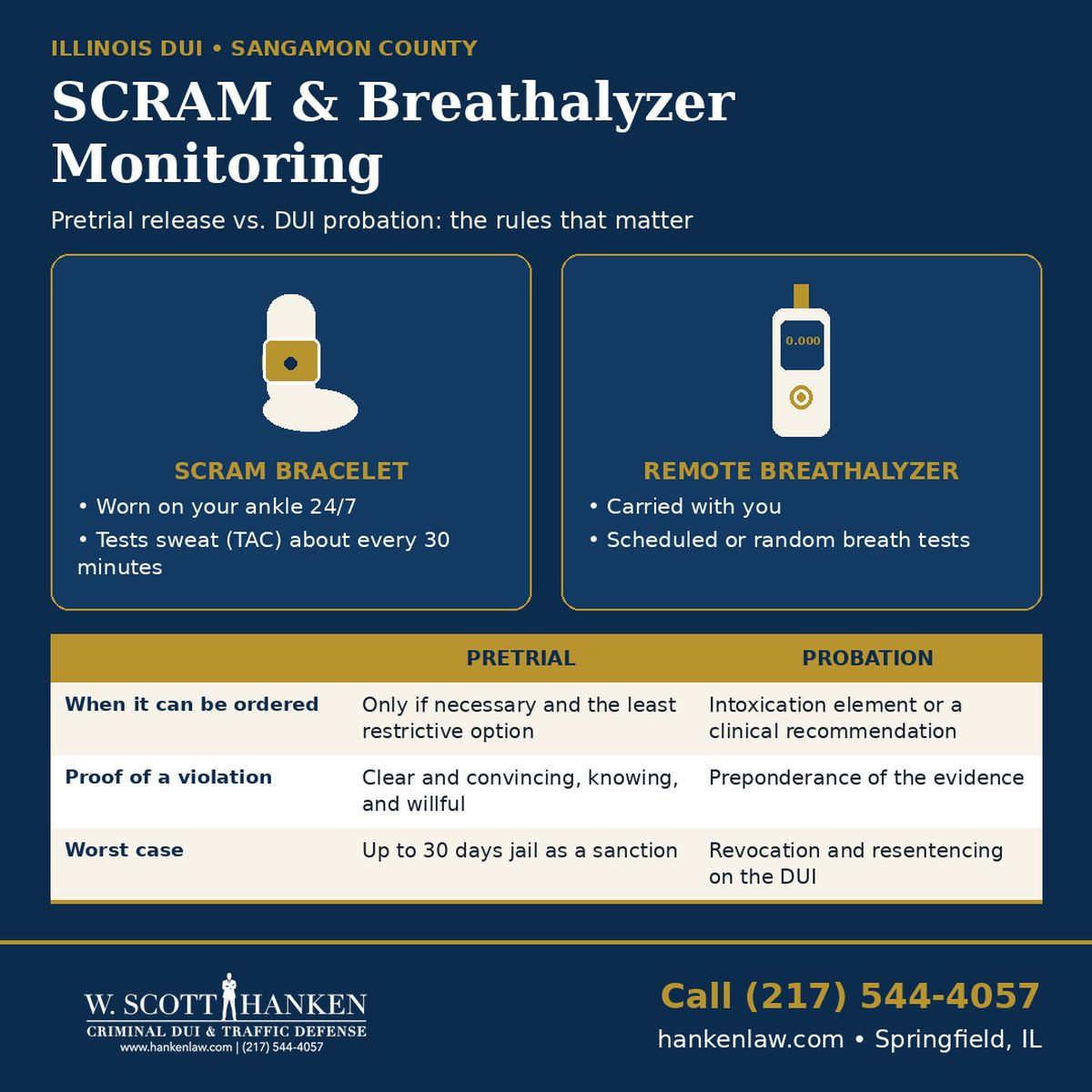
A SCRAM bracelet tests your sweat around the clock. A remote breathalyzer tests your breath on a schedule. Both report to the agency supervising you, and both can generate a violation report.
The SCRAM bracelet tests the perspiration just above your skin roughly every 30 minutes. It uses sensors to flag possible tampering or obstruction. A remote breathalyzer prompts you to blow at scheduled or random times set by the monitoring program, and it photographs you during each test.
Illinois law treats both as monitoring devices. The Electronic Monitoring and Home Detention Law defines an “approved electronic monitoring device” to include equipment that records or transmits information about a person’s consumption of alcohol. 730 ILCS 5/5-8A-2, as amended by P.A. 101-652, eff. July 1, 2021.
| SCRAM bracelet | Remote breathalyzer | Ignition interlock (BAIID) | |
|---|---|---|---|
| Where it goes | Your ankle, 24/7 | Your pocket or home | Your vehicle |
| What it tests | Sweat (TAC) | Breath (BrAC) | Breath, before and during driving |
| How often | About every 30 minutes | Scheduled or random prompts | Every time you start or drive |
| Most common violation | Drinking event or tamper alert | Missed or late test | Failed or skipped test |
| Who usually orders it | Pretrial court or sentencing judge | Pretrial court or sentencing judge | Usually the Secretary of State, as a condition of driving relief |
Which device you get is changing locally. In my experience, Sangamon County appears to be moving away from SCRAM devices toward remote breath monitoring, because of a number of complications that have arisen with SCRAM.
Can a Judge Order SCRAM Before I Am Convicted of DUI in Illinois?
Yes, but only after the court finds the condition is necessary and individualized.
Under the current pretrial release statute, the court may add conditions beyond the mandatory ones only when they are necessary for specific purposes. Those purposes are to ensure you appear in court, prevent new criminal offenses, ensure you comply with your release conditions, or prevent interference with the administration of justice. Those conditions “shall include the least restrictive means and be individualized.” 725 ILCS 5/110-10(b), last amended by P.A. 102-1104, eff. January 1, 2023.
A companion section requires the court to impose only the least restrictive conditions necessary. It adds stricter rules for electronic monitoring, GPS monitoring, or home confinement. The court may impose them only if no less restrictive condition would reasonably ensure your appearance or protect an identifiable person from an imminent threat of serious physical harm. It must state its basis on the record and revisit the condition every 60 days. 725 ILCS 5/110-5(c), (g)–(i), last amended by P.A. 102-1104, eff. January 1, 2023.
The statute does not say whether a SCRAM bracelet counts as “electronic monitoring” for these purposes. But Illinois defines an approved electronic monitoring device to include one that reports alcohol consumption. That gives a strong argument that the stricter findings and the 60-day review apply to SCRAM, and likely to a remote breath device as well.
In Sangamon County, pretrial supervision runs through the Illinois Office of Statewide Pretrial Services (OSPS). OSPS job postings for Sangamon County describe field officers who install monitoring equipment and review alcohol monitoring data for compliance. OSPS alcohol monitoring officers also prepare violation reports and testify in court. That officer is often the key witness against you at a violation hearing.
Pretrial vs. Probation: The Standards at a Glance
| Pretrial release | DUI probation or supervision | |
|---|---|---|
| When monitoring can be ordered | Only if necessary, individualized, and the least restrictive means (725 ILCS 5/110-10(b), 110-5) | When the offense has an intoxication element, a clinical assessment recommends it, or another listed basis applies (730 ILCS 5/5-6-3(n)) |
| Who pays | No fee provision in the pretrial statute; OSPS says it does not charge for supervision services | On probation, a daily device fee, reduced or waived if you cannot pay (730 ILCS 5/5-6-3(b)(10)(iv)); on supervision, costs based on ability to pay (730 ILCS 5/5-6-3.1(g)) |
| Proof needed for a violation | Clear and convincing evidence of a knowing, willful violation (725 ILCS 5/110-6) | Preponderance of the evidence (730 ILCS 5/5-6-4) |
| Worst case on a violation | Up to 30 days in jail as a sanction | Revocation and resentencing on the DUI |
| Built-in review | Every 60 days for electronic monitoring (725 ILCS 5/110-5(i)), with a strong argument it covers SCRAM | Only on a motion to modify |
Who Pays for SCRAM or a Remote Breathalyzer in Illinois?
Before trial, you generally should not be paying. After a conviction or an order of supervision, the court can charge you for the device, but it must account for your ability to pay.
The current version of 725 ILCS 5/110-10 contains no fee provision. Section 110-5(e) bars the court from using your inability to pay for a release condition as a reason to keep you in jail. OSPS states on its pretrial supervision page that it will never ask for payment for GPS or supervision services.
Probation is different. Suppose you are convicted of an alcohol offense and placed on an approved monitoring device. The court “shall impose a reasonable fee for each day of the use of the device,” unless it finds you cannot pay. In that case it may set a lesser fee or none. 730 ILCS 5/5-6-3(b)(10)(iv).
On court supervision, monitoring and testing costs are assessed according to your ability to pay. 730 ILCS 5/5-6-3.1(g). Separately, an indigent person on probation cannot be assessed the costs of mandatory alcohol or drug testing. 730 ILCS 5/5-6-3(g).
One DUI cost has no ability-to-pay exception in the statute: the person evaluated pays for the required professional evaluation. 625 ILCS 5/11-501.01(a).
Injustice Watch reported that the vendor supplying SCRAM bracelets in Cook County billed defendants roughly $12 to $24 per day. Even at $12 a day, a 12-month term costs more than $4,000. If money is tight, raise it at sentencing, not after you have fallen behind.
Can a Judge Make SCRAM a Condition of DUI Probation or Supervision?
Yes. DUI is one of the offenses where Illinois law expressly allows a judge to order you not to have alcohol in your body. Monitoring is how that order gets enforced.
Since January 1, 2024, P.A. 103-391 has limited when a court can order someone on probation, conditional discharge, or supervision to keep alcohol or cannabis out of their body. The court can do so only in listed situations, including when:
- the person is under 21
- the offense “had as an element of the offense the presence of an intoxicating compound in the person’s body”
- the person is in a certified problem-solving court
- a validated clinical assessment or treatment plan recommends abstinence or testing
The court must also state on the record how any alcohol testing condition reasonably relates to the crime. 730 ILCS 5/5-6-3(n), most recently amended by P.A. 103-1071, eff. July 1, 2025.
A DUI charge under 625 ILCS 5/11-501 is built on alcohol or drugs in your system, so the element exception will usually apply.
The evaluation matters just as much. After a finding of guilt and before final sentencing or an order for supervision, anyone arrested for DUI “shall be required to undergo a professional evaluation.” The evaluation determines whether an alcohol or drug problem exists and how serious it is. It must come from a program licensed by the Illinois Department of Human Services, and its cost “shall be paid for by the individual.” 625 ILCS 5/11-501.01(a).
If the evaluation recommends treatment or remedial education, that cannot be the only disposition, and the court “shall monitor compliance” with the recommendations. 625 ILCS 5/11-501.01(h).
A minimal-risk evaluation that recommends only remedial education gives your lawyer a concrete basis to argue against a long SCRAM term. A high-risk evaluation recommending treatment and abstinence gives the State its best argument for one.
At a Sangamon County sentencing, the fight is rarely over whether the judge can order monitoring. It is over how long, which device, and whether the evaluation supports it. Choose your evaluator carefully and be truthful in the interview. Evaluators typically review your driving abstract and the BAC from your arrest.
In my practice, I have noticed a growing trend among Sangamon County judges in alcohol-related cases to require both alcohol evaluations and monitoring. Expect both to come up at sentencing, and prepare for both.
What If My DUI Was Reduced to Reckless Driving? Can I Still Be Ordered Onto SCRAM?
Possibly not. Once the alcohol element is gone, the statute requires some other basis before the court can order abstinence or alcohol testing.
Reckless driving has no intoxication element. Under 730 ILCS 5/5-6-3(n), the court would need another listed basis, such as a clinical assessment or treatment plan that recommends abstinence or testing. If the court finds alcohol contributed to the offense, it can order abstinence only for the gap between sentencing and the completed assessment. That order is capped at 30 days, and it ends if the treatment plan does not recommend abstinence or testing.
Do not assume the reduction makes the evaluation go away. The evaluation requirement in 625 ILCS 5/11-501.01(a) applies to “an offense based upon an arrest for a violation of Section 11-501.” By its text, that reaches a reckless driving plea that began as a DUI arrest.
So in a Springfield plea negotiation, the evaluation result often decides whether a SCRAM term can lawfully attach to the reduced charge. A reduced charge with a monitoring term may not be what the statute allows unless a clinical recommendation backs it up.
Does SCRAM Time Before Trial Count Toward My Sentence After People v. Stafford?
Sometimes. Days on pretrial home confinement must be credited, and the judge has discretion to credit days on electronic monitoring without home confinement. Whether SCRAM days count is an open argument worth making.
The pretrial statute requires custodial credit for each day of home confinement. It also lets the court, in its discretion, give credit for days on GPS or electronic monitoring without home confinement. 725 ILCS 5/110-5(h).
On November 19, 2026, the Illinois Supreme Court decided People v. Stafford, 2026 IL 132265. Stafford was released on bond before the Pretrial Fairness Act took effect. His bond included GPS electronic home monitoring that confined him to his residence except for approved appointments and errands.
The court held that a person is on home detention, and entitled to presentence credit under 730 ILCS 5/5-4.5-100(b), when the confinement significantly restricts their liberty. It reversed the denial of credit and sent the case back for the trial court to calculate it.
Stafford does not address SCRAM, and it was decided under the sentencing credit statute rather than section 110-5(h). Still, two arguments follow. First, if your SCRAM order came with home confinement or comparable restrictions such as a 12-hour curfew, Stafford supports mandatory credit. Second, if it did not, Illinois defines an approved electronic monitoring device to include one that detects alcohol consumption (730 ILCS 5/5-8A-2). That supports a request for discretionary credit under section 110-5(h).
If you spent months on a SCRAM bracelet in Sangamon County before your plea, ask your lawyer to raise credit at sentencing. It is far easier to win it then than to fix the mittimus later.
What Happens at a SCRAM Violation Hearing Before Trial in Sangamon County?
You do not lose your release automatically. To sanction you, the State has to prove a knowing, willful violation by clear and convincing evidence.
The State must prove each of these by clear and convincing evidence:
- you committed an act that violated a release condition
- you actually knew the act would violate the court’s order
- the violation was willful
- it was not caused by a lack of access to financial resources
You are entitled to counsel and a chance to be heard. If the State proves its case, the court can admonish you, modify your conditions, or order up to 30 days in the county jail. 725 ILCS 5/110-6, last amended by P.A. 102-1104, eff. January 1, 2023.
Revoking your release is a separate process. It requires a new felony or Class A misdemeanor charge, alleged to have occurred while you were released on a felony or Class A misdemeanor. A drinking alert, by itself, is not a new charge.
That is why the willfulness and knowledge elements matter in Sangamon County. A dead battery or a lost cell signal on a remote breath device is not the same as choosing to drink. Neither is a missed test while you were at work, if a supervisor can confirm it.
Call W. Scott Hanken, Attorney at Law at (217) 544-4057 if you have received a violation notice. The facts you preserve in the first few days often decide the hearing.
What Happens If I Violate SCRAM While on DUI Probation or Supervision?
The State can file a petition to revoke, and the standard drops to a preponderance of the evidence. If the judge finds a violation, the court can resentence you on the original DUI.
At a probation or supervision violation hearing, the State must prove the violation by a preponderance of the evidence. You have the right to counsel and to confront and cross-examine witnesses. If you are held only on the violation, the hearing must take place within 14 days.
If the court finds a violation, it can continue you on the same sentence or add or modify conditions. It can also revoke and impose any sentence that was available at your original sentencing. 730 ILCS 5/5-6-4, last amended by P.A. 101-652, eff. January 1, 2023.
Supervision is not a conviction. Losing it can convert the case into a DUI conviction with license revocation through the Secretary of State.
What If the SCRAM Report Says I Drank, but I Did Not?
Then the data itself becomes the issue. A SCRAM alert is an interpretation of a sweat reading, not a blood test, and it can be challenged.
Transdermal readings lag behind and do not convert neatly to a blood or breath alcohol level. Defense lawyers nationally have challenged SCRAM evidence on reliability and sufficiency grounds. Those challenges include environmental alcohol from products such as hand sanitizer, lotions, and cleaning supplies, and the way analysts interpret the curve of a reading. UC Berkeley’s Samuelson Law, Technology & Public Policy Clinic maintains a project on challenging SCRAM bracelets that collects the science and defense materials.
In a Sangamon County hearing, the request starts with discovery. Ask for the raw TAC data, the analyst’s notes, the device maintenance records, and the full event report. The one-page summary the State attaches to its petition is not enough.
If you believe a reading is wrong, write down what you used on your skin and did in the 24 hours before the alert, and keep receipts.
What If I Cannot Afford to Keep Paying for the Device?
Tell the court before the monitoring company removes the device. Inability to pay is a defense to a pretrial sanction, and it must be considered before probation fees are imposed.
Before trial, OSPS says it does not charge for supervision services, and the State must prove a violation was not caused by a lack of access to financial resources. On probation, the court can reduce or waive the device fee. On supervision, costs are assessed based on your ability to pay.
A common mistake is letting the bill go unpaid until the vendor shuts off monitoring and reports noncompliance. A motion to modify the fee, filed early, puts the issue in front of the judge on your terms.
How Long Will I Have to Wear SCRAM in Illinois?
There is no single statutory term. Pretrial electronic monitoring must be reviewed every 60 days, and there is a strong argument that this covers SCRAM. On probation, it lasts as long as the judge orders, up to the length of the sentence.
For pretrial electronic monitoring, the court must determine every 60 days whether a less restrictive condition would work, and it must remove the monitoring if one would. 725 ILCS 5/110-5(i). A clean 60 or 90 days on SCRAM is the best evidence for a motion to step down to a remote breathalyzer or remove monitoring entirely.
On probation, negotiate a defined monitoring period with a step-down after a clean stretch, rather than monitoring for the full term.
With Sangamon County already shifting toward remote breath monitoring, asking to move from SCRAM to a remote breathalyzer is a realistic request.
Frequently Asked Questions (FAQs)
You can shower, but you should not submerge the bracelet. Baths, pools, and hot tubs can interfere with the device and trigger an alert. Follow your officer’s written instructions.
No. A SCRAM CAM bracelet measures alcohol only. If your order also prohibits drugs, expect separate drug testing, such as urine or patch testing.
Avoid it. Many non-alcoholic beers contain small amounts of alcohol, and you do not want to explain a low-level reading at a hearing.
No. A remote breathalyzer monitors you wherever you are. An ignition interlock (BAIID) is installed in your vehicle and only controls whether the car starts. Remote breath monitoring is usually court-ordered. An interlock usually comes from the Illinois Secretary of State as a condition of driving relief.
Yes. Before trial, your lawyer can ask the court to modify your release conditions, including at the 60-day review that applies to electronic monitoring. On probation, your lawyer can file a motion to modify conditions. Clean test results are your best support.
Contact your supervising officer immediately and get written confirmation from your employer. Before trial, the State must prove the violation was willful, so that documentation matters.
Yes. Illinois requires a professional alcohol and drug evaluation from a state-licensed program before final sentencing or an order for supervision, and you pay for it. Its recommendation often shapes whether the judge orders monitoring.
It can. Days on home confinement must be credited. The judge has discretion to credit electronic monitoring days without home confinement, and Illinois defines a monitoring device to include one that detects alcohol. People v. Stafford did not address SCRAM, so ask for the credit at sentencing.
Yes. Ask for the raw TAC data, analyst notes, maintenance records, and full event report. Document what you used on your skin before the alert.
Not by itself. But if it leads to revocation of DUI supervision and a conviction, the conviction is reported to the Illinois Secretary of State and can trigger license revocation.
Further Reading
Practice Area
Related Articles
- Illinois Pretrial Sentence Credit: What Public Act 104-0722 Changes on January 1, 2027: read this if you are counting days toward your sentence, since it explains the other side of pretrial credit.
- Probation Revocation in Springfield, Illinois: Your Questions Answered: if a SCRAM alert turns into a petition to revoke, this walks through the hearing and what sentence you could face.
- Notice, Summons, or Warrant: How Illinois Courts Bring You Back for a Probation Violation: what to expect if a violation report leads to a warrant instead of a court date.
- 2026 Guide to BAIID & MDDP for First-Time DUI in Springfield, IL: the interlock side of the comparison above, and how it ties to driving relief.
- DUI Court Supervision Won’t Protect Your Illinois CDL: why supervision may not save your commercial license, even if you keep it.
- The Ultimate Guide to DUI Defense in Sangamon County: the full case path from arrest to sentencing, where monitoring conditions get set.
Browse by Topic
Ready to Fight Your DUI Charge in Springfield?
Call W. Scott Hanken at (217) 544-4057 or contact us online for a free consultation. We serve clients throughout Springfield, Sangamon County, and Central Illinois.
About the Author: W. Scott Hanken, Attorney at Law
Scott Hanken is a Springfield, Illinois criminal defense attorney with over 37 years of experience, including service as a former Sangamon County prosecutor. He has been voted Best Attorney by the Illinois Times and State Journal-Register, holds an Avvo 10.0 “Superb” rating, and has earned over 270 five-star Google reviews. He serves clients throughout Sangamon County and Central Illinois.
📍 1100 S 5th St, Springfield, IL 62703 | ☎ (217) 544-4057 | 🌐 hankenlaw.com
This article is for general educational purposes only and does not constitute legal advice. Every case is unique — contact an experienced Springfield criminal defense attorney for guidance on your specific situation.
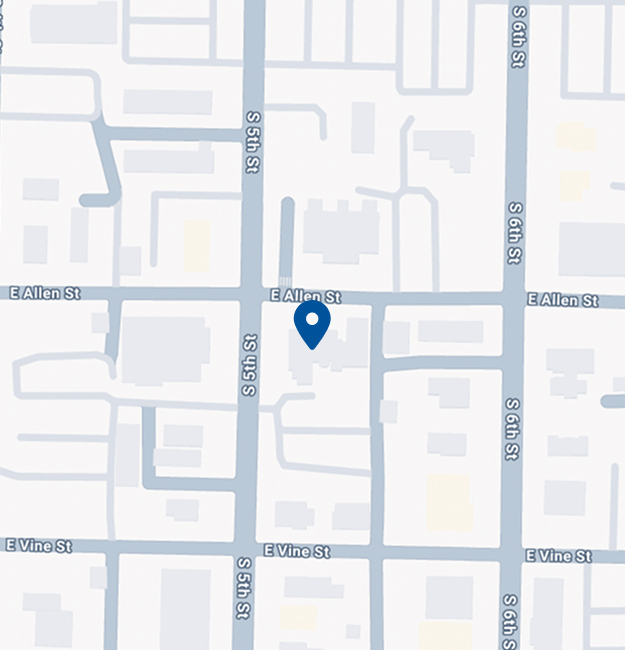
Address
Our offices are located at the corner of South Fifth Street and Vine, in the historic Mary Bryant Home for the Blind.