- Free Consultation: (217) 544-4057 Tap Here To Call Us








Illinois Graduated Driver Licensing: What Every Springfield Teen — and Their Parents — Needs to Know Before a Traffic Ticket Changes Everything


Last Reviewed & Updated: September 28, 2026
By: W. Scott Hanken | Former Sangamon County Prosecutor | Springfield Criminal Defense & Traffic Ticket Defense Attorney | Voted “Best Attorney” — Illinois Times Best of Springfield & State Journal-Register Reader’s Choice | Springfield, IL | Sangamon County | (217) 544-4057 | hankenlaw.com
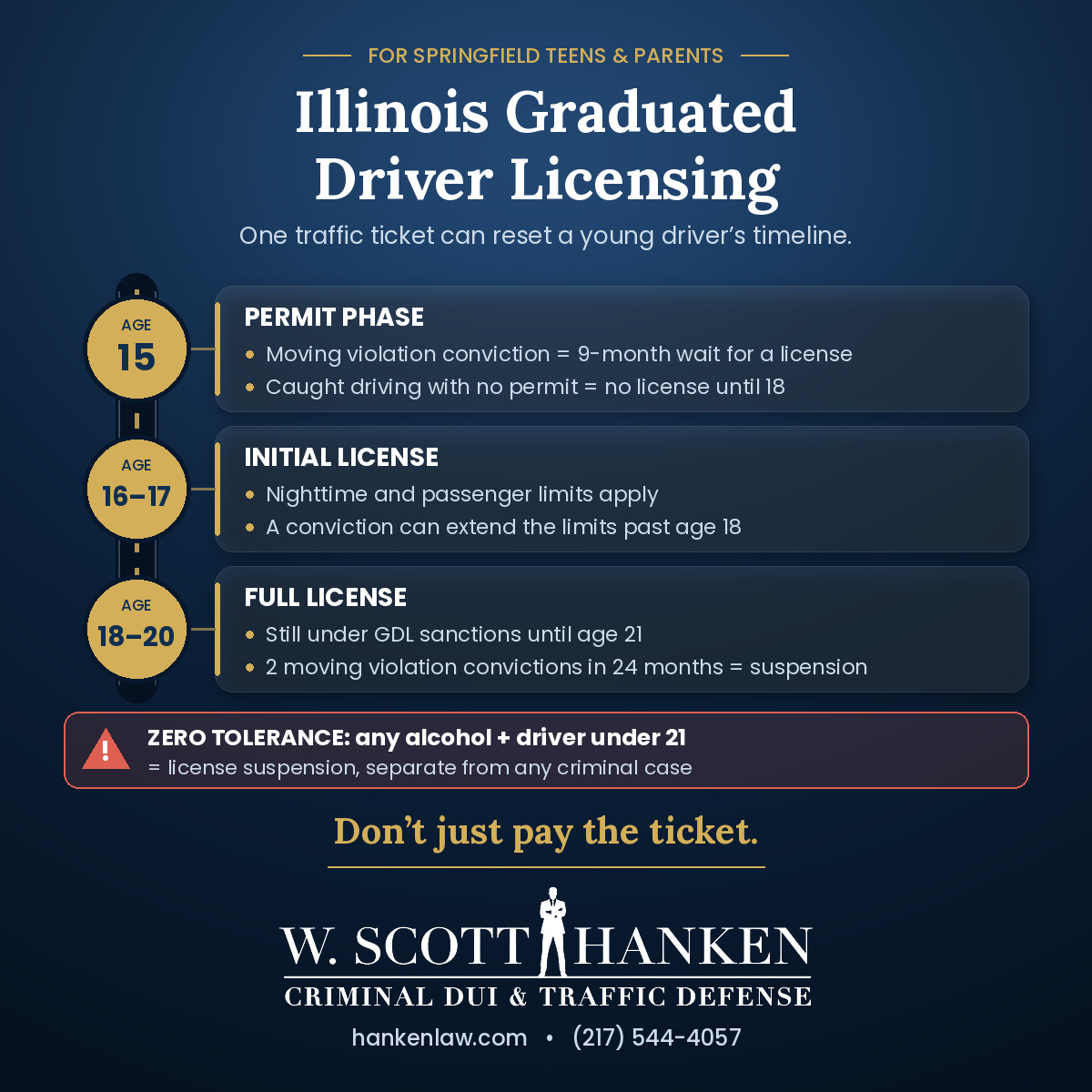
Bottom Line: Illinois holds drivers under 21 to a stricter standard than everyone else on the road. For a teen who doesn’t have a license yet, a single moving violation conviction pushes the license back nine months. For a licensed driver under 21, two moving violation convictions committed within 24 months can trigger a suspension — no matter how minor either ticket seemed. A Springfield teen traffic ticket is never “just a fine,” and paying it without a plan is usually the costliest option.
What Is Illinois’ Graduated Driver Licensing Program — and Who Does It Apply To?
Illinois’ Graduated Driver Licensing (GDL) program covers new drivers from the permit stage through age 20. The core statute is 625 ILCS 5/6-107. The legislature wrote the program’s purpose into the law itself: more practice time before licensing, stronger licensing standards for drivers under 21, and sanctions on the driving privileges of under-21 drivers who commit serious traffic violations.
The program has three phases, and a ticket carries different consequences in each one. Much of the enforcement happens under other statutes, including the Secretary of State’s suspension authority in 625 ILCS 5/6-206 and the court supervision rules in 730 ILCS 5/5-6-1. That’s why so many families are caught off guard by how a “simple” ticket plays out.
According to the Illinois Secretary of State, the program has been praised by traffic safety organizations nationwide since its 2008 overhaul. The Secretary of State summarizes the current rules on its Graduated Driver’s License page.
| Phase | Ages | Main Restrictions | What One Ticket Can Cost |
|---|---|---|---|
| Instruction Permit | Starts at 15 | Supervising adult 21+ in the front seat; nighttime limits; passenger limits; no phone use | A moving violation conviction delays the license 9 months; driving with no permit means no license until 18 |
| Initial Licensing | 16–17 | Nighttime limits; one passenger under 20 for the first 12 months; no phone use | A conviction can extend passenger limits — sometimes past 18 |
| Full Licensing | 18–20 | Phone ban until 19 | Two moving violation convictions within 24 months can mean suspension |
Phase One: The Instruction Permit (Starting at Age 15)
A 15-year-old enrolled in an approved driver education course can apply for an instruction permit. The teen needs a parent or guardian’s written consent and must pass vision and written tests. The permit is valid for 24 months, and a teen must hold it for at least nine months before applying for a license.
What the permit allows: Supervised driving only. The teen can drive with the driver education instructor, or practice with a parent, legal guardian, family member, or person in loco parentis. That supervising adult must be 21 or older, be licensed for the vehicle, have at least one year of driving experience, and sit in the seat beside the driver (625 ILCS 5/6-107.1).
What it restricts:
- Passengers: One person in the front seat, and no more back-seat passengers than there are seat belts. Every occupant must be buckled.
- Phones: Drivers under 19 may not use a cell phone while driving, even hands-free, except in an emergency. Texting while driving is prohibited for all drivers.
- Nighttime driving: The permit is invalid Sunday through Thursday from 10 p.m. to 6 a.m., and Friday and Saturday from 11 p.m. to 6 a.m. The statute makes exceptions. They include driving with a parent or guardian, running an errand at a parent’s direction without detours, traveling to or from work, emergencies, and traveling to or from an adult-supervised school, religious, or civic activity. Local curfew ordinances can differ.
- School attendance: A teen certified as a chronic or habitual truant can be denied a permit.
What happens after a ticket in the permit phase:
- Moving violation conviction: No license for nine months (625 ILCS 5/6-107(d)). The same nine-month delay applies to a conviction for violating the GDL rules or the under-18 seat belt law. It also applies to court supervision for underage alcohol offenses under the Liquor Control Act.
- Driving without a permit: A teen who drives without a valid license or permit can’t get a permit or license until age 18 (6-107(c)). The same bar applies to offenses that would require mandatory revocation and to certain drug offenses committed while driving.
- No hardship relief: Permit-phase drivers aren’t eligible for a hardship permit. A teen under 16 whose privileges are suspended or revoked can’t receive a restricted driving permit.
- Unresolved tickets block the license: Under what’s often called “Kelsey’s Law,” a teen under 18 can’t be issued a graduated license while any traffic citation is still pending (6-107(i)).
The permit phase is unforgiving. One conviction can push a teen’s license months down the road, and driving without a permit closes the door on early licensing entirely.
Phase Two: The Initial Licensing Phase (Ages 16–17)
To get a graduated license, a teen must be at least 16 and have:
- held a valid instruction permit for at least nine months;
- completed an approved driver education course;
- a parent or guardian’s written certification of at least 50 hours of supervised driving, including 10 at night;
- a parent or guardian’s written consent at the time of application;
- proof of school enrollment, graduation, or home instruction, with no chronic truancy; and
- no pending, unresolved traffic citation.
Phase Two restrictions include:
- Nighttime: The same 10 p.m. and 11 p.m. limits from the permit phase continue until 18.
- Passengers: For the first 12 months of licensing, or until 18 if that comes first, the driver may carry no more than one passenger under age 20. Siblings, step-siblings, children, and stepchildren of the driver don’t count toward that limit. After that period, the limit is one front-seat passenger and no more back-seat passengers than seat belts, until age 18.
- Phones and seat belts: The under-19 phone ban and the rule that every occupant must be buckled both continue.
The passenger can get a ticket, too. It’s a separate offense for a 15- to 19-year-old to ride with a first-year graduated license holder when another passenger under 20 is also in the car. The exception is when that other passenger is the driver’s sibling, step-sibling, child, or stepchild (6-107(h)). Many parents don’t know their teen can be cited just for getting into the wrong car.
What happens after a ticket in Phase Two?
- Warning letter: A moving violation conviction before age 18 triggers a Secretary of State warning letter to both the teen and the parents.
- Passenger limits extended: If the offense happened during the first 12 months of licensing and leads to a conviction, the passenger limit stays in place until the driver goes six consecutive months without another conviction.
- Restrictions past 18: If the offense happened in the six months before the teen’s 18th birthday and leads to a conviction, the passenger limits continue past 18. They last until six consecutive conviction-free months have passed.
- Nighttime violations: Driving during restricted hours can lead to a discretionary suspension (625 ILCS 5/6-206(a)(13)).
- The under-21 suspension rule applies here too: Two moving violation convictions within 24 months can mean a suspension, as explained below.
That matters more than most families expect. A ticket at 17 can follow a teen past their 18th birthday.
Parental consent — and parental cancellation. Drivers ages 16 and 17 need a parent or guardian’s written consent to hold a license. The parent or guardian who gave consent can withdraw it at any time, for any reason, until the teen turns 18. The Secretary of State will then cancel the license (625 ILCS 5/6-108). Driving privileges aren’t restored until that parent consents again or the teen turns 18, whichever comes first, and the teen must reapply and pay the required fees.
Phase Three: The Full Licensing Phase (Ages 18–20)
At 18, most age-based restrictions fall away, as long as the driver kept a conviction-free record for the six months before turning 18. The phone ban still lasts until 19. After that, young drivers follow the same hands-free-only rule as every other Illinois driver.
A young adult who didn’t take driver education in high school and applies for a first license between 18 and 20 must complete a six-hour adult driver education course first.
Here’s what most young drivers don’t know: the GDL framework doesn’t end at 18. Under 625 ILCS 5/6-206(a)(36), the Secretary of State may suspend the license of a driver who was under 21 at the time of arrest and has been convicted of two or more moving violations committed within any 24-month period. Every moving violation counts, not just the serious ones. Because the statute looks at age at the time of arrest (for a traffic ticket, the date the ticket was written), a ticket written at 20 can still count under the under-21 rule even if the conviction comes after the driver turns 21.
According to the Secretary of State:
- The suspension lasts at least one month. Its length depends on how serious the offenses were and on the driver’s prior record.
- Each additional moving violation after that suspension can bring another suspension (6-206(a)(44)).
- Getting the license back can require a driver remedial education course and retesting (6-206(c-5)), plus a reinstatement fee, which the Secretary of State lists as $70.
Being 19 and feeling like a “regular” driver doesn’t change any of this.
What Counts as a “Serious” Traffic Violation for Drivers Under 21?
Illinois defines “serious traffic violations” in 625 ILCS 5/1-187.001. The list includes:
- Reckless driving
- Speeding 26 mph or more over the limit
- Leaving the scene of a crash that damaged a vehicle, or failing to stop, exchange information, or give aid after a crash
- Illegally transporting or possessing alcohol in the passenger area of a vehicle
- Driving without a valid license or permit
- Passing in a no-passing zone, or driving on the left side of the road in a no-passing zone
- Failing to yield to a pedestrian at an intersection or on a sidewalk
- Failing to stop for an approaching train or railroad signals
- Backing up on a controlled-access highway
The court supervision rule. Court supervision is the usual way to keep a ticket from becoming a conviction. For serious violations by drivers under 21, it’s tightly limited. Supervision is available only if the young driver completes a court-approved traffic safety program. It isn’t available at all if the driver has already received supervision for a serious traffic violation (730 ILCS 5/5-6-1(h)). In practice, that means one supervision for a serious violation while under 21. A teen who uses it on a reckless driving ticket at 17 won’t have it for an aggravated speeding ticket at 19.
A separate rule applies at any age. A driver who has received supervision twice for moving violations in the 12 months before an arrest can’t get supervision a third time (5-6-1(k)).
What About Alcohol? Zero Tolerance and Other Under-21 Rules
Illinois has zero tolerance for drinking and driving under 21. Under 625 ILCS 5/11-501.8, a driver under 21 whose test shows any alcohol concentration above 0.00 faces a license suspension. Refusing the test brings a longer one. According to the Secretary of State’s Zero Tolerance guidance:
| Zero Tolerance Event | First Offense | Second Offense |
|---|---|---|
| Test shows alcohol above 0.00 | 3-month suspension | 1-year suspension |
| Refuses or fails to complete the test | 6-month suspension | 2-year suspension |
This suspension is administrative. The Secretary of State imposes it separately from any criminal case, so a plea deal in court doesn’t make it go away. If the test shows 0.08 or higher, or the officer has other evidence of impairment, the driver can also be charged with DUI under 625 ILCS 5/11-501, and those criminal penalties come on top of the suspension.
Driving relief during a Zero Tolerance suspension generally comes through a restricted driving permit (RDP). To get one, the driver must complete the Secretary of State’s Alcohol/Drug Education & Awareness Program and meet the other eligibility requirements. Families often ask about the Monitoring Device Driving Permit (MDDP) that adult first-time DUI offenders use. The MDDP is built around DUI statutory summary suspensions, and drivers under 18 aren’t eligible for it.
The zero-tolerance rules also reach beyond the driver’s seat:
- Alcohol offenses as a vehicle occupant: Court supervision for underage purchase, possession, or consumption of alcohol while in a motor vehicle, even as a passenger, brings a three-month suspension (6-206(a)(43)). A conviction brings a longer one: the Secretary of State lists six months for a first conviction and twelve months for a second.
- Transporting alcohol: A first conviction for illegally transporting alcohol while under 21 can result in a suspension (6-206(a)(33)).
- Teens not yet licensed: For an applicant under 18, court supervision for an underage alcohol offense also triggers the nine-month license delay (6-107(d)).
What Are the Real-World Consequences in Sangamon County When a Teen Gets a Ticket?
Most families assume a traffic ticket is just a fine. Pay it, move on.
That assumption is exactly what gets young drivers into trouble in Sangamon County traffic court.
One moving violation conviction won’t suspend a young driver’s license by itself. If the driver is under 18, it does trigger a warning letter to the teen and the parents. More importantly, it starts a 24-month clock. The next conviction for any moving violation committed within that window can mean a suspension.
I’ve worked with families in the Springfield area who didn’t realize the first ticket had started the clock. The second ticket comes in, and suddenly their teenager can’t drive to school or work. Outside Springfield’s bus routes, Sangamon County families have few alternatives to driving, and that loss hits hard and fast.
Is every ticket worth fighting? Not always. But for a driver under 21, the calculus is different. Even a “minor” violation carries long-term weight.
What Should You Do if Your Teen Gets a Traffic Ticket in Springfield or Sangamon County?
- Don’t just pay it. Paying a ticket is a guilty plea that results in a conviction. A teen under 18 can’t get court supervision by mail. Supervision generally requires the teen to appear in court in person, with a parent or guardian’s written consent (730 ILCS 5/5-6-1(n)), and the Secretary of State also requires traffic safety school.
- Find out what kind of ticket it is. Whether it’s a moving or non-moving violation, and whether it’s a “serious” violation, controls supervision eligibility, license timelines, and the long-term record.
- Check the calendar. The consequences depend on timing. Is the teen still in the permit phase? In the first 12 months of licensing? Within six months of turning 18? Is there another conviction in the last 24 months?
- Plan for court. For a teen under 18 seeking supervision, the teen and a parent should expect to attend in person. An attorney can find out whether supervision is realistic, negotiate with the prosecutor, and make that court date count. For drivers 18 to 20, an attorney can often appear on their behalf. See Can a Lawyer Handle a Traffic Ticket for Me in Sangamon County Court?
- Resolve it. Don’t let it linger. A pending ticket blocks a license for applicants under 18, and missing a court date creates its own problems.
- If alcohol is involved, act immediately. The Zero Tolerance suspension runs on its own timeline, separate from the court case.
For the full range of violations and what aggressive representation looks like in practice, see our Traffic Ticket Defense page.
Also be aware that seemingly minor things can set up a traffic stop in the first place. I recently wrote about how license plate covers and frames can get a driver pulled over [URL NEEDED]. It’s worth a read before handing the keys to a teenager.
Frequently Asked Questions (FAQs)
Often, yes, but the rules are stricter than for adults. A driver under 18 must generally appear in court in person, with a parent or guardian’s written consent, and complete traffic safety school. Supervision can’t be arranged by paying online or by mail. For a serious traffic violation, a driver under 21 must complete a traffic safety program and can receive supervision only once for a serious violation while under 21. No driver of any age can receive supervision for a moving violation after two supervisions in the prior 12 months.
If both tickets end in convictions for offenses committed within 24 months, the Secretary of State can suspend the license under 625 ILCS 5/6-206(a)(36). The Secretary of State sets a minimum suspension of one month, and the actual length depends on the violations and the driver’s record. The rule applies to every driver who was under 21 when ticketed, regardless of GDL phase. Turning 18 didn’t end it.
Yes, significantly. A first Zero Tolerance suspension lasts three months, or six months for a refused test. A second lasts one year, or two years for a refusal. The suspension is administrative and separate from any criminal case, so the court outcome doesn’t erase it. A family that focuses only on the criminal ticket can find the suspension in effect before anyone has dealt with it. A license suspended before age 21 also requires a driver remedial education course before reinstatement.
Yes. The parent or guardian who signed the consent for a driver under 18 can withdraw it at any time, for any reason, by contacting the Secretary of State, which will cancel the license. No court order is required. The teen can’t drive again until that parent restores consent or the teen turns 18, whichever comes first. The teen must then reapply and pay the required fees. Some parents use this proactively when a teen’s driving raises safety concerns.
Yes. During a driver’s first 12 months with a graduated license (or until that driver turns 18), it’s an offense for a passenger aged 15 to 19 to ride along when another passenger under 20 is also in the car. The exception is when that other passenger is the driver’s sibling, step-sibling, child, or stepchild.
It depends on age and phase. Permit-phase drivers aren’t eligible for hardship permits. A teen under 16 whose privileges are suspended or revoked can’t receive a restricted driving permit. Older young drivers may be able to apply for a restricted driving permit, depending on the reason for the suspension.
A suspension is temporary. It has a defined end date, and privileges can be reinstated when it ends once the reinstatement requirements are met, which for drivers under 21 can include remedial education and a fee. A revocation has no automatic end date. The driver must apply to the Secretary of State for reinstatement, usually through a hearing. Revocations can result from DUI convictions, mandatory-revocation offenses under 625 ILCS 5/6-205, or the Secretary of State’s discretionary authority under 625 ILCS 5/6-206. A cancellation, such as when a parent withdraws consent, voids the license until the teen reapplies.
FFurther Reading
Practice Area
Related Articles
- Illinois Zero Tolerance Law: The Complete Guide for Drivers Under 21 in Springfield & Sangamon County — if alcohol was involved, this covers the hearing, the timeline, and the permit options in depth.
- Can a Lawyer Handle a Traffic Ticket for Me in Sangamon County Court? — for 18- to 20-year-olds who want to know whether they have to miss work or class for court.
- Your Phone at a Red Light: Illinois’s Cell Phone Driving Law Explained — the under-19 phone ban is one of the easiest tickets for a teen to pick up.
- Aggravated Speeding in an Illinois Work Zone: Penalties and Why Court Supervision Is Off the Table — 26+ mph over is a serious violation, and this shows how fast supervision disappears.
- Missed a Traffic Court Date in Illinois? What Happens Next — an unresolved ticket can block a teen’s license, so read this before a court date slips by.
Browse by Topic
Ready to Fight Your Traffic Case in Springfield?
Call W. Scott Hanken at (217) 544-4057 or contact us online for a free consultation. We serve clients throughout Springfield, Sangamon County, and Central Illinois.
About the Author: W. Scott Hanken, Attorney at Law
Scott Hanken is a Springfield, Illinois criminal defense attorney with over 37 years of experience, including service as a former Sangamon County prosecutor. He has been voted Best Attorney by the Illinois Times and State Journal-Register, holds an Avvo 10.0 “Superb” rating, and has earned over 270 five-star Google reviews. He serves clients throughout Sangamon County and Central Illinois.
📍 1100 S 5th St, Springfield, IL 62703 | ☎ (217) 544-4057 | 🌐 hankenlaw.com
This article is for general educational purposes only and does not constitute legal advice. Every case is unique — contact an experienced Springfield criminal defense attorney for guidance on your specific situation.

Address
Our offices are located at the corner of South Fifth Street and Vine, in the historic Mary Bryant Home for the Blind.