- Free Consultation: (217) 544-4057 Tap Here To Call Us














Illinois CarPlay Video Law: When You Can Watch in the Car — and When It’s a Ticket


Last Reviewed & Updated: September 16, 2026
By: W. Scott Hanken | Former Sangamon County Prosecutor | Springfield Criminal Defense & Traffic Ticket Defense Attorney | Voted “Best Attorney” — Illinois Times Best of Springfield & State Journal-Register Reader’s Choice | Springfield, IL | Sangamon County | (217) 544-4057 | hankenlaw.com
Bottom Line: Apple released iOS 27 on September 14, 2026, and it lets video apps run on your car’s CarPlay screen. Illinois law has not changed to accommodate that. Video on the dash is lawful in Illinois only because Apple locks it to Park — the moment the car moves, two separate Illinois statutes come into play, one aimed at the screen in your dash and one aimed at the phone in your hand.
What Actually Changed in CarPlay
For more than a decade, Apple refused to allow video on a CarPlay display at all. That changed in two steps.
With iOS 26, Apple quietly opened a technical path called “AirPlay video in the car,” letting an iPhone send video to a compatible CarPlay screen. With iOS 27, Apple went further and began allowing developers to build CarPlay apps you can actually browse video in — so you can find something to watch on the car screen itself rather than picking it on your phone first. Apple’s CarPlay Developer Guide now includes a video app category and requires those apps to support AirPlay video streaming.
Two limits matter for Illinois drivers:
- Playback only works when the vehicle is parked. Apple built this in for safety reasons. If the system detects motion, video stops.
- Your automaker has to turn it on. Apple has said the feature works in new vehicles that support it, and as of this writing no manufacturer has publicly announced a specific model that does. Installing iOS 27 does not unlock video in a car whose infotainment system was never built for it.
So the practical situation in Springfield right now is that most drivers cannot use this even if they want to. That will change as new model years reach dealerships, which is exactly why it’s worth understanding the law before the hardware catches up.
Illinois Regulates Screens Twice, Not Once
Most people assume there’s one “distracted driving law” in Illinois. There are two, they cover different objects, and they carry different penalties. A single drive can violate both.
The Screen in Your Dash — 625 ILCS 5/12-604.1
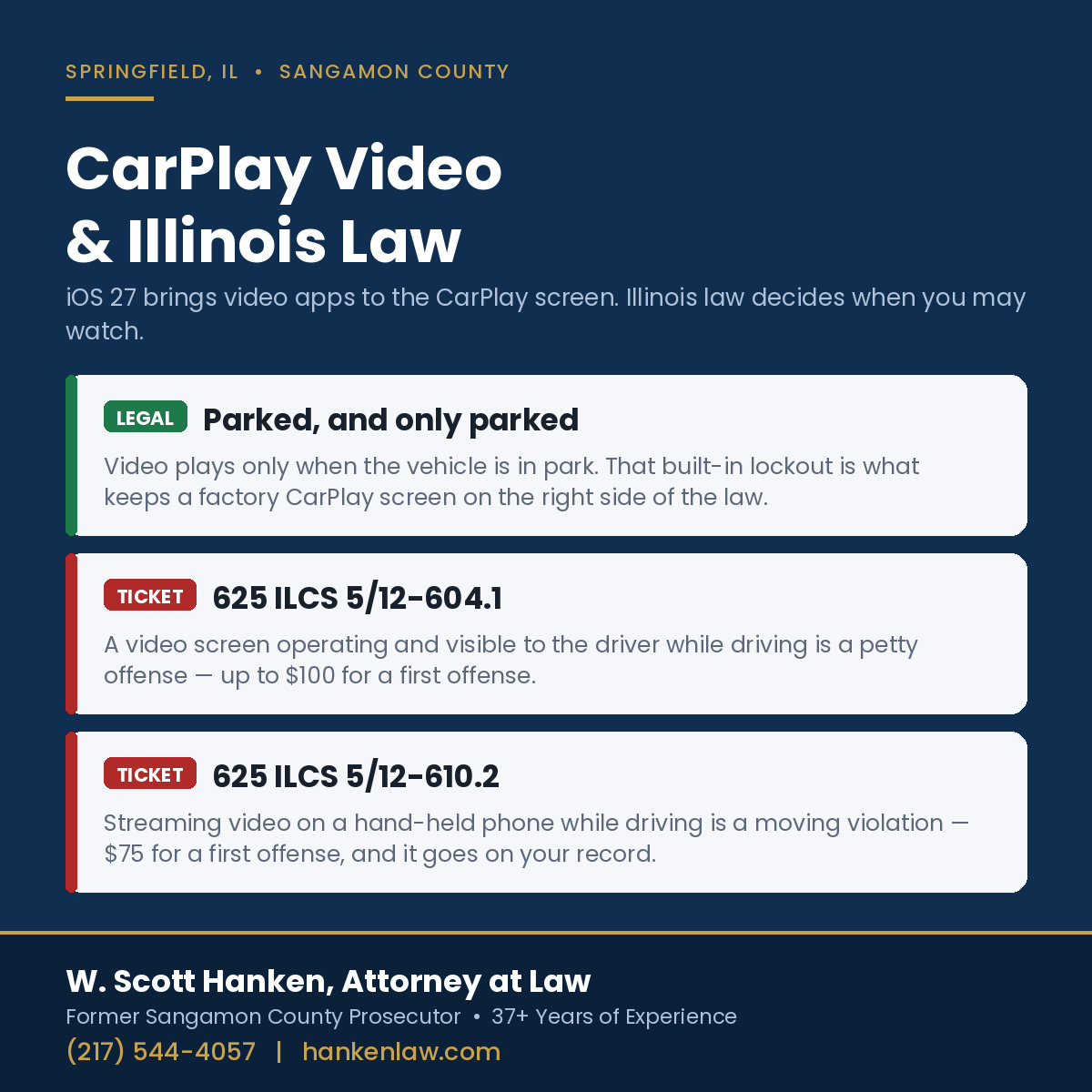
Section 12-604.1 makes it unlawful to operate a motor vehicle if a television receiver, video monitor, or video screen displaying entertainment content is operating anywhere forward of the back of the driver’s seat, or is operating and visible to the driver while driving.
That’s broad language, but the statute carves out most of what’s normally on a dash. It does not apply to a vehicle information display, a GPS or navigation display, a mapping display, or a display used to help you see around the vehicle — your backup camera is fine. It also does not apply to equipment with an interlock that disables entertainment functions while the vehicle is being driven, or to permanently installed equipment whose moving entertainment images are not visible to the driver while the vehicle is in motion.
A violation is a petty offense. The fine is capped at $100 for a first offense, $200 for a second within a year of a prior conviction, and $250 for a third or subsequent within a year of two prior convictions.
The Phone in Your Hand — 625 ILCS 5/12-610.2
Section 12-610.2 is the statute most people mean when they say “the cell phone law,” and since Public Act 103-0310 took effect on January 1, 2024, it says so explicitly: you may not operate a motor vehicle on a roadway while using an electronic communication device to watch or stream video, to join a video conferencing application, or to access a social media site.
Two details do real work here.
First, the statute’s hands-free and single-button exemptions — the ones that let you take a call — expressly do not apply when you’re streaming video, video conferencing, or on social media. Hands-free mode is not a defense to watching video.
Second, “electronic communication device” is defined to exclude a GPS or navigation system and to exclude a device that is physically or electronically integrated into the motor vehicle. That carve-out is why your factory dash screen is governed by 12-604.1 and your iPhone is governed by 12-610.2.
A violation is an offense against traffic regulations governing the movement of vehicles — a moving violation. Fines run $75 for a first offense, $100 for a second, $125 for a third, and $150 for a fourth or subsequent.
Why the “Park Only” Lockout Is the Whole Ballgame
Read those two statutes together and Apple’s design choice looks less like caution and more like compliance.
A CarPlay screen showing a movie while you’re rolling down MacArthur Boulevard is a video screen operating and visible to the driver while driving. What keeps a factory installation lawful is precisely the thing Apple built in: the entertainment images aren’t visible to the driver while the vehicle is in motion, and the system disables them when you shift out of Park. That’s the shape of the exemptions in 12-604.1.
Defeat the lockout and you’ve removed the exemption. That matters, because a market already exists for exactly that.
Aftermarket Adapters Are Where Drivers Get Hurt
Search for CarPlay video and you’ll find dongles and adapters promising YouTube and Netflix on your dash with no park restriction. They are sold openly and they work.
In Illinois, using one while driving puts you outside the interlock and not-visible-while-moving exemptions that protect a factory system. The screen is operating, it’s forward of the driver’s seat, and it’s showing entertainment. That is the conduct 12-604.1 describes.
And because these devices usually stream from your phone, an officer who sees a movie on your dash has a reasonable basis to believe your phone is involved too. That is a plausible two-citation stop.
A practical note: none of this is a problem when you’re parked. Waiting in a school pickup line in Park, charging an EV, killing twenty minutes before an appointment — watch whatever you want. The statutes are about operating and driving.
When a Ticket Becomes a Criminal Charge
Both statutes have aggravated versions, and they escalate sharply.
Illinois recognizes aggravated use of a video device under 12-604.1 and aggravated use of an electronic communication device under 12-610.2. Each applies when the driver violates the underlying prohibition, is involved in a crash causing great bodily harm, permanent disability, disfigurement, or death to another person, and the violation is a proximate cause of that injury or death.
The classification is the same under both statutes:
- Class A misdemeanor where the crash caused great bodily harm, permanent disability, or disfigurement
- Class 4 felony where the crash caused a death
A driver charged with aggravated use of an electronic communication device also faces a minimum $1,000 fine.
This is the reason a screen case is not automatically a minor case. A fender bender on a wet Sangamon County road that would otherwise be a property-damage exchange becomes a criminal matter if someone is seriously hurt and a prosecutor can tie it to a screen.
What a Conviction Costs Beyond the Fine
The $75 is rarely what hurts.
A conviction under 12-610.2 is a moving violation, which means it is reported to the Secretary of State and enters your driving record. Accumulated moving-violation convictions can put your license at risk, and insurers price them accordingly. Court supervision, where a judge grants it, holds the case open and — if you complete the conditions — closes it without a conviction ever being entered, which is why supervision is so often the objective in these cases.
Commercial drivers face a different calculation entirely. For a CDL holder, supervision does not provide the same protection it gives an ordinary driver, and distracted-driving convictions carry consequences a passenger-car driver never sees. If you hold a CDL, treat any screen citation as serious from the first phone call.
What the Numbers Actually Show
The Illinois Department of Transportation reports that 253 people died and 28,271 were injured in crashes involving distractions in Illinois between 2020 and 2024. In 2024 alone, 51 people were killed in crashes involving at least one distracted driver — 4.3% of all Illinois traffic fatalities that year.
Nationally, the National Highway Traffic Safety Administration counted 3,208 people killed and an estimated 315,167 injured in distraction-affected crashes in 2024.
IDOT and the Illinois State Police run enforcement waves specifically targeting texting, social media use, and video viewing. Officers are looking for this.
Frequently Asked Questions (FAQs)
Yes — while parked. Illinois law prohibits a video screen from operating and being visible to the driver while driving, and prohibits streaming video on a hand-held device while operating a vehicle on a roadway. Neither applies to a parked car. CarPlay’s park-only restriction is what keeps the feature on the right side of both statutes.
Not under 12-604.1, as long as the screen isn’t forward of the back of the driver’s seat and isn’t visible to you while you’re driving. Rear-seat entertainment systems are common and lawful for that reason. The problem arises when the display is on the dash.
No. The hands-free and single-button exemptions in 12-610.2 expressly do not apply when the device is being used to watch or stream video, join a video conference, or access social media.
A red light is not the same as parked. The statute’s narrow exemptions cover using a device while parked on the shoulder of a roadway, and while stopped because normal traffic is obstructed with the transmission in neutral or park. Sitting at a signal on Sixth Street is not in that list.
A single first offense will not. But a 12-610.2 conviction is a moving violation that goes on your driving record, and accumulated moving-violation convictions can lead to a suspension. That is the main reason to fight the ticket rather than pay it.
Then nothing changes for you yet. Apple has opened the door, but each manufacturer decides whether to walk through it, and no specific models have been publicly confirmed. The law described here applies regardless — including to the aftermarket adapters some drivers use to get around the restriction.
Further Reading
Practice Area
Related Articles
- Your Phone at a Red Light: Illinois’s Cell Phone Driving Law Explained — the full cost breakdown of a 12-610.2 ticket, including the insurance surcharge and why supervision won’t save a CDL.
- What to Do During a Traffic Stop in Illinois: A Step-by-Step Guide — what to say and what to hand over if you’re pulled over for something an officer saw on your screen.
- Illinois Improper Lane Usage: What the Law Actually Says, What It Costs, and Why You Should Fight It — the charge that usually gets stacked on when a distracted driver drifts.
- Traffic Ticket from a Fender Bender in Springfield? Here’s What Actually Happens Next — what to expect when a screen citation comes with a crash report attached.
Browse by Topic
Ready to Fight Your Traffic Case in Springfield?
Call W. Scott Hanken at (217) 544-4057 or contact us online for a free consultation. We serve clients throughout Springfield, Sangamon County, and Central Illinois.
About the Author: W. Scott Hanken, Attorney at Law
Scott Hanken is a Springfield, Illinois criminal defense attorney with over 37 years of experience, including service as a former Sangamon County prosecutor. He has been voted Best Attorney by the Illinois Times and State Journal-Register, holds an Avvo 10.0 “Superb” rating, and has earned over 270 five-star Google reviews. He serves clients throughout Sangamon County and Central Illinois.
📍 1100 S 5th St, Springfield, IL 62703 | ☎ (217) 544-4057 | 🌐 hankenlaw.com
This article is for general educational purposes only and does not constitute legal advice. Every case is unique — contact an experienced Springfield criminal defense attorney for guidance on your specific situation.
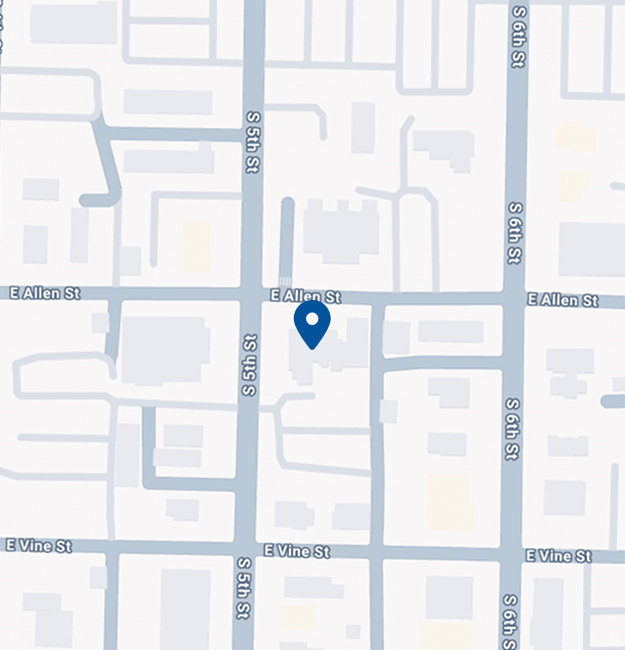
Address
Our offices are located at the corner of South Fifth Street and Vine, in the historic Mary Bryant Home for the Blind.