- Free Consultation: (217) 544-4057 Tap Here To Call Us
















Illinois Gambling Laws: Card Games, Bookies & Forfeiture


Last Reviewed & Updated: November 9, 2026
By: W. Scott Hanken | Former Sangamon County Prosecutor | Springfield Criminal Defense Attorney | Voted “Best Attorney” — Illinois Times Best of Springfield & State Journal-Register Reader’s Choice | Springfield, IL | Sangamon County | (217) 544-4057 | hankenlaw.com
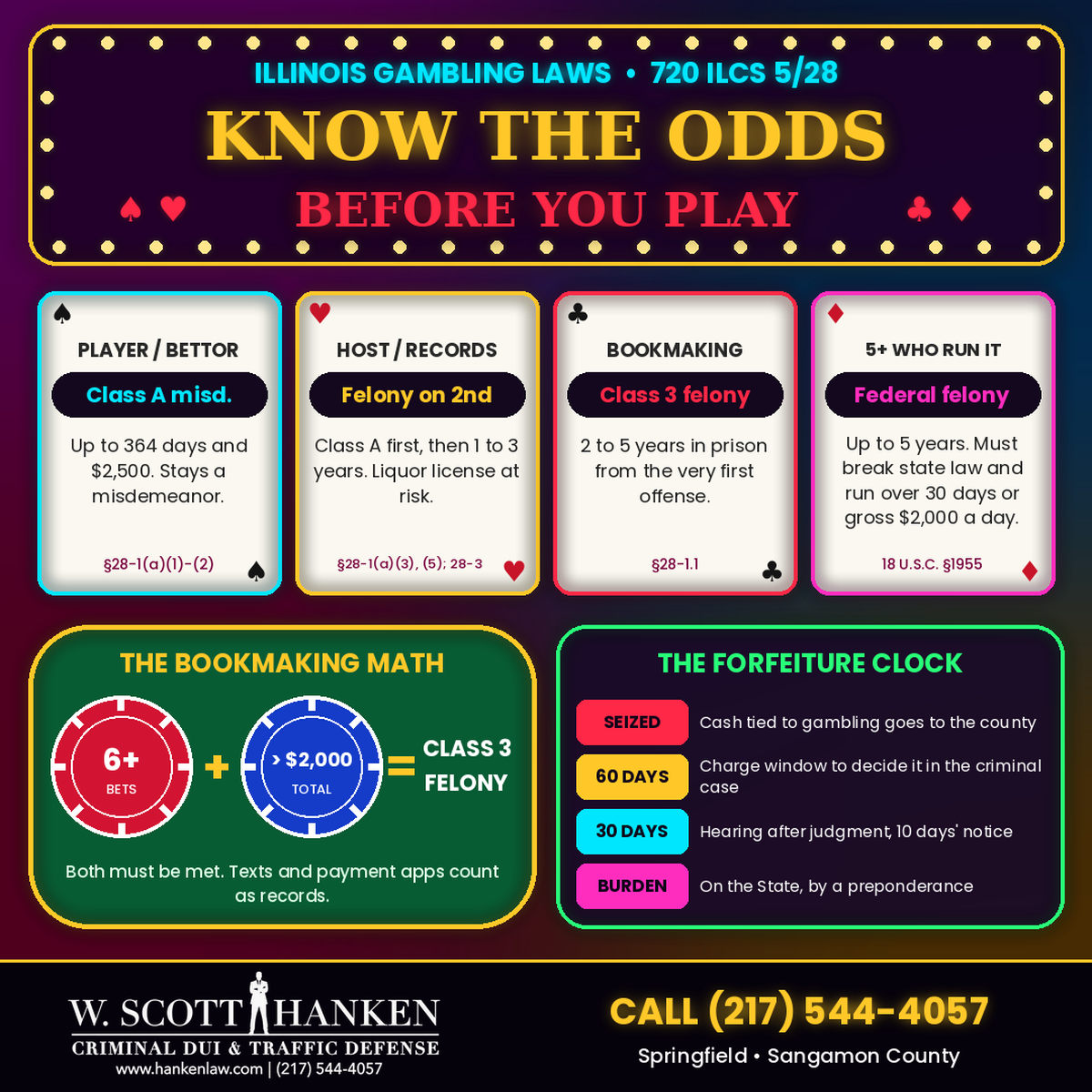
Playing cards or dice for money outside a licensed casino, video gaming location, or sportsbook is a Class A misdemeanor in Illinois. Taking more than five bets totaling over $2,000 is bookmaking, a Class 3 felony. Police can also seize the cash on the table, and the county can keep it if the State proves the money was tied to the gambling.
Bottom Line: If you were caught in a backyard poker game or a street dice game, you are most likely facing a misdemeanor, and court supervision is often a realistic outcome. The stakes rise sharply if you hosted the game, took a cut, held the bet records, or have a prior gambling conviction. Separately from the criminal case, the State can try to keep your seized money under 720 ILCS 5/28-5, and that fight has its own deadlines.
Key Takeaways:
- Playing in an illegal poker or dice game is a Class A misdemeanor in Illinois, punishable by up to 364 days in jail and a $2,500 fine.
- Simply playing or betting never becomes a felony, even on a repeat conviction.
- Holding bet records or money received from bets, or keeping a gambling device, becomes a Class 4 felony on a second conviction. Hosting the game is a Class 4 felony for every offense after the first.
- Bookmaking, more than five bets totaling over $2,000, is a Class 3 felony from the first offense.
- Police can seize cash “integrally related” to gambling, but the State must prove that connection at a forfeiture hearing.
Is It Illegal to Play Poker or Dice for Money in Illinois?
Yes. Illinois makes it a crime to knowingly play any game of chance or skill for money, and it has no exception for friendly or social games. A kitchen-table poker game in Springfield and a dice game in a parking lot are treated the same way. Only state-licensed gaming and a few narrow exceptions are lawful.
The governing statute is 720 ILCS 5/28-1, last amended by P.A. 104-468, effective June 16, 2026. Subsection (a)(1) makes it a crime to knowingly play a game of chance or skill for money or anything of value. Notice the words “or skill.” Illinois does not let you off the hook by arguing poker is a skill game. The statute covers both.
Statute Callout — 720 ILCS 5/28-1(a)(1) and (c):
“A person commits gambling when he or she: (1) knowingly plays a game of chance or skill for money or other thing of value, unless excepted in subsection (b) of this Section.”
“Gambling is a Class A misdemeanor. A second or subsequent conviction under subsections (a)(3) through (a)(12), is a Class 4 felony.”
The exceptions in subsection (b) are narrow and mostly cover state-licensed activity: the Illinois Lottery, licensed casinos, video gaming terminals at licensed establishments, sports wagering and fantasy contests under the Sports Wagering Act, licensed bingo, raffles and poker runs conducted under the Raffles and Poker Runs Act, and charitable games. One exception matters for home games: subsection (b)(13) exempts games where money can be won but no payment or purchase is required to play. A free-entry tournament where the host puts up a prize is lawful. A $20 buy-in game is not.
What Is the Penalty for Getting Caught in an Illegal Card Game or Dice Game?
A player caught in an illegal card game or dice game in Illinois faces a Class A misdemeanor. The maximum is 364 days in jail and a $2,500 fine, and probation or conditional discharge can run up to 2 years. For players, the charge stays a misdemeanor no matter how many prior gambling cases you have.
The sentencing range comes from 730 ILCS 5/5-4.5-55, which sets a jail term of “less than one year.” In practice, that means 364 days.
Here is a point most people miss. The felony enhancement in subsection (c) of Section 28-1 applies to second convictions under (a)(3) through (a)(12). It does not apply to (a)(1), simply playing, or (a)(2), placing a wager. A player charged under (a)(1) is facing a misdemeanor even on a second or third case. Class A gambling charges in the Sangamon County Circuit Court are generally eligible for court supervision, which avoids a conviction if you complete it.
Can a Gambling Charge Become a Felony in Illinois?
Yes. Holding bet records or money received from bets, and keeping a gambling device, become a Class 4 felony on a second conviction, punishable by 1 to 3 years in prison. Hosting an illegal game is a Class 4 felony for every offense after the first. Bookmaking is a Class 3 felony from the very first offense. Which subsection the State charges often decides whether you face a misdemeanor or a felony.
Subsection (a)(5) covers anyone who knowingly owns or possesses a book or apparatus used to record bets, or who knowingly possesses money received in the course of a bet or wager. Subsection (a)(3) covers keeping or using a gambling device. A second conviction under either is a Class 4 felony: 1 to 3 years in prison (3 to 6 years extended term), with probation of up to 30 months available under 730 ILCS 5/5-4.5-45.
This matters because charging is a prosecutor’s choice. The same person caught at the same table can be charged under (a)(1) as a player, which never becomes a felony, or under (a)(5) for holding winnings received from bets, which does. If you have a prior gambling conviction, which subsection the State picks may be the single most important fact in your case.
What Counts as Bookmaking in Illinois?
Bookmaking in Illinois means knowingly accepting more than five bets that together total more than $2,000. It is charged as syndicated gambling, a Class 3 felony punishable by 2 to 5 years in prison. Both thresholds must be met, and the statute counts bets no matter how they are recorded, including texts, apps, and spreadsheets.
Statute Callout — 720 ILCS 5/28-1.1(d) and (f), last amended by P.A. 101-31, effective June 28, 2019:
“A person engages in bookmaking when he or she knowingly receives or accepts more than five bets or wagers upon the result of any trials or contests of skill, speed or power of endurance or upon any lot, chance, casualty, unknown or contingent event whatsoever, which bets or wagers shall be of such size that the total of the amounts of money paid or promised to be paid to the bookmaker on account thereof shall exceed $2,000. Bookmaking is the receiving or accepting of bets or wagers regardless of the form or manner in which the bookmaker records them.”
“Syndicated gambling is a Class 3 felony.”
Six bets totaling $1,900 is not bookmaking. Neither is four bets totaling $5,000. The statute text sets no time window for counting the bets, so the way the State groups them is often the first thing to challenge.
The final sentence of subsection (d) closes an old loophole. Bets recorded in a group text, a payment app, a spreadsheet, or a notebook all count. A Class 3 felony carries 2 to 5 years in prison (5 to 10 years extended term) under 730 ILCS 5/5-4.5-40, with probation of up to 30 months available.
The legislature declared in subsection (a) that the section exists to restrain the business of gambling for profit and must be “liberally construed” to that end. Expect prosecutors to read it broadly.
Can I Be Charged Federally for Running a Betting Operation?
Yes, if the operation is large enough. Federal law makes it a felony, punishable by up to 5 years in federal prison, to run an illegal gambling business. The business must break state law, involve five or more people who conduct, finance, manage, supervise, direct, or own it, and either operate substantially continuously for more than 30 days or take in $2,000 in gross revenue in a single day.
The statute is 18 U.S.C. § 1955. Bettors do not count toward the five; the people who run, staff, or bankroll the operation do. The statute’s examples of gambling include bookmaking, pool-selling, and dice tables, and the list is not exhaustive. A Springfield sports book with a few runners and collectors can cross that line faster than most people expect.
What Happens If I Host an Illegal Card Game?
The person who hosts the game faces a separate charge for keeping a gambling place: a Class A misdemeanor the first time and a Class 4 felony for each later offense. If a court finds the property is a gambling place, any food or liquor license there is voided and the property can be sold to pay gambling fines.
The statute is 720 ILCS 5/28-3, last amended by P.A. 102-558, effective August 20, 2021. It reaches anyone who knowingly allows property they own, occupy, or control to be used for illegal gambling. “Gambling place” is broad: real estate, a vehicle, a boat, or any other property. Your house, garage, and car all qualify.
Once a circuit court finds a premises is a gambling place, three consequences follow:
- The premises is a public nuisance and can be proceeded against as one.
- Every state or local license to serve food or liquor at the premises is void. It cannot be reissued for 60 days, the convicted person cannot get one for 1 year, and after a second conviction the person cannot be reissued one at all.
- The premises can be sold to pay any unpaid judgment or fine under the gambling article.
For a Springfield bar or restaurant owner who allows a back-room card game, the liquor license consequence can be worse than the criminal penalty. A business can survive a fine. It may not survive losing its license.
Can Police Take the Money on the Table at an Illegal Game?
Yes. Illinois law lets police seize gambling devices and any money “integrally related” to gambling, and the money is forfeited to the county where it was seized. The State must prove that connection by a preponderance of the evidence at a forfeiture hearing, and the process follows strict deadlines tied to whether and when charges are filed.
Statute Callout — 720 ILCS 5/28-5, last amended by P.A. 102-558, effective August 20, 2021
Here is how the forfeiture process works in a Sangamon County case:
- Seizure. Police seize the gambling devices and the cash connected to the gambling.
- The 60-day window. If a person with a property interest in the seized items is charged within 60 days of the seizure, the forfeiture is decided inside the criminal case.
- The hearing. Within 30 days after judgment on that charge, the court holds a forfeiture hearing. The State must file a written petition and mail notice by certified mail at least 10 days before the hearing to everyone it believes has an interest in the property.
- The burden. The State must prove forfeiture by a preponderance of the evidence. That is a lower bar than proof beyond a reasonable doubt, but the burden stays on the State.
- No charge filed. If nobody is charged, or the case is dropped without a conviction or acquittal, the State’s Attorney must bring a separate civil (in rem) proceeding against the property itself. Owners can bring their own civil action to get it back.
Two details matter in practice. First, devices get some protection: apart from a device that has no lawful use, a gambling device cannot be forfeited unless someone with a property interest knew of the unlawful use. Second, cash only goes if it was “integrally related” to gambling. Money in your wallet is not automatically gambling money because you were sitting at the table. The State has to connect it.
Subsection (h) makes property seized or forfeited under Section 28-5 subject to the Illinois Seizure and Forfeiture Reporting Act (5 ILCS 810), which requires agencies to report what they take. The exemptions in subsections (e), (f), (g), and (i) cover only certain licensed casino equipment, video gaming terminals, and sports lottery terminals while they are offered for sale, used for training, or out for repair. They do nothing for a private card or dice game.
Can Police Search My Phone After a Gambling Arrest?
Generally, not without a warrant. The U.S. Supreme Court has held that police need a warrant to search the digital contents of a phone seized during an arrest. That matters in gambling cases because bets now live in text messages and payment apps, so an unlawful phone search can be the key to suppressing the State’s evidence.
The case is Riley v. California, 573 U.S. 373 (2014). If officers scrolled through your texts at the scene without a warrant or valid consent, that evidence may be subject to suppression in the Sangamon County Circuit Court. For more on how warrant rules apply to digital surveillance, see Do Police Need a Warrant to Search Flock Data in Illinois?
What If…? Conditional Questions Sangamon County Defendants Ask
What if I was only a player and never ran the game?
A player is charged under 720 ILCS 5/28-1(a)(1) or (a)(2), both Class A misdemeanors that stay misdemeanors on later convictions under subsection (c). In Sangamon County, the practical question is whether the State charged you as a player or under (a)(5) for holding bet money or records. If it is the latter and you have a prior, the case may be a felony, and the defense often starts with whether you actually “received” money “in the course of a bet.”
What if it was a friendly home game with a small buy-in?
The size of the stakes does not change the charge. Section 28-1 contains no dollar threshold for players and no social game exception. The only home-game safe harbor is subsection (b)(13): no payment or purchase required to play. A $5 buy-in game is technically illegal. Whether a Springfield prosecutor would spend resources on it is a different question.
What if poker is a game of skill?
Illinois’ playing prohibition covers games of chance “or skill,” so the argument does not defeat a charge under (a)(1) on its face. The Illinois Supreme Court did adopt a “predominant factor” test in Dew-Becker v. Wu, 2020 IL 124472, holding that head-to-head daily fantasy sports contests were predominantly skill-based and fit the bona fide skill contest exception in subsection (b)(2). That decision dealt with fantasy sports in a civil lawsuit, not a cash poker game in a criminal case, and Illinois now regulates fantasy contests under the Sports Wagering Act. Arguing that a private cash game qualifies as a “bona fide contest for the determination of skill” would be an uphill, untested position.
What if I took bets on football but stayed under $2,000?
You are not a bookmaker under Section 28-1.1, but you are not in the clear. Accepting and recording bets still fits 28-1(a)(5), and possibly (a)(6) for selling pools. That is a Class A misdemeanor the first time and a Class 4 felony on a second conviction.
What if police seized my cash but never charged me?
The State’s Attorney must file a separate civil forfeiture case against the money under 28-5(d). You have the right to contest it and to bring your own civil action to recover property. Do not assume the money is gone, and do not ignore any notice you receive.
How Do Illinois Gambling Penalties Compare?
Illinois gambling offenses, statutes, classifications, and sentencing ranges as of November 2026:
| Conduct | Statute | Classification | Possible Sentence |
|---|---|---|---|
| Playing cards or dice for money | 720 ILCS 5/28-1(a)(1) | Class A misdemeanor, every conviction | Up to 364 days jail; up to $2,500 fine; up to 2 years probation |
| Placing a bet on a game or election | 720 ILCS 5/28-1(a)(2) | Class A misdemeanor, every conviction | Same as above |
| Holding bet records or money from bets | 720 ILCS 5/28-1(a)(5) | Class A misdemeanor; Class 4 felony on second | 1 to 3 years prison (felony); probation up to 30 months |
| Keeping a gambling device | 720 ILCS 5/28-1(a)(3) | Class A misdemeanor; Class 4 felony on second | Same as above |
| Hosting (keeping a gambling place) | 720 ILCS 5/28-3 | Class A misdemeanor; Class 4 felony on each subsequent offense | Plus liquor/food license voided; premises can be sold for fines |
| Bookmaking (more than 5 bets, over $2,000) | 720 ILCS 5/28-1.1 | Class 3 felony | 2 to 5 years prison (5 to 10 extended); probation up to 30 months |
| Illegal gambling business (5+ people running it) | 18 U.S.C. § 1955 | Federal felony | Up to 5 years federal prison |
How Do You Fight a Gambling Charge in Sangamon County?
The strongest defenses to an Illinois gambling charge usually come from the facts, not the statute. The State must prove you acted knowingly, that no exception applies, that the bookmaking numbers add up, and that the evidence was lawfully obtained. The charging subsection itself is often negotiable, which can turn a felony exposure into a misdemeanor.
- Knowledge. Every subsection requires that you acted “knowingly.” A guest who did not know money was changing hands, or a homeowner who did not know a game was happening, has a real defense.
- The exceptions. Licensed raffles, charitable games, poker runs, and free-entry contests are lawful. If the event was properly licensed, it is not gambling.
- The numbers. In a bookmaking case, the State must prove more than five bets and more than $2,000. Challenge how it counted.
- The search. Gambling arrests often start with a raid or a phone search. Unlawful entry or a warrantless phone search can knock out the core evidence.
- The charging subsection. Pushing a case from (a)(5) to (a)(1) can be the difference between a felony and a misdemeanor.
Frequently Asked Questions (FAQs)
Yes, if players pay to play and can win money. Illinois has no social gambling exception. A home game is only lawful if no payment or purchase is required to participate.
Technically, yes. A Class A misdemeanor carries up to 364 days in jail. Court supervision, which avoids a conviction, is generally available for a Class A gambling charge.
Not under the playing provision. Section 28-1(a)(1) requires that you knowingly play for money. Simply being present is not playing, though the State may argue you held bet money or helped run the game, which are separate charges.
They can seize it, but the county can only keep money “integrally related to acts of gambling.” Cash in your pocket is not automatically gambling money. The State must prove the connection by a preponderance of the evidence.
Accepting more than five bets that total more than $2,000. That is syndicated gambling, a Class 3 felony punishable by 2 to 5 years in prison.
Not automatically. If no conviction or acquittal results, the State’s Attorney must file a separate civil forfeiture case, and you can contest it or file your own action. The State must show the money was integrally related to gambling.
Yes. Making a wager on the result of any game or contest outside a licensed sportsbook is gambling under 720 ILCS 5/28-1(a)(2), a Class A misdemeanor.
Not if it is conducted under the Raffles and Poker Runs Act or the Charitable Games Act. Both are listed exceptions in Section 28-1(b). An unlicensed event does not get that protection.
Yes. If a court finds the premises is a gambling place, every food and liquor license for that location is void, cannot be reissued for 60 days, and the convicted person cannot hold one for 1 year.
It depends on the subsection. A second conviction for simply playing or betting stays a misdemeanor. A second conviction for holding bet money or records or using a gambling device is a Class 4 felony, and so is any repeat offense of hosting a gambling place.
Further Reading
Related Articles
- New Illinois Law on Gambling Disorder: What It Means for Criminal Charges — For when gambling losses have turned into theft or fraud charges.
- Can Police Force You to Unlock Your Phone in Sangamon County? Face ID, Passcodes & Your Rights — What to do when officers want into the phone that holds your bet texts.
- Evidence Tampering in Illinois: Deleted Texts, Hidden Guns — Why deleting the group chat after a raid can create a second, worse charge.
- Entrapment Defense in Illinois: What Actually Works — For anyone who took a bet from an undercover officer.
- The Law of Accountability in Illinois: A Complete Springfield IL Guide to 720 ILCS 5/5-2, Real-World Examples, and Defenses — How you can be charged for “helping run” a game you never organized.
Browse by Topic
Ready to Fight Your Criminal Charge in Springfield?
Call W. Scott Hanken at (217) 544-4057 or contact us online for a free consultation. We serve clients throughout Springfield, Sangamon County, and Central Illinois.
About the Author: W. Scott Hanken, Attorney at Law
Scott Hanken is a Springfield, Illinois criminal defense attorney with over 37 years of experience, including service as a former Sangamon County prosecutor. He has been voted Best Attorney by the Illinois Times and State Journal-Register, holds an Avvo 10.0 “Superb” rating, and has earned over 270 five-star Google reviews. He serves clients throughout Sangamon County and Central Illinois.
📍 1100 S 5th St, Springfield, IL 62703 | ☎ (217) 544-4057 | 🌐 hankenlaw.com
This article is for general educational purposes only and does not constitute legal advice. Every case is unique — contact an experienced Springfield criminal defense attorney for guidance on your specific situation.

Address
Our offices are located at the corner of South Fifth Street and Vine, in the historic Mary Bryant Home for the Blind.