- Free Consultation: (217) 544-4057 Tap Here To Call Us
















Is It Illegal to Drive With Earbuds in Illinois?


Last Reviewed & Updated: November 23, 2026
By: W. Scott Hanken | Former Sangamon County Prosecutor | Springfield Criminal Defense & Traffic Ticket Defense Attorney | Voted “Best Attorney” — Illinois Times Best of Springfield & State Journal-Register Reader’s Choice | Springfield, IL | Sangamon County | (217) 544-4057 | hankenlaw.com
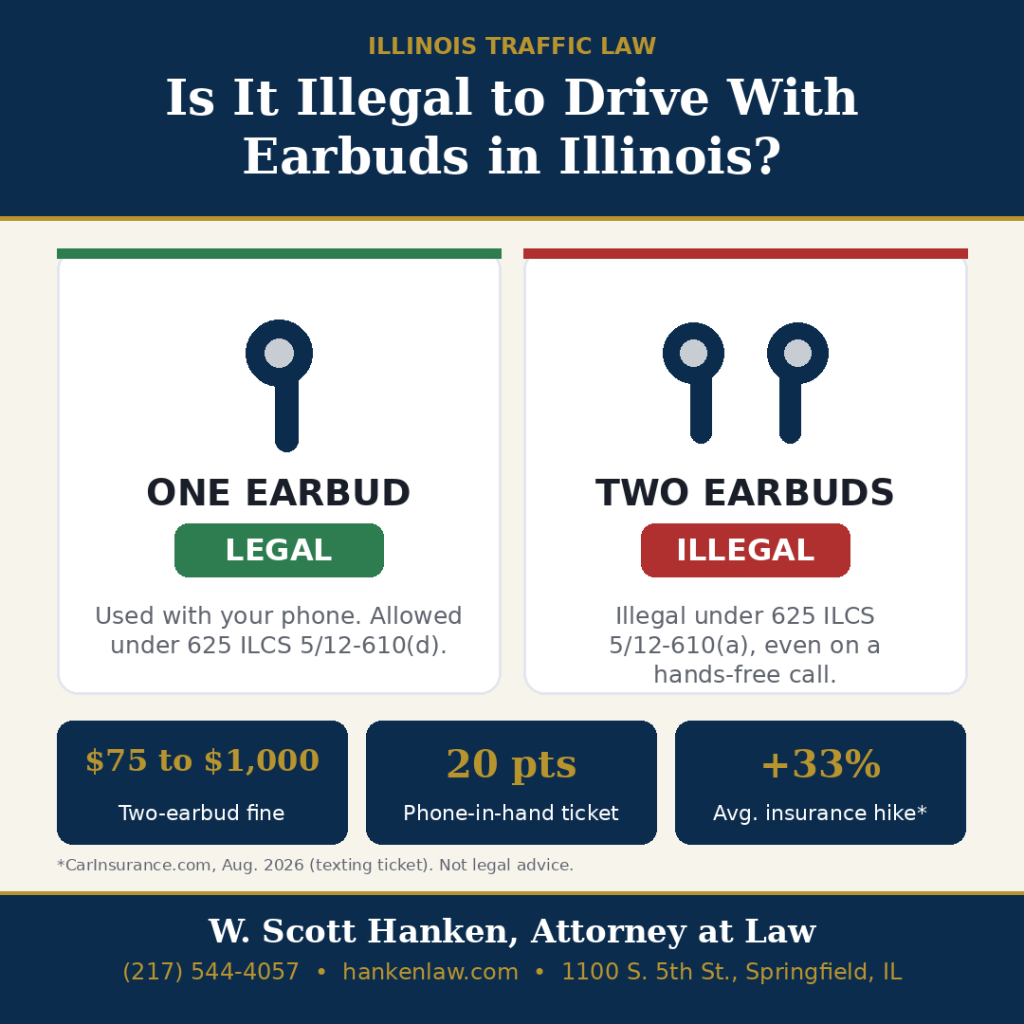
Yes, if both ears are covered. Illinois law bars drivers from wearing headset receivers, so earbuds in both ears are illegal behind the wheel. The only cell phone exception is a single earbud. Two earbuds can bring a fine, and adding a hand-held phone creates a moving violation.
Bottom Line: One earbud for a phone call is legal for most adult drivers. Two earbuds are not, whether you are listening to music, a podcast, or a hands-free call. The earbud ticket itself is usually a fine-only petty offense. The phone ticket that often comes with it carries 20 points, counts toward a license suspension, and is the kind of entry insurers price into your premium.
Key Takeaways:
- Earbuds in both ears violate 625 ILCS 5/12-610, no matter what you are listening to.
- One earbud used with a cell phone is expressly allowed.
- A headset ticket is a petty offense with a fine of $75 to $1,000. A third conviction within one year of the first becomes a Class C misdemeanor.
- A hand-held phone ticket under 625 ILCS 5/12-610.2 is a moving violation worth 20 points, even on a first offense.
- Drivers under 19 with a permit or graduated license cannot use a phone at all, even hands-free.
- Court supervision keeps a ticket off the record insurers see. A conviction does not.
Key Authorities: 625 ILCS 5/12-610 (headsets) · 625 ILCS 5/12-610.2 (hand-held devices) · 625 ILCS 5/12-610.1 (under-19 drivers and school, work, and emergency zones) · 92 Ill. Adm. Code 1040.20 and 1040.30 (points and suspensions)
What Does Illinois Law Say About Earbuds While Driving?
If you drive with earbuds in Illinois, one statute controls: wearing headset receivers while driving is prohibited, with one exception that matters to most people, a single earbud used with a cell phone.
Section 12-610(a) bars any driver of a motor vehicle on Illinois highways from wearing headset receivers while driving. Subsection (d) carves out a single-sided headset or earpiece used with a cellular or other mobile telephone. The section was last amended by P.A. 101-395, effective August 16, 2019.
Statute Callout — 625 ILCS 5/12-610, Headset Receivers
- (a) Except as provided under Section 11-1403.3 (motorcycle intercom helmets), no driver of a motor vehicle on the highways of this State shall wear headset receivers while driving.
- (b) and (c) Exempt traffic-study equipment, on-duty police, EMS, and fire personnel, and single-sided amateur radio headsets.
- (d) Does not prohibit the use of a single-sided headset or earpiece with a cellular or other mobile telephone.
- Source: P.A. 101-395, eff. 8-16-19.
There is no exception for “transparency mode,” noise-canceling turned off, or low volume. The officer’s question is simple: is something in both ears?
Is One AirPod Legal While Driving in Illinois?
One earbud is legal when it is being used with your phone, which is how nearly every Bluetooth earbud works. That is the core answer for anyone wearing AirPods while driving in Illinois. On a Springfield traffic stop, one AirPod connected to your phone for a call fits Section 12-610(d) squarely.
The gray area is one earbud playing music. The exception covers use “with” a mobile telephone, not just calls, and nearly all earbud audio streams from a phone. No published Illinois decision I am aware of has resolved that question, so the safe practice is one ear only, and nothing in either ear when you can avoid it.
Why Are Two Earbuds Illegal Even on a Hands-Free Call?
Because two different statutes govern your phone and your ears, and you have to satisfy both.
Section 12-610.2, the hand-held device ban, allows hands-free and voice-operated phone use, and its exception expressly mentions headsets. That does not mean any headset is fine. Section 12-610 still limits a phone headset to a single-sided earpiece. So a driver on a hands-free call with both AirPods in complies with the device law and violates the headset law at the same time.
This is a common trap. The phone is mounted, the call started by voice command, both hands on the wheel. Then the officer sees two white earbuds.
The same is true for music. Starting a playlist on a mounted phone by voice command fits the hands-free and voice-operated exception in Section 12-610.2(d)(3). Do not count on the “multifunction device” exception in Section 12-610.2(d)(10): it covers devices such as music players and dispatch systems, but it expressly excludes hand-held wireless telephones. Either way, two earbuds still violate Section 12-610.
What Is the Fine for Driving With Earbuds in Illinois?
A headset violation is a petty offense with a fine of $75 to $1,000, plus court assessments.
Section 12-610 does not set its own penalty, so the Vehicle Code’s general penalty provision controls. Under 625 ILCS 5/16-104, a first or second conviction is a petty offense, and a third or subsequent conviction within one year after the first is a Class C misdemeanor. The petty offense sentencing statute, 730 ILCS 5/5-4.5-75, sets a $75 minimum fine and a maximum of $1,000. A Class C misdemeanor carries up to 30 days in jail under 730 ILCS 5/5-4.5-65.
That escalation surprises people. Three headset convictions inside a year turn a fine-only ticket into a criminal misdemeanor in the Sangamon County Circuit Court. Court assessments are also added on top of every fine.
What Happens if I Was Also Holding My Phone?
The stakes jump. A hand-held phone ticket is a moving violation with Secretary of State points, even on a first offense.
Section 12-610.2(b) bars operating a motor vehicle on a roadway while using an electronic communication device, including streaming video, video conferencing, or accessing social media. Since July 1, 2019, when P.A. 100-858 took effect, a first violation counts as an offense against traffic regulations governing the movement of vehicles. Before that change, only a second violation did. P.A. 103-310, effective January 1, 2024, added the video, video-conferencing, and social media language. In 2026, P.A. 104-682 added artificial intelligence smart glasses to the definition of an electronic communication device and made the hands-free exception unavailable for them. Swapping earbuds for AI smart glasses does not get you around the law. For the full breakdown of the hand-held phone law, including the red-light myth and every exception, see our guide to Illinois’s cell phone driving law.
Statute Callout — 625 ILCS 5/12-610.2, Electronic Communication Devices
- (b) No driving on a roadway while using an electronic communication device.
- (c) Moving violation. Maximum fines: $75 first offense, $100 second, $125 third, $150 fourth or subsequent.
- (d)(3) Exception for hands-free or voice-operated use, which may include a headset (still subject to the one-ear limit in Section 12-610). This exception, and the single-button exception in (d)(9), does not cover watching or streaming video, video conferencing, or accessing social media. The hands-free exception also does not apply to artificial intelligence smart glasses.
- (b-5) and (e) Aggravated use: a crash causing great bodily harm, permanent disability, or disfigurement is a Class A misdemeanor; a crash causing death is a Class 4 felony; minimum fine $1,000.
- Source: P.A. 103-310, eff. 1-1-24; P.A. 104-682 (2026).
Does an Earbud Ticket Go on My Driving Record or Add Points?
The headset ticket generally does not carry points. The phone ticket carries 20.
The Secretary of State assigns points through its offense table at 92 Ill. Adm. Code 1040.20. That table assigns 20 points to a Section 12-610.2(b) conviction for any arrest on or after July 1, 2019. Section 12-610, the headset statute, does not appear in the point table. For comparison, speeding 1 to 10 mph over the limit is 5 points.
Points matter because of the suspension rules. Under 625 ILCS 5/6-206(a)(2), as amended by P.A. 104-577 (eff. 7-16-26), the Secretary of State may suspend a driver convicted of three moving violations committed within any 12-month period. Section 6-206(a)(36) lowers that to two moving violations within 24 months for drivers under 21. Once the three-ticket threshold is met, 92 Ill. Adm. Code 1040.30 sets the penalty from two things: your point total and whether you have a prior suspension or revocation within the last seven years.
| Points | No prior suspension in 7 years | One prior suspension in 7 years |
|---|---|---|
| 0 to 14 | No action | No action |
| 15 to 44 | 2-month suspension | 4-month suspension |
| 45 to 74 | 3-month suspension | 6-month suspension |
| 75 to 89 | 6-month suspension | 12-month suspension |
| 90 to 99 | 9-month suspension | 12-month suspension |
| 100 to 109 | 12-month suspension | 12-month suspension |
| 110 or more | Revocation | Revocation |
A separate table applies if you already have a safety responsibility, financial responsibility, or unsatisfied-judgment suspension in effect and at least one of the three convictions came after it took effect. In that case, any total from 15 through 109 points brings a 12-month suspension. Drivers under 21 are measured on a separate table under 92 Ill. Adm. Code 1040.29.
Here is how fast it adds up. One phone ticket (20 points) plus two minor speeding tickets (5 points each) in the same 12 months totals 30 points. That is a 2-month suspension for a driver with a clean history and a 4-month suspension for a driver with one prior.
If you already have a speeding ticket from earlier this year, a phone ticket today could be the second of the three convictions that cost you your license.
In my more than 37 years of practice, the great majority of driving while suspended or revoked cases I handle did not start with anything serious. They started with minor offenses the driver never took care of, or with a lapse in insurance. Clients are often caught off guard at the traffic stop because they never updated their address with the Secretary of State, so the suspension notice went to an old address or sat unread. A $75 phone ticket is exactly the kind of minor offense that starts that chain. Keep your address current with the Secretary of State, and do not let a small ticket sit. For more on how the Secretary of State handles repeat convictions, see our post on the Illinois speed limiter law.
Earbuds, Phones, and Your License: Side-by-Side
| Situation | Statute | Legal? | SOS Points | Fine |
|---|---|---|---|---|
| One earbud, hands-free call, adult driver | 12-610(d); 12-610.2(d)(3) | Yes | 0 | None |
| One earbud, music only | 12-610(d) | Gray area | 0 | $75 to $1,000 if charged |
| Two earbuds, music or podcast | 12-610(a) | No | None assigned | $75 to $1,000 petty offense |
| Two earbuds, hands-free call | 12-610(a) | No | None assigned | $75 to $1,000 petty offense |
| Third headset conviction within 1 year | 12-610; 16-104 | No | None assigned | Class C misdemeanor, up to 30 days jail |
| Phone in hand, any driver | 12-610.2(b) | No | 20 | Up to $75 first offense; up to $150 fourth or later |
| Under 19 with permit or GDL, any phone use | 12-610.1(b) | No | 10 | Petty offense |
| Phone in school zone, work zone, or within 500 ft of emergency scene (not voice-operated) | 12-610.1(e) | No | 15 | Petty offense |
| Phone use causes crash with great bodily harm | 12-610.2(b-5) | No | 30 | Class A misdemeanor; $1,000 minimum fine |
| Phone use causes crash with death | 12-610.2(b-5) | No | 30 | Class 4 felony; $1,000 minimum fine |
Points come from 92 Ill. Adm. Code 1040.20. Section 12-610 itself is not assigned points; the points in this table come from the phone statutes. Fines are statutory maximums or ranges before court assessments.
Will an Earbud or Cell Phone Ticket Raise My Car Insurance?
A conviction usually will. Court supervision usually will not, because insurers cannot see it.
Insurers rate drivers from the driving abstract. A cell phone conviction appears there as a moving violation. CarInsurance.com’s August 2026 analysis puts the average Illinois increase after a texting ticket at 33 percent, from $1,938 to $2,585 a year, or $647 annually. A $75 fine can cost far more than $75 in premiums.
Court supervision changes that math. Supervision under 730 ILCS 5/5-6-1 is not a conviction. Under 92 Ill. Adm. Code 1040.60, information about a driver’s placement on court supervision is not released except to the narrow list of recipients the rule allows, and insurers are not on it. In Sangamon County, whether supervision is offered, and on what terms, is often the single most important question in a traffic case.
Insurers often rate any electronic-device conviction as distracted driving, so keeping either ticket off the public record is the cleanest way to protect your premium.
What If I Am Under 19 or Have a Graduated License?
Then any phone use is illegal, including hands-free.
Section 12-610.1(b) bars a driver under 19 who holds an instruction permit or a graduated license from driving while using a wireless phone. The only exception to that subsection is for emergencies. The hands-free and headset exceptions that protect adults do not apply. A conviction carries 10 points, and a moving violation can delay or extend graduated license restrictions under 625 ILCS 5/6-107. The section was last amended by P.A. 102-982, effective July 1, 2023 (625 ILCS 5/12-610.1).
What If I Was in a School Zone or Work Zone?
All drivers face a stricter phone rule in school zones, construction and maintenance zones, and within 500 feet of an emergency scene.
Section 12-610.1(e) prohibits wireless phone use in those locations by any driver. It does allow voice-operated use, which may include a headset, and single-button calling. A violation is 15 points. Because Section 12-610 still applies, the headset that keeps you legal under 12-610.1(e) must be a single earbud. Sangamon County has active construction corridors every season, and a work-zone stop can also bring the aggravated speeding exposure covered in our post on Illinois work zone speeding penalties.
What If I Was in a Crash While Wearing Two Earbuds?
The earbuds alone do not create the aggravated offense, but they can become evidence against you.
Aggravated use under Section 12-610.2(b-5) requires a violation of the device ban, meaning phone use, plus a crash in which that violation was a proximate cause of great bodily harm or death. Two earbuds without phone use do not satisfy that element. They still matter. In a civil lawsuit, a safety-statute violation can be offered as evidence of negligence, and after a serious crash a prosecutor will ask whether you could hear horns or sirens. Police may also seek your phone records to show what was playing.
What If I Have a CDL?
Supervision generally will not protect you. The federal anti-masking rule, 49 CFR 384.226, bars a state from using supervision or any similar deferral to keep a CDL holder’s traffic conviction off the driving record. It applies to violations in any type of motor vehicle, including a ticket written in your personal car. If the phone violation happens while you are driving a commercial motor vehicle, it is also a serious traffic violation under 49 CFR 383.51, and two within three years bring a 60-day disqualification. A hand-held phone ticket in your personal car does not count toward that federal disqualification, but with supervision off the table, it still becomes a conviction on your record. See our post on why court supervision won’t protect your Illinois CDL, and call before you resolve any ticket.
What Should I Do if I Already Have an Earbud or Phone Ticket in Sangamon County?
Do not pay it yet. Paying by mail is a guilty plea and a conviction.
Use this checklist:
- Write down, while you still remember, where the phone was, which ears had earbuds, and what was playing.
- Note whether you were parked on the shoulder or stopped because traffic was obstructed, with the transmission in neutral or park. Both are exceptions under Section 12-610.2(d)(5) and (d)(6).
- Ask your attorney to request the squad car and dashcam video.
- Check your driving abstract for other convictions within the last 12 months.
- Confirm your address with the Secretary of State so you receive every notice.
- Ask about court supervision, unless you hold a CDL.
Court supervision, where available, keeps the ticket off the record insurers see and out of the three-in-12-months suspension count. Learn more about how we handle these cases on our Springfield traffic ticket defense page.
Primary Authorities
- 625 ILCS 5/12-610, Headset receivers (P.A. 101-395, eff. 8-16-19)
- 625 ILCS 5/12-610.1, Wireless telephones (P.A. 102-982, eff. 7-1-23)
- 625 ILCS 5/12-610.2, Electronic communication devices (P.A. 103-310, eff. 1-1-24; P.A. 104-682 (2026); first-offense moving violation by P.A. 100-858, eff. 7-1-19)
- 625 ILCS 5/16-104, General penalties (P.A. 91-357, eff. 7-29-99)
- 625 ILCS 5/6-206, Discretionary suspension (as amended by P.A. 104-577, eff. 7-16-26)
- 730 ILCS 5/5-4.5-75, Petty offenses; sentence
- 730 ILCS 5/5-4.5-65, Class C misdemeanors; sentence
- 92 Ill. Adm. Code 1040.20, offense and point table
- 92 Ill. Adm. Code 1040.29, drivers under 21
- 92 Ill. Adm. Code 1040.30, suspension point tables
- 92 Ill. Adm. Code 1040.60, release of supervision information
- 49 CFR 383.51, CDL disqualification for serious traffic violations
- 49 CFR 384.226, Prohibition on masking convictions
Frequently Asked Questions (FAQs)
No. The hand-held device law allows a headset for hands-free calls, but Section 12-610 still limits phone headsets to a single-sided earpiece. Two earbuds violate the headset statute even when the call itself is legal.
It is a gray area. The exception covers a single earpiece used with a cell phone and does not expressly limit it to calls. Most one-earbud music use streams from a phone, but no published Illinois case has settled the question. One ear only is the safest practice.
A headset violation is a petty offense with a fine of $75 to $1,000, plus court assessments. A third conviction within one year of the first is a Class C misdemeanor punishable by up to 30 days in jail.
No. The headset statute, Section 12-610, does not appear in the Secretary of State’s point table. A hand-held phone ticket under Section 12-610.2 is different: it is a moving violation worth 20 points, even on a first offense.
No. The statute bans wearing headset receivers while driving. It contains no exception for noise-canceling, transparency mode, or low volume.
A conviction usually will. One industry analysis puts the average Illinois increase after a texting ticket at 33 percent. Court supervision is not released to insurers, which is why the disposition matters more than the fine.
No. A driver under 19 with a permit or graduated license may not use a wireless phone at all while driving, except in an emergency. Hands-free use is not an exception for that age group.
Further Reading
Practice Area
Related Articles
- Your Phone at a Red Light: Illinois’s Cell Phone Driving Law Explained — Every exception to the hand-held phone ban, including what you can and can’t do at a red light.
- Illinois CarPlay Video Law: When You Can Watch in the Car — and When It’s a Ticket — If your screen plays video, this is where the line falls.
- Illinois Graduated Driver Licensing: What Every Springfield Teen — and Their Parents — Needs to Know Before a Traffic Ticket Changes Everything — For parents worried about what one phone ticket does to a teen’s license.
- DUI Court Supervision Won’t Protect Your Illinois CDL — Why CDL holders can’t count on supervision to keep a ticket off their record.
- Can a Lawyer Handle a Traffic Ticket for Me in Sangamon County Court? — Whether you have to go to court yourself to fight an earbud or phone ticket.
- Missed a Traffic Court Date in Illinois? What Happens Next — If the court date on your ticket has already passed.
Browse by Topic
Ready to Fight Your Traffic Case in Springfield?
Call W. Scott Hanken at (217) 544-4057 or contact us online for a free consultation. We serve clients throughout Springfield, Sangamon County, and Central Illinois.
About the Author: W. Scott Hanken, Attorney at Law
Scott Hanken is a Springfield, Illinois criminal defense attorney with over 37 years of experience, including service as a former Sangamon County prosecutor. He has been voted Best Attorney by the Illinois Times and State Journal-Register, holds an Avvo 10.0 “Superb” rating, and has earned over 270 five-star Google reviews. He serves clients throughout Sangamon County and Central Illinois.
📍 1100 S 5th St, Springfield, IL 62703 | ☎ (217) 544-4057 | 🌐 hankenlaw.com
This article is for general educational purposes only and does not constitute legal advice. Every case is unique — contact an experienced Springfield criminal defense attorney for guidance on your specific situation.

Address
Our offices are located at the corner of South Fifth Street and Vine, in the historic Mary Bryant Home for the Blind.