- Free Consultation: (217) 544-4057 Tap Here To Call Us















Flock Camera Maps in Illinois: MapQuest, DeFlock & the Law


Last Reviewed & Updated: October 19, 2026
By: W. Scott Hanken | Former Sangamon County Prosecutor | Springfield Criminal Defense & Traffic Ticket Defense Attorney | Voted “Best Attorney” — Illinois Times Best of Springfield & State Journal-Register Reader’s Choice | Springfield, IL | Sangamon County | (217) 544-4057 | hankenlaw.com
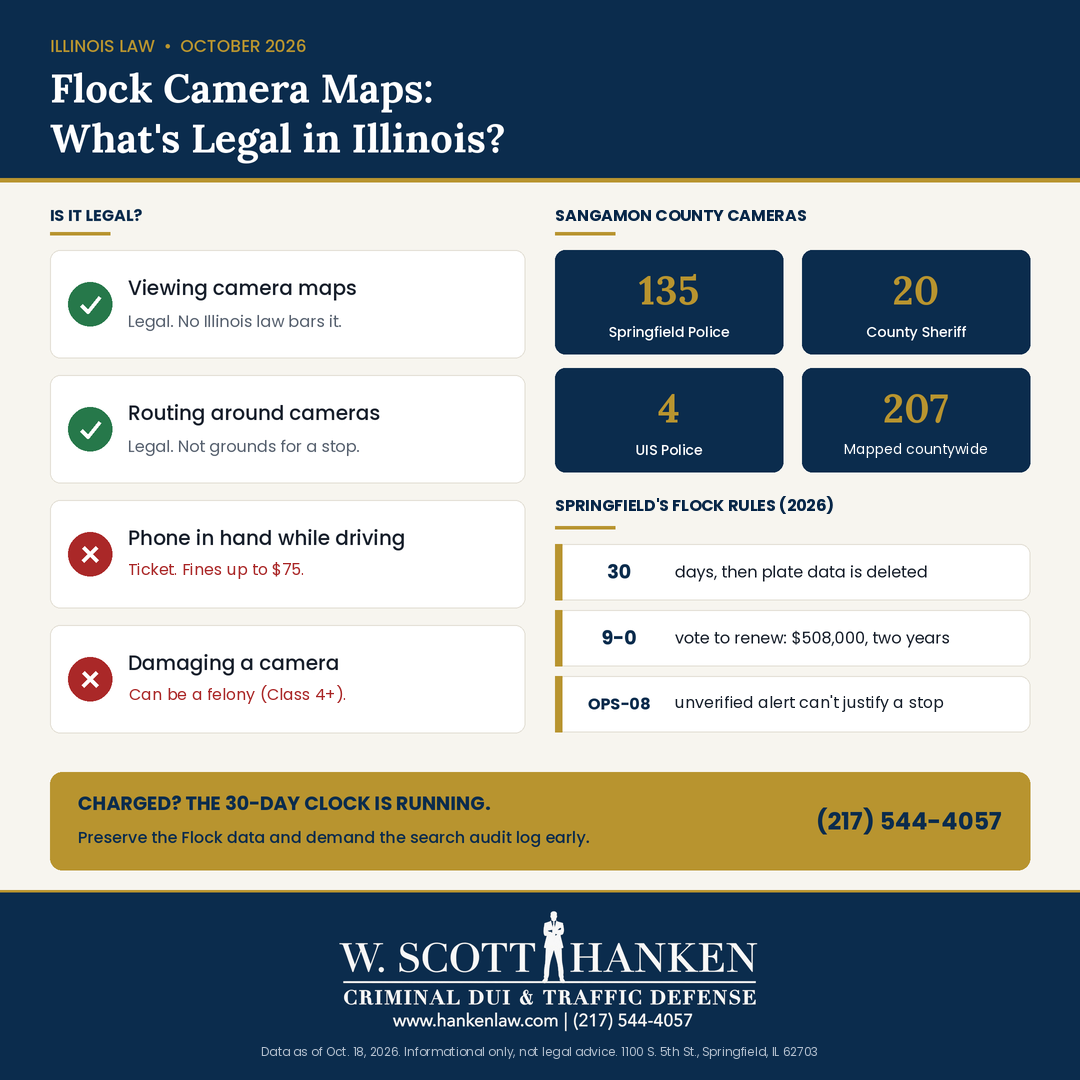
Viewing a Flock camera map such as MapQuest’s Surveillance Layer or DeFlock is legal in Illinois. No state law prohibits checking crowdsourced camera locations. But holding your phone to check the map while driving can get you a ticket, and damaging a camera can be a felony.
Bottom Line: A camera map is information, not protection. Checking it before you drive is lawful. Handling your phone while you drive is not. Damaging a camera you find on the map can be a felony. If Flock data shows up in your Sangamon County case, the map can help your lawyer test the State’s timeline, but it will not erase what the camera already recorded.
Key Takeaways:
- Viewing or sharing a Flock camera map is legal in Illinois; no statute prohibits it.
- Avoiding cameras is not grounds for a stop, but any traffic violation on your detour is.
- Holding your phone to check a map while driving is a moving violation, with a fine of up to $75 for a first offense.
- Springfield’s Flock transparency portal lists 135 cameras, and the city renewed its contract 9-0 on July 7, 2026 (Ordinance 2026-315).
- Springfield deletes Flock data after 30 days unless it is held for a case, so defense preservation requests must go out fast.
- Under Springfield police policy, an unverified Flock alert can’t justify a stop; the officer must verify the hit and have reasonable suspicion.
- Damaging a government-supported camera is a felony, from Class 4 up to Class 1; damage to a private camera is charged under the general criminal damage law.
What Is MapQuest’s Surveillance Layer?
It is an optional map overlay that marks reported locations of license plate readers and outdoor surveillance cameras. MapQuest announced it on October 15, 2026, and it is available in MapQuest’s mobile app.
The layer flags devices from 11 named manufacturers, plus other outdoor surveillance cameras: Flock Safety, Motorola Solutions (Vigilant), Genetec, Axis Communications, Axon, Leonardo (ELSAG), Neology, Rekor, PlateSmart, Ubicquia, and Verkada. Reported locations appear as markers on the map.
Two limits matter. First, the locations are crowdsourced and user-reported, so the map is incomplete. Second, the layer does nothing to the cameras. Your plate is still read, time-stamped, and stored when you pass one.
How Do I Turn On MapQuest’s Surveillance Layer?
Open the MapQuest mobile app, tap Map Options, and switch on the Surveillance Layer. It sits next to the traffic and incident layers. Set it up before you start driving, not at a red light.
Are There Other Apps That Map Flock Cameras?
Yes. MapQuest has brought a dedicated license plate reader layer to a mainstream navigation app, but volunteer projects have mapped these cameras for some time.
| Platform | What it does | Routes around cameras? |
|---|---|---|
| MapQuest Surveillance Layer | Shows reported ALPRs and outdoor cameras from 11+ manufacturers inside a standard navigation app | No |
| DeFlock (deflock.org) | Volunteer map built on OpenStreetMap; users can view and report camera locations | Its map site advertises privacy-focused route planning |
| FlockHopper | Free website and app showing the fastest route and an alternative that passes fewer known readers | Yes |
| FlockDetour | Shows fastest, balanced, and fewer-cameras routes with added minutes and camera counts; web planner free, app navigation paid | Yes |
| MyTownView | Lists documented surveillance camera locations by town, including Sangamon County communities | No |
| Waze and Google Maps | Crowdsourced police and speed-camera alerts in some regions | No dedicated ALPR layer |
DeFlock’s volunteer map now holds tens of thousands of license plate reader locations nationwide, and the total keeps rising. None of these platforms is affiliated with Flock Safety, and none claims to be complete.
Is It Legal to Use a Flock Camera Map in Springfield, Illinois?
Yes. No Illinois statute prohibits viewing, sharing, or contributing to a map of where license plate readers are mounted. The cameras sit on public poles along public roads, and recording where they are is ordinary public observation.
Illinois regulates the people who run license plate readers, not the people who look at them. That law is 625 ILCS 5/2-130, discussed below. Nothing in Springfield or Sangamon County practice changes this: checking a camera map at your kitchen table before you leave is lawful.
What can turn lawful into unlawful is how you use the map. Three situations come up, and each is covered next.
Can Police Stop Me Just for Avoiding Flock Cameras in Illinois?
No. Choosing a different lawful route is not a crime, and avoiding cameras alone does not give an officer grounds to stop you. Any traffic violation you commit along the detour, however, does.
A traffic stop requires reasonable suspicion based on specific, articulable facts. Terry v. Ohio, 392 U.S. 1 (1968), set that standard: an officer needs more than a hunch. An officer in Springfield cannot pull you over because your phone shows a FlockDetour route.
The catch is the second half of the rule. Under Whren v. United States, 517 U.S. 806 (1996), any observed traffic violation justifies a stop, whatever the officer’s real motive. Drivers taking unfamiliar side streets to dodge cameras are more likely to roll a stop sign, miss a turn signal, or drift across a lane line on a road they don’t know. That violation, not the detour, becomes the lawful basis for the stop. Everything that follows, from an odor of cannabis to field sobriety tests, flows from it. Our guide on what to do during a traffic stop in Illinois walks through your rights once you are pulled over.
Can a Flock Camera That Isn’t on the Map Still Record Me?
Yes. A camera missing from MapQuest or DeFlock records your plate exactly the same way, and the State can use that data in your case.
Every map in the table above depends on volunteers spotting and reporting devices. Some readers never get reported. Others are mounted on patrol cars and move. At least one Flock reader has been found hidden inside the housing of a roadside radar speed sign, which makes it much harder to recognize.
Illinois law also reaches cameras you would never think to look for. The statutory definition of an automated license plate reader includes devices owned by private businesses and homeowners’ associations to the extent their data is shared with a law enforcement agency. A subdivision entrance camera or a retail parking lot reader can feed the same investigation as a police-owned unit on a city pole.
Statute Callout — 625 ILCS 5/2-130(a) (definition): 625 ILCS 5/2-130 defines an “ALPR” as an electronic device mounted on a law enforcement vehicle or in a stationary location that records data on or photographs a vehicle or its plate and compares it to existing law enforcement databases. The definition expressly includes devices owned or operated by a person or entity other than a law enforcement agency to the extent the collected data is shared with law enforcement. (Source: P.A. 103-540, eff. January 1, 2024.)
What Is the Fine for Looking at MapQuest While Driving in Illinois?
Up to $75 for a first offense, and it counts as a moving violation. Holding and operating your phone while driving violates Illinois’s hand-held device law, even if the app is a map.
625 ILCS 5/12-610.2 bars using an electronic communication device while operating a motor vehicle. The definition excludes devices built into the car, and it also excludes “a global positioning system or navigation system.” Whether that exclusion reaches a smartphone running a map app is an open question, so don’t count on it as a defense for a phone in your hand. The statute allows hands-free or voice-operated use and single-button use, so a mounted phone giving voice directions is a different situation from scrolling the Surveillance Layer at a red light on South Grand.
Maximum fines run $75 for a first offense, $100 for a second, $125 for a third, and $150 for a fourth or subsequent offense. Every violation, including a first, is an offense governing the movement of vehicles, so a conviction is reported to the Secretary of State as a moving violation. Court supervision, if the judge grants it, is not a conviction, but it does not protect a CDL holder. Our post on Illinois’s cell phone driving law covers how that plays out. (Last amended by P.A. 103-310, eff. January 1, 2024.)
Higher fines have been proposed. SB 2791 would raise the maximums to $250, $500, and $750, and would add a safety course and possible license suspension for repeat offenders. It was re-referred to the Senate Assignments Committee on March 27, 2026, and is not law.
If you hold a CDL, the stakes are higher. Under 49 CFR 383.51, a conviction for violating a state law against hand-held phone use while driving a commercial motor vehicle is a serious traffic violation. A second serious-violation conviction within three years means a 60-day CDL disqualification, and a third means 120 days. Federal rules separately bar commercial drivers from using a hand-held mobile phone while driving a CMV (49 CFR 392.82). If you have been cited, see our traffic ticket defense page.
How Many Flock Cameras Are in Springfield and Sangamon County?
The Springfield Police Department’s Flock transparency portal listed 135 cameras when checked on October 18, 2026. Add the Sheriff’s Office, UIS Police, and mapped cameras in at least ten other Sangamon County municipalities, and the county has a dense network.
| Agency | Flock cameras |
|---|---|
| Springfield Police Department | 135 (Flock transparency portal, checked October 18, 2026) |
| Sangamon County Sheriff’s Office | 20 (Atlas of Surveillance, September 2025) |
| University of Illinois Springfield Police Department | 4 (Atlas of Surveillance, September 2025) |
When checked on October 18, 2026, Springfield’s transparency portal also reported 418,371 vehicles detected and 2,016 searches over its most recent 30-day window. The portal’s own header shows a last-updated date of November 26, 2025, so treat these figures as a snapshot and check the portal for current numbers.
Countywide, MyTownView’s public-records tracker documents at least 207 camera locations across 11 Sangamon County municipalities. That figure includes Springfield’s own cameras, 48 locations in unincorporated areas, and some non-Flock camera types. Chatham, Riverton, and Rochester police are named on Flock records. Community-mapped camera locations also appear in Williamsville, Southern View, Sherman, Divernon, Auburn, Illiopolis, and Spaulding, though the operator of those cameras is not always identified. Exact camera counts for each smaller town are not fully published.
What Rules Did Springfield Put on Its Flock Cameras in 2026?
Springfield renewed its Flock contract in July 2026 with new council oversight, including annual reporting and breach notification. Separately, the police department’s own policy caps data retention at 30 days.
On July 7, 2026, the Springfield City Council voted 9-0 to approve Ordinance 2026-315, a two-year renewal of the city’s Flock agreement worth $508,000, covering March 1, 2026, through February 28, 2028. The renewal came with conditions:
- Annual reporting. An amendment from Ward 2 Alderman Shawn Gregory requires the Springfield Police Department to report to aldermen every year on how the cameras are used.
- Breach notification. Security breaches and internal misuse of data must be reported through an internal process routed through city legal.
- No quiet loosening. The department’s camera policies cannot be relaxed without council approval.
The department’s own rules sit in Springfield Police General Order 26-026 (OPS-08), effective March 2, 2026. It limits Flock use to official investigations and prohibits using the system for traffic enforcement, fines, towing, or immigration enforcement. Every investigative search requires the officer to enter a case or CAD number and the type of crime under investigation. Springfield’s transparency portal lists no federal agencies among the outside agencies with access, and a deputy chief told the council in July 2026 that the department does not share its data nationwide.
That search log matters in Sangamon County Circuit Court. If Flock data appears in your case, the audit trail shows who searched your plate, when, and under which case number. A defense lawyer can request it in discovery and compare it against the reason the State gives for the search.
How Long Does Springfield Keep Flock Plate Data?
Thirty days. Springfield’s policy caps cloud retention of Flock data at 30 days, after which it is deleted unless it has been preserved for a case.
OPS-08 sets the 30-day ceiling, and the city’s Flock transparency portal lists the same 30-day retention period. In August 2026, Flock cut its recommended default retention from 30 days to seven. That recommendation doesn’t force existing contracts to change, and Springfield’s portal still lists 30 days.
Illinois law sets no statewide limit, so other agencies in Sangamon County may keep data longer under their own policies. A 2024 bill, SB 3320, would have set retention rules for state law enforcement agencies, allowing them to keep detections for up to five years with tighter access limits after 90 days. It died when the 103rd General Assembly adjourned on January 7, 2025.
Can Springfield Police Stop Me Solely on a Flock Alert?
No. An unverified alert isn’t enough. Springfield’s policy requires officers to confirm the hit before acting, and they still need reasonable suspicion to detain you. A confirmed hit on a stolen vehicle or an active warrant will often supply that reasonable suspicion.
Flock cameras check passing plates against hot lists from NCIC, Illinois LEADS, and NCMEC Amber Alerts. When a flagged plate passes a camera, officers get an alert. OPS-08 requires officers to verify every alert before taking enforcement action, and that verification should include visually inspecting the scanned plate image. A registration query through LEADS can help confirm it. The policy also states that an officer may not detain anyone based on an alert unless the officer has reasonable suspicion.
A bill filed in February 2026, HB 5231, would write a similar rule into state law: an ALPR notification would not, on its own, count as reasonable suspicion for a stop. The bill has sat in the House Rules Committee since February 10, 2026, and is not law.
These checks exist because alerts can go wrong. Plate-reading software can misread characters or confuse identical plate numbers from different states, and a hot list can still flag a vehicle whose stolen status or warrant was cleared but never removed.
A violation of department policy does not, by itself, require a court to throw out evidence. The Fourth Amendment question is whether the officer had reasonable suspicion. But if an officer skipped the plate-image check and the alert turned out to be wrong, the defense can argue the stop lacked reasonable suspicion, and the officer’s departure from OPS-08 becomes a central line of cross-examination at a suppression hearing in Sangamon County Circuit Court.
Can a Camera Map Help My Defense?
It can help your lawyer ask better questions. It cannot make Flock evidence disappear.
When the State uses license plate reader hits to place a vehicle on a route, the defense needs to know which cameras exist along that route, not just the ones that produced hits. A public camera map is a starting point for that comparison. If a car supposedly traveled from Chatham to downtown Springfield, and several mapped readers along the most direct path recorded nothing, that gap is worth examining. It may point to a different route, a different vehicle, or a misread plate. The map is not evidence on its own; reported locations have to be confirmed through discovery and, where needed, subpoenas.
Timing matters. Because Springfield deletes unpreserved plate data after 30 days, records that could help you, such as a camera showing your car somewhere else at the time of the offense, may be gone within a month. If Flock data could support your defense, your lawyer needs to send a preservation request right away, not after the first court date.
Key Defense Motions: Springfield Police General Order 26-026 (OPS-08) caps Flock data storage at 30 days. If Flock data may matter in your case, two steps should happen as early as possible, well inside that 30-day window. First, a formal evidence preservation letter to the Springfield Police Department covering plate reads, images, and alerts for the relevant dates and locations. Second, a discovery request or motion for the Flock search audit log, including the case or CAD number officers entered for each search of your plate.
Whether the State needed a warrant to search Flock history in the first place is a separate question, covered in our post on whether police need a warrant for Flock camera data in Illinois. For how the Supreme Court’s Chatrie decision applies to local surveillance technology, see our post on police drones and surveillance in Springfield.
Who Can See My License Plate Data in Illinois?
More agencies than most drivers realize, but with limits. Illinois law bars sharing plate data for abortion or immigration enforcement and requires a written promise before any out-of-state agency gets access.
Under 625 ILCS 5/2-130(b), an ALPR user may not sell, share, allow access to, or transfer ALPR information to any state or local jurisdiction to investigate or enforce a law that interferes with reproductive or other lawful health care, or that permits detention or investigation based on immigration status. Under subsection (c), an Illinois ALPR user may not share data with an out-of-state agency unless that agency first signs a written declaration that it will not use the data for those purposes. Subsection (d) requires ALPR information to be held confidentially to the fullest extent permitted by law.
Statute Callout — 625 ILCS 5/2-130(b) through (d): 625 ILCS 5/2-130 prohibits sharing ALPR information for reproductive health care or immigration-status enforcement, requires a written declaration before sharing with any out-of-state law enforcement agency, and requires ALPR information to be held confidentially to the fullest extent permitted by law. (Source: P.A. 103-540, eff. January 1, 2024.)
Springfield’s sharing is broader than many drivers assume. OPS-08 allows electronic sharing with other agencies at the direction of the police chief, and the city’s transparency portal lists 178 outside agencies with access, all of them in Illinois, including the Illinois State Police and Chicago police. Out-of-state agencies must sign the declaration Section 2-130 requires.
Enforcement statewide has been uneven. In 2025, Illinois Secretary of State Alexi Giannoulias said police in suburban Mount Prospect had shared data with a Texas sheriff in a search he tied to an abortion case, and his office’s audit found that U.S. Customs and Border Protection had accessed Illinois license plate data. Flock paused its pilot programs with federal agencies around the same time.
What Happens If I Damage or Cover a Flock Camera?
It can be a felony. If the camera is government supported property, damaging it is criminal damage to government supported property, a Class 4 felony even when the damage is $500 or less.
Under 720 ILCS 5/21-1.01, “government supported” property is property supported in whole or in part with state, local, or school district funds, or with federal funds administered or granted through state agencies. Knowingly damaging it is a felony at every dollar level. (Last amended by P.A. 97-1108, eff. January 1, 2013.)
| Damage amount | Offense class | Prison range |
|---|---|---|
| $500 or less | Class 4 felony | 1 to 3 years |
| More than $500 up to $10,000 | Class 3 felony | 2 to 5 years |
| More than $10,000 up to $100,000 | Class 2 felony | 3 to 7 years |
| More than $100,000 | Class 1 felony | 4 to 15 years |
When the damage exceeds $10,000, the court must also impose a fine equal to the value of the damage. A single Flock unit with its pole, solar panel, and installation can push past the $500 line quickly, which moves the charge to a Class 3.
Two caveats matter. Many Flock cameras are owned by the company and leased to the agency that uses them, and whether a leased camera counts as government supported is a question a court would have to decide. And damage to a privately owned reader, such as a business or homeowners’ association camera, falls under the general criminal damage to property statute, where the charge depends on the dollar amount and the kind of property involved.
Flock cameras have been smashed and vandalized in other states. In Sangamon County, that conduct would be charged, and the damaged camera’s last images or a neighboring reader may become the State’s first exhibit.
Frequently Asked Questions (FAQs)
Yes. No Illinois law prohibits downloading or viewing MapQuest’s Surveillance Layer, DeFlock, FlockHopper, or FlockDetour. The legal risk comes from handling the phone while driving or from what you do to a camera, not from the app itself.
No. Avoiding a camera is not, by itself, reasonable suspicion for a stop. But any traffic violation on your detour, even a rolling stop, is a lawful reason to pull you over.
No. Illinois has no law against mapping or sharing license plate reader locations. Illinois law regulates the agencies that run the cameras, not the people who map them.
Not on an unverified one. Springfield Police General Order OPS-08 requires officers to verify every alert before acting and bars detaining anyone on an alert without reasonable suspicion. A verified hit on a stolen car or an active warrant will often supply that suspicion.
Evidence from the stop may be challenged. If the officer skipped verification and the alert was wrong, your lawyer can argue the stop lacked reasonable suspicion and move to suppress what was found.
Up to $75 for a first offense, $100 for a second, $125 for a third, and $150 for a fourth or subsequent offense. Every violation counts as a moving violation, and court supervision won’t protect a CDL holder. Hands-free, voice-operated use is allowed.
Springfield’s Flock transparency portal listed 135 cameras when checked on October 18, 2026. The Sangamon County Sheriff’s Office has 20 and UIS Police has 4. Countywide, at least 207 camera locations are documented across 11 Sangamon County municipalities, a count that includes Springfield.
Thirty days. Springfield deletes Flock data after 30 days unless it is preserved for a case. Illinois law sets no statewide limit, so other agencies may keep data longer.
Yes. Every camera map is crowdsourced and incomplete. Unmapped readers, readers on patrol cars, and private cameras that share data with police all record plates the same way.
Only under conditions. Illinois ALPR users must obtain a written declaration from an out-of-state agency before sharing, and may not share for reproductive health care or immigration-status enforcement under 625 ILCS 5/2-130.
Act quickly, because Springfield deletes plate data after 30 days. Your lawyer should send a preservation letter right away and request the search audit log in discovery.
Yes. If the camera is government supported property, damaging it is a Class 4 felony at $500 or less and a Class 3 felony above $500. Damage to a private camera is charged under the general criminal damage statute instead.
Further Reading
Practice Area
Related Articles
- Do Police Need a Warrant to Search Flock Data in Illinois? — If Flock data is already in your case, this is the next question: did police need a warrant to pull it?
- What to Do During a Traffic Stop in Illinois: A Step-by-Step Guide — What to say, and not say, if a detour around cameras ends with lights behind you.
- Your Phone at a Red Light: Illinois’s Cell Phone Driving Law Explained — The real cost of a phone ticket, including the insurance and CDL fallout this post only touches.
- License Plate Covers Are Illegal in Illinois — And That Frame on Your Car Could Get You Pulled Over — Thinking about blocking a plate reader instead of avoiding it? Read this first.
- Springfield’s Police Transparency Dashboard: A Defense Tool — Another public Springfield data source your lawyer can use to test the State’s case.
- Police Drones and Surveillance in Springfield, Illinois: What Your Rights Are — and Why They Matter Right Now — How the Supreme Court’s 2026 Chatrie ruling shapes surveillance cases here.
Browse by Topic
Ready to Fight Your Traffic Case in Springfield?
Call W. Scott Hanken at (217) 544-4057 or contact us online for a free consultation. We serve clients throughout Springfield, Sangamon County, and Central Illinois.
About the Author: W. Scott Hanken, Attorney at Law
Scott Hanken is a Springfield, Illinois criminal defense attorney with over 37 years of experience, including service as a former Sangamon County prosecutor. He has been voted Best Attorney by the Illinois Times and State Journal-Register, holds an Avvo 10.0 “Superb” rating, and has earned over 270 five-star Google reviews. He serves clients throughout Sangamon County and Central Illinois.
📍 1100 S 5th St, Springfield, IL 62703 | ☎ (217) 544-4057 | 🌐 hankenlaw.com
This article is for general educational purposes only and does not constitute legal advice. Every case is unique — contact an experienced Springfield criminal defense attorney for guidance on your specific situation.
Address
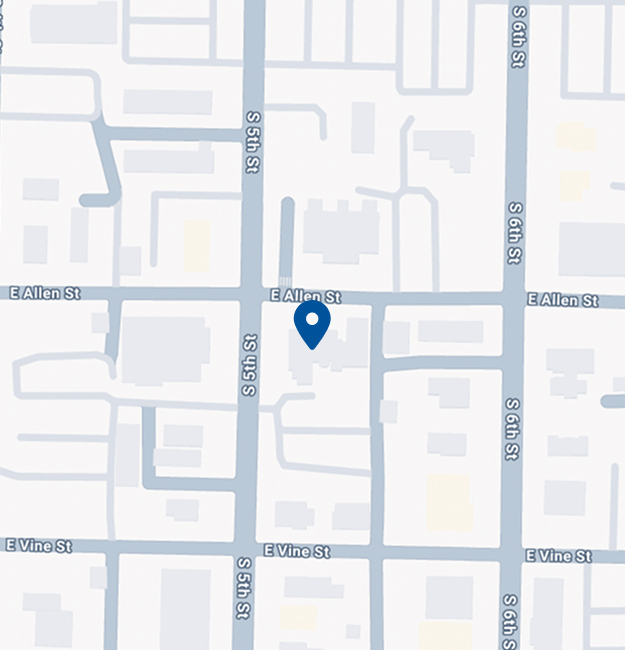
Our offices are located at the corner of South Fifth Street and Vine, in the historic Mary Bryant Home for the Blind.