- Free Consultation: (217) 544-4057 Tap Here To Call Us













Can the Police Lie to You? Illinois Interrogation Rules


Last Reviewed & Updated: November 6, 2026
By: W. Scott Hanken | Former Sangamon County Prosecutor | Springfield Criminal Defense Attorney | Voted “Best Attorney” — Illinois Times Best of Springfield & State Journal-Register Reader’s Choice | Springfield, IL | Sangamon County | (217) 544-4057 | hankenlaw.com
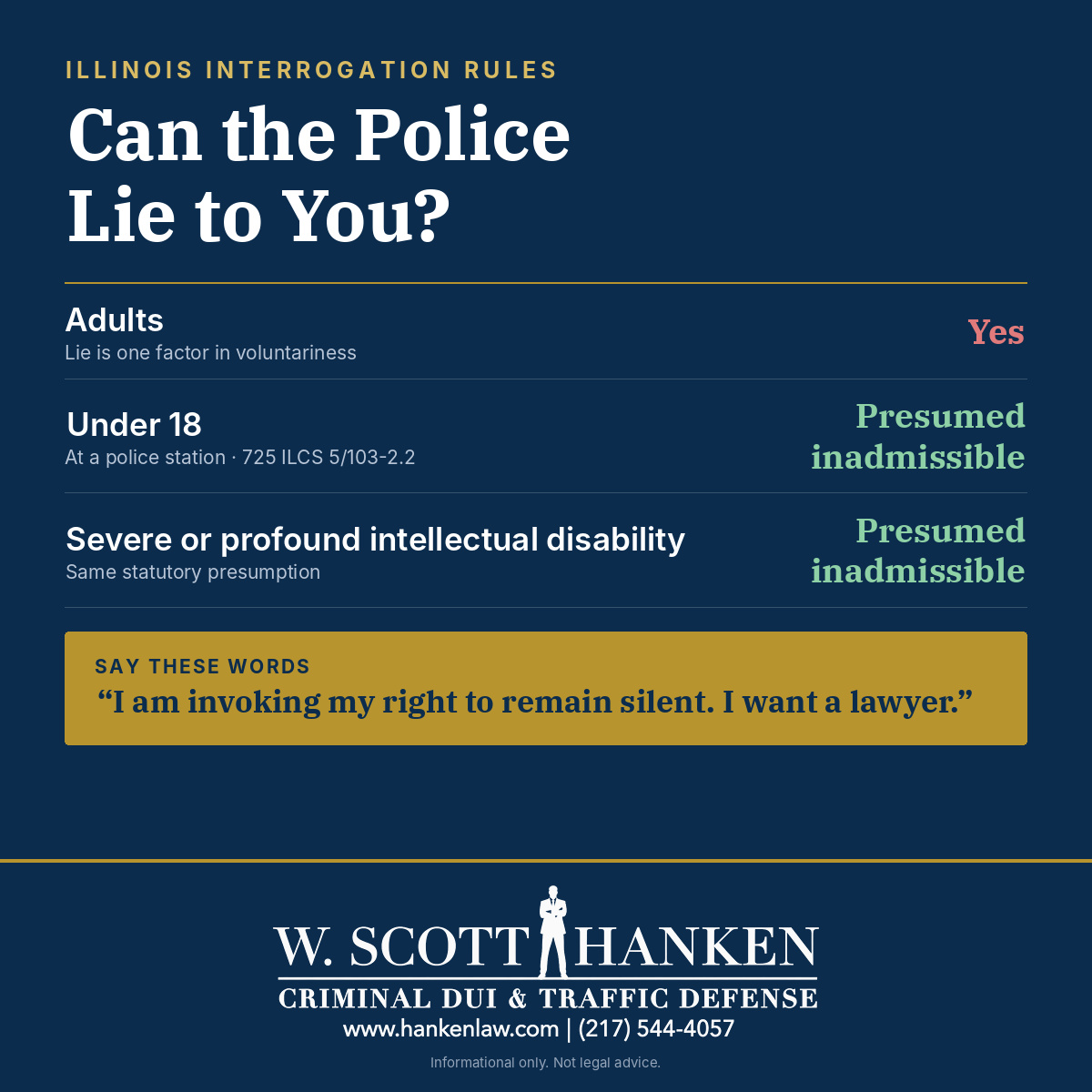
Short Answer: Yes. Illinois police can legally lie to adults during questioning, including claiming they have DNA, video, or a friend’s confession, and the lie alone rarely gets a confession suppressed. Lies to suspects under 18 at a police station are different: that confession is presumed inadmissible.
Bottom Line: If you are questioned by Springfield police or the Sangamon County Sheriff’s Office as an adult, assume anything an officer tells you about the evidence could be false, and assume anything you say will be used. Police do not have to read you Miranda rights until you are both in custody and being questioned, so most roadside, doorstep, and “just come down and talk” conversations happen with no warnings at all. The only reliable protection is to say clearly, out loud: “I am going to remain silent. I want a lawyer.”
Is It Legal for Police to Lie to You During an Interrogation in Illinois?
Yes, for adults it is legal. Courts treat a police lie as one factor in deciding whether a confession was voluntary, not as an automatic violation.
The United States Supreme Court set the rule in Frazier v. Cupp, 394 U.S. 731 (1969). An officer falsely told Frazier that his cousin had already confessed. The Court held the lie was relevant but did not make an otherwise voluntary confession inadmissible. The Illinois Supreme Court follows the same approach: deception is one circumstance among many in the “totality of the circumstances” analysis. People v. Martin, 102 Ill. 2d 412 (1984); People v. Kashney, 111 Ill. 2d 454, 465–67 (1986).
In practice, a judge in the Sangamon County Circuit Court weighs the lie alongside your age, intelligence, education, experience, and physical condition; how long the questioning lasted; whether you were warned of your rights; whether you were physically or mentally abused; and whether the detention itself was legal. Those are the voluntariness factors the Illinois Supreme Court listed in People v. Slater, 228 Ill. 2d 137 (2008). A single false claim about fingerprints, standing alone, almost never wins a motion to suppress for an adult.
Can Springfield Police Lie to Me About DNA or Video?
Yes. A lie about evidence that does not exist is the most common deception in an interrogation room, and for adults it is legal. Officers are trained to make you believe denial is pointless.
These tactics show up again and again in interrogation recordings:
- “We have you on video.” (There is no video, or it does not show your face.)
- “Your DNA (or fingerprints) came back.” (No lab test was run.)
- “Your buddy already told us everything.” (He did not.)
- “You failed the polygraph.” (The results were inconclusive or never scored.)
- “This is your only chance to tell your side before it goes to the State’s Attorney.”
- “We just need to clear this up so you can go home.”
- “Everyone makes mistakes. I just need to know it was an accident.”
The last two are minimization. They are not lies about evidence; they shrink the apparent consequences so a confession feels safe. They are also legal for adults.
The most egregious example I have faced in my career involved a client who was developmentally disabled, with a low IQ. Police had my client bite down on a piece of yellow legal paper, left the interrogation room, and came back to announce that the lab had matched those bite marks to bite marks found on a dead infant’s arms. That never happened. No comparison had been run. When the bite marks were actually examined later, my client was specifically excluded, and the case was ultimately dismissed. A fabricated forensic match aimed at someone who cannot easily see through it is exactly the kind of tactic that produces false confessions.
Illinois law has since added a protection here. Since January 1, 2024, a station-house confession obtained by deception from a person with a “severe or profound intellectual disability” is presumed inadmissible under 725 ILCS 5/103-2.2. That section does not define the term. The Juvenile Court Act’s parallel provision, 705 ILCS 405/5-401.6, defines it narrowly: an IQ of 40 or below, or 55 or below combined with significant mental illness that impairs rational judgment. Many developmentally disabled people fall above those lines. For them, the fight is still the totality-of-the-circumstances test, where limited intellectual ability weighs heavily.
Where Is the Line Between a Legal Lie and an Illegal Confession?
The line is coercion. Police may lie about the facts, but they may not use threats or promises that overbear your will.
The leading Illinois example is Lynumn v. Illinois, 372 U.S. 528 (1963). Chicago officers told a mother she would lose state financial aid for her children, and could lose the children themselves, unless she cooperated. The Supreme Court held that confession was coerced and could not be used. A lie about fingerprints pressures you to admit what happened. A threat against your children pressures you to say whatever ends the threat. Courts treat those two things very differently.
Lies about your rights are also off limits. Miranda v. Arizona, 384 U.S. 436 (1966), states that any evidence an accused was “threatened, tricked, or cajoled” into waiving his rights shows the waiver was not voluntary. An officer can lie about the evidence. An officer cannot tell you “this conversation is off the record” or “a lawyer can’t help you at this stage” to get you to give up your rights.
Does Illinois Ban Police From Lying to Minors?
Yes. Since January 1, 2022, a confession from someone under 18, obtained through deception at a police station, is presumed inadmissible in felony and Article 11 sex-offense cases. Illinois was the first state in the country to pass this protection.
Statute Callout — 725 ILCS 5/103-2.2 and 705 ILCS 405/5-401.6: Source: 725 ILCS 5/103-2.2 (P.A. 102-101, eff. 1-1-22; last amended by P.A. 103-341, eff. 1-1-24) and 705 ILCS 405/5-401.6 (P.A. 102-101, eff. 1-1-22; last amended by P.A. 103-605, eff. 7-1-24).
- “Deception” means the knowing communication of false facts about evidence or unauthorized statements regarding leniency by a law enforcement officer or juvenile officer.
- A “protected person” is a minor who was under 18 when the offense was committed or, since January 1, 2024, a person with a severe or profound intellectual disability.
- The protection applies to custodial interrogations at a police station or other place of detention, for any felony under the Criminal Code of 2012 or any misdemeanor sex offense under Article 11 of that Code. On its face, that language does not reach drug felonies charged under the Illinois Controlled Substances Act or felony DUI under the Illinois Vehicle Code.
- The State can overcome the presumption only by proving, by a preponderance of the evidence, that the confession was voluntary under the totality of the circumstances. The burden is on the State.
Two practical points matter here. First, the law covers false statements about leniency, not just about evidence. “Tell me what happened and you’ll go home tonight” is deception if the officer has no authority to make that promise. Second, the protection does not stop the questioning. It shifts the fight to a suppression hearing, where the State has to justify the confession.
Is Illinois Going to Ban Police From Lying to Adults?
Not yet. A bill to extend the deception ban to adults is pending, but it stalled in 2026.
House Bill 2596, introduced in February 2025, would create a new Section 103-2.3 making confessions obtained through deception presumptively inadmissible for adults charged with a felony or an Article 11 sex-offense misdemeanor, using the same police-station limitation and preponderance standard that apply to minors. The bill was assigned to the House Judiciary-Criminal Committee in March 2025 and again in February 2026, and was re-referred to the Rules Committee each time, most recently on March 27, 2026, where it remains.
Bill status last checked: November 4, 2026.
Until something passes, adults in Springfield, other than those with a severe or profound intellectual disability, have no statutory deception protection. Your protection is the totality-of-the-circumstances test and your own decision not to talk.
Do Police Have to Read You Miranda Rights Before Asking Questions?
No. Miranda warnings are required only when you are in custody and being interrogated. Questions asked before custody need no warnings.
Illinois courts decide custody with a two-part test from People v. Slater, 228 Ill. 2d 137 (2008): what were the circumstances of the questioning, and, given those circumstances, would a reasonable person have felt free to end the conversation and leave? The factors include where and when the questioning happened, how long it lasted, the tone of the questions, how many officers were present, whether family or friends were there, whether there were signs of formal arrest such as handcuffs, drawn weapons, booking, or fingerprinting, how you got there, and your age, intelligence, and mental makeup.
Here is the uncomfortable part. Oregon v. Mathiason, 429 U.S. 492 (1977), involved a man who came to the station voluntarily, was told he was not under arrest, and was then falsely told his fingerprints had been found at the scene. He confessed. The Supreme Court held he was not in custody, so no Miranda warnings were required, and the fingerprint lie did not change that. In Springfield, the “can you come down to the station and help us clear something up?” phone call is the modern version of Mathiason.
Can Police Use What You Said Before They Read You Your Rights?
Usually, yes. Statements made before you were in custody are generally admissible, warnings or not.
- Traffic stops. Berkemer v. McCarty, 468 U.S. 420 (1984), held that ordinary roadside questioning during a traffic stop is not custodial. “How much have you had to drink tonight?” requires no Miranda warning, and your answer comes in at a DUI trial in the Sangamon County Circuit Court. Once you are arrested and questioned further, Miranda applies even to misdemeanor traffic offenses.
- Spontaneous statements. Anything you blurt out that is not a response to a question is admissible even after arrest.
- Question first, warn later. Police cannot deliberately get a confession, read the warnings, and then have you repeat it. In Missouri v. Seibert, 542 U.S. 600 (2004), the Court held the warned confession inadmissible where police deliberately used that two-step technique and took no curative steps, such as a substantial break in time and circumstances before the second round of questioning.
- No lawsuit for a Miranda violation. Vega v. Tekoh, 597 U.S. 134 (2022), held that a Miranda violation alone does not support a civil damages claim. The remedy is suppression of the statement in your criminal case.
What happens after the roadside questioning ends matters too. For implied consent and license suspensions after a DUI arrest, see our post on cannabis DUI and implied consent in Springfield.
Do I Have to Talk to Police if I’m Not Under Arrest?
No. If you are not under arrest, you can decline to answer and walk away. But silence protects you only if you say out loud that you are invoking your rights.
In Salinas v. Texas, 570 U.S. 178 (2013), a man answered police questions voluntarily at the station, then went silent when asked whether shotgun shells would match his gun. Because he never said he was invoking the Fifth Amendment, a plurality of the Court allowed prosecutors to use his silence against him at trial. In Berghuis v. Thompkins, 560 U.S. 370 (2010), a suspect sat mostly silent for nearly three hours, then answered “yes” to a question about praying for forgiveness. The Court held he never unambiguously invoked his right to remain silent, so the answer came in.
The lesson is mechanical. Use the words. “I am invoking my right to remain silent. I want a lawyer.” Then stop talking, even if the officer keeps going. For a deeper look at how the privilege works in court, see our post on pleading the Fifth in Illinois.
Which Police Interrogations Have to Be Recorded in Illinois?
Station-house interrogations for homicides (including aggravated DUI causing death), several violent felonies, and, for suspects under 18, every felony under the Criminal Code of 2012 and every Article 11 sex-offense misdemeanor must be electronically recorded. Without a recording, the statement is presumed inadmissible.
The rule is in 725 ILCS 5/103-2.1 (last amended by P.A. 99-882, eff. 1-1-17). The State can overcome the presumption only by proving, by a preponderance of the evidence, that the unrecorded statement was both voluntary and reliable. Exceptions include spontaneous statements, routine booking questions, and situations where recording was not feasible.
| Who is being questioned | Can police lie about evidence? | Must a station interrogation be recorded? | Authority |
|---|---|---|---|
| Adult, most drug, burglary, theft, weapons, and non-fatal DUI cases | Yes; one factor in voluntariness | No | Frazier v. Cupp; People v. Martin |
| Adult, homicide or aggravated DUI causing death | Yes; one factor in voluntariness | Yes | 725 ILCS 5/103-2.1(b) |
| Adult, predatory or aggravated criminal sexual assault, aggravated arson, aggravated kidnapping, aggravated vehicular hijacking, home invasion, armed robbery, aggravated battery with a firearm | Yes; one factor in voluntariness | Yes | 725 ILCS 5/103-2.1(b-5) |
| Under 18 at the time of the offense, any Criminal Code felony or Article 11 sex-offense misdemeanor | No; confession presumed inadmissible | Yes | 725 ILCS 5/103-2.2; 725 ILCS 5/103-2.1(a-10) |
| Severe or profound intellectual disability (since January 1, 2024) | No; confession presumed inadmissible | Only if the offense is on the recording list | 725 ILCS 5/103-2.2 |
Why the Recording Law and the Deception Law Work Together
This is the piece most legal sites miss. The deception ban for minors is only as strong as the evidence that a lie was told, and the recording statute is what supplies that evidence. Because 103-2.1(a-10) requires recording of a minor’s station-house interrogation for the same felony and Article 11 offenses covered by 103-2.2, the video is usually the exhibit that proves the deception. The two statutes work as a pair.
Adults charged with offenses outside the recording list, which covers most drug, burglary, theft, weapons, and non-fatal DUI cases, have no statutory recording guarantee. If an officer lied in an unrecorded interview, proving it becomes a contest of credibility between you and the officer. That is why, in a Sangamon County case, one of the first things defense counsel should demand in discovery is every interview-room recording and every body-worn camera file that captured the conversation, including the minutes before anyone mentioned Miranda.
What Happens at a Suppression Hearing in Sangamon County Circuit Court?
A suppression hearing is where a judge decides whether your statement can be used. The State must prove the statement was voluntary; you do not have to prove it was coerced.
The procedure is set by 725 ILCS 5/114-11 (last amended by P.A. 97-1150, eff. 1-25-13). Your lawyer files a written motion before trial stating the facts that show the confession was involuntary. If those facts, taken as true, would show involuntariness, the court must hold a hearing. The State carries both the burden of going forward and the burden of proving voluntariness, by a preponderance of the evidence. [725 ILCS 5/114-11(d); People v. Slater, 228 Ill. 2d 137, 149 (2008).] The judge, not the jury, decides admissibility, but if the statement comes in, the circumstances of how it was obtained can still be argued to the jury on how much weight it deserves. [725 ILCS 5/114-11(f).]
In a Sangamon County courtroom, the hearing usually turns on the recording. Officers testify about what they said, the defense plays the video, and the judge measures one against the other. When the officers’ account and the recording diverge, the hearing is often decided right there.
What If Your Situation Does Not Fit the General Rule?
What if I was 17 when the offense happened but 18 when police questioned me?
You are still protected. The statute defines a protected person by age “at the time of the commission of the offense,” not at the time of questioning. [725 ILCS 5/103-2.2(a).] In a Sangamon County case where police waited until after an 18th birthday to bring someone in on an older allegation, the deception presumption still applies, and the State still carries the burden.
What if officers lied to a teenager in the squad car or at home, not at the station?
The statutory presumption likely does not apply. Both 103-2.2 and 5-401.6 cover only custodial interrogations “at a police station or other place of detention,” and the Criminal Procedure Code version expressly excludes courthouses. [725 ILCS 5/103-2.2(a), (b).] A lie told in the back of a Springfield patrol car falls back under the ordinary totality-of-the-circumstances test, where the minor’s age carries heavy weight but the lie does not trigger an automatic presumption. Expect this to be litigated; the statute does not say whether a squad car parked outside the station counts.
What if the officer promised I would go home if I just told the truth?
It depends on your age. For someone under 18 questioned at a police station in a felony or Article 11 case, an unauthorized statement about leniency is “deception” under the statute, and the confession is presumed inadmissible. [725 ILCS 5/103-2.2(a).] For an adult, courts ask whether the promise was specific enough, and coercive enough, to overbear your will. A vague “it’ll go better for you if you cooperate” usually survives. A specific promise that you will not be charged, made by someone with no authority to keep it, is a much stronger suppression argument. Lynumn v. Illinois, 372 U.S. 528 (1963).
What if police told me they had a warrant to search, and I let them in?
That consent is not valid. When an officer claims a warrant to obtain consent, the claim tells you resistance is pointless, and consent given in response does not count. Bumper v. North Carolina, 391 U.S. 543 (1968). This is a Fourth Amendment search issue rather than an interrogation issue, but it is the one lie about legal authority, rather than about evidence, that courts consistently refuse to tolerate.
What Should You Say if Springfield Police Want to Question You?
Say less than you think. Every word you add is something the State can use, and nothing you say will talk an officer out of an arrest decision already made.
- Ask: “Am I under arrest, or am I free to leave?” If you are free to leave, leave.
- Say: “I am invoking my right to remain silent. I want a lawyer.” Use those words.
- Do not consent to a search. Say “I do not consent to any searches.” Do not physically resist.
- Do not lie to the police. Lying to officers can create new charges. Silence is legal; false statements may not be.
- Do not “go down to the station to clear things up” without a lawyer. A voluntary interview is the setting where police have the most room to lie and the least obligation to warn you.
- If you are the parent of a teenager, or care for an adult with a developmental disability, tell them to ask for you and for a lawyer, and to say nothing else.
If you are worried that you might be charged with resisting for refusing to answer, read our post on resisting or obstructing a peace officer in Illinois. Declining to answer questions is not obstruction.
Key Takeaways:
- Police can lie to adults about evidence; the lie is one factor in whether a confession was voluntary.
- Deception during a station-house interrogation in a felony or Article 11 case makes the confession presumptively inadmissible for anyone under 18 (since 2022) and anyone with a severe or profound intellectual disability (since 2024).
- House Bill 2596, which would extend that rule to adults, has sat in the Rules Committee since March 27, 2026.
- Miranda applies only to custody plus interrogation; roadside and voluntary interviews usually need no warnings.
- Silence protects you only if you clearly say you are invoking your rights.
- At a suppression hearing, the State must prove your statement was voluntary.
Primary Authorities
- 725 ILCS 5/103-2.2, Prohibition of deceptive tactics (P.A. 102-101, eff. 1-1-22; P.A. 103-341, eff. 1-1-24)
- 705 ILCS 405/5-401.6, Prohibition of deceptive tactics, Juvenile Court Act (P.A. 102-101, eff. 1-1-22; P.A. 103-605, eff. 7-1-24)
- 725 ILCS 5/103-2.1, When statements by accused may be used (P.A. 98-547, eff. 1-1-14; P.A. 99-882, eff. 1-1-17)
- 725 ILCS 5/114-11, Motion to suppress confession (P.A. 97-1150, eff. 1-25-13)
- House Bill 2596, 104th General Assembly (re-referred to Rules Committee, March 27, 2026)
- Miranda v. Arizona, 384 U.S. 436 (1966)
- Frazier v. Cupp, 394 U.S. 731 (1969)
- Lynumn v. Illinois, 372 U.S. 528 (1963)
- Bumper v. North Carolina, 391 U.S. 543 (1968)
- Oregon v. Mathiason, 429 U.S. 492 (1977)
- Berkemer v. McCarty, 468 U.S. 420 (1984)
- Missouri v. Seibert, 542 U.S. 600 (2004)
- Berghuis v. Thompkins, 560 U.S. 370 (2010)
- Salinas v. Texas, 570 U.S. 178 (2013)
- Vega v. Tekoh, 597 U.S. 134 (2022)
- People v. Martin, 102 Ill. 2d 412 (1984)
- People v. Kashney, 111 Ill. 2d 454 (1986)
- People v. Slater, 228 Ill. 2d 137 (2008)
Frequently Asked Questions (FAQs)
Yes, if you are an adult. Courts treat the lie as one factor in deciding whether your confession was voluntary, and a lie about evidence alone rarely leads to suppression. Frazier v. Cupp, 394 U.S. 731 (1969).
Not without consequences. Since January 1, 2022, a confession from someone under 18, obtained through deception during a custodial interrogation at a police station, is presumed inadmissible for felonies under the Criminal Code of 2012 and Article 11 sex-offense misdemeanors. [725 ILCS 5/103-2.2.]
Not at a police station, in a felony or Article 11 case, if the person has a severe or profound intellectual disability; since January 1, 2024, that confession is presumed inadmissible. [725 ILCS 5/103-2.2.] For someone above the statutory IQ thresholds, the disability is still a major factor in whether the confession was voluntary.
No. A Miranda violation does not dismiss a case. At most, the statements you made during custodial interrogation without warnings are suppressed, and the State can still proceed on its other evidence. Statements made before you were in custody usually are not affected at all.
You must provide your license, registration, and proof of insurance. You do not have to answer questions about where you have been or how much you have had to drink. Politely say you are choosing not to answer questions. Berkemer v. McCarty, 468 U.S. 420 (1984).
No. Once you clearly ask for a lawyer during custodial interrogation, questioning must stop until a lawyer is present, unless you yourself restart the conversation. The request must be clear; “maybe I should get a lawyer” may not be enough.
For an adult, yes, and courts have generally treated a fake polygraph result like any other lie about evidence. For someone under 18, a false statement about test results is a false fact about evidence under the Illinois deception statute.
It can be. Depending on the circumstances, a false statement to an officer can lead to obstruction or other charges. The safer choice is always silence, not a false story.
Further Reading
Related Articles
- Can an Illinois Prosecutor Argue That Asking for a Lawyer Shows Guilt? — what happens at trial after you say the words this post recommends.
- Entrapment Defense in Illinois: What Actually Works — when police deception moves out of the interview room and into the crime itself.
- Can Police Stop You for Being in a High Crime Area? — the street stop that often comes before the questioning.
- Can Police Force You to Unlock Your Phone in Sangamon County? Face ID, Passcodes & Your Rights — how the Fifth Amendment works when police want your passcode instead of your words.
- What to Do During a Traffic Stop in Illinois: A Step-by-Step Guide — the roadside version of the script above.
Browse by Topic
Ready to Fight Your Criminal Charge in Springfield?
Call W. Scott Hanken at (217) 544-4057 or contact us online for a free consultation. We serve clients throughout Springfield, Sangamon County, and Central Illinois.
About the Author: W. Scott Hanken, Attorney at Law
Scott Hanken is a Springfield, Illinois criminal defense attorney with over 37 years of experience, including service as a former Sangamon County prosecutor. He has been voted Best Attorney by the Illinois Times and State Journal-Register, holds an Avvo 10.0 “Superb” rating, and has earned over 270 five-star Google reviews. He serves clients throughout Sangamon County and Central Illinois.
📍 1100 S 5th St, Springfield, IL 62703 | ☎ (217) 544-4057 | 🌐 hankenlaw.com
This article is for general educational purposes only and does not constitute legal advice. Every case is unique — contact an experienced Springfield criminal defense attorney for guidance on your specific situation.

Address
Our offices are located at the corner of South Fifth Street and Vine, in the historic Mary Bryant Home for the Blind.